Showing posts with label english. Show all posts

Saturday, October 22, 2022

First Hop Harvest Bitter

When brewing this beer and starting to write this post I was dealing with a terrible sinus infection and hadn’t been doing a good job keeping up with my brewing or my blog. I was out of CO2 in my kegerator and had multiple beers that had recently been kegged or were in need of a keg, so they were likely getting oxidized and I didn’t have the time or energy to deal with them. While I thought about also cancelling this brew day to rest and recover I didn’t want my first year hop cones to whither on the vine so I picked them and brewed a small bitter of sorts.
Centennial Hops a couple weeks before harvesting

I ended up with only a touch over 1.5 oz of fresh wet hops (1.115 oz centennial, .385 oz Comet and just .125 oz Goldings), which is around the equivalent of .3-.4 oz of dry hops per most conversions I’ve seen, so any ideas about making a super hoppy IPA (or even American pale ale) went out the window and I instead reworked the Special Bitter I had been planning to brew later in the year to instead be a lower gravity and half volume batch in order to give the hops some chance of shining through in the finished beer. Just 3 pounds of base malt (equal parts Maris otter and golden promise) and a quarter pound each of a few flavoring malts (victory, torrified wheat, and crystal 70/80) hopefully got the recipe in the ballpark of what I was looking for: a very small beer with an emphasis on hops but enough malt backbone to remain balanced and drinkable. Due to bad weather and my struggles with illness I brewed in a bag on my stovetop, only popping outside at the end to chill the wort. While half an ounce of commercially bought Goldings pellets were added for the full 60 minute boil to provide bitterness the fresh wet hops were added post-boil during the “whirlpool” around 150F and left in until the full chill and transfer to carboy had completed. While I slightly undershot my expected gravity and came in at only 1.030 I’m hopeful this will still be an enjoyable, if not overly expressive or impressive, beer. 

The hops smelled great off the vine, all three seemed pungent with classic pine and citrus hop goodness (though I had a sinus infection so I was working hard to smell much). After picking I found myself too tired to start the brew day so I packed them up and went back to bed. After sitting in ziplock bags in the fridge for a day they had changed a bit with the Goldings only really smelling of leaves and unripe fruit, maybe they were underripe? The comet had a bit of tropical mango aroma mixed with a floral, earthy, and grassy character reminiscent of a meadow, and the centennial carried aromas of tangerine, pine, and fresh cut grass. It was interesting to see what these fresh scents were like after having only experienced dried hops for so long and I was excited to see what, if any, of that character comes through in the beer.

Tasting notes:

Smell: Not strong on the nose but what does come through is nice: predominantly malt character of graham crackers, granola, and sugar cookies with more moderate yeast and hop notes giving a touch of orange peel, grass, and basil. Searching hard I also find some very subtle dried fruit/raisin character that may be from the crystal malt or a combination of factors.

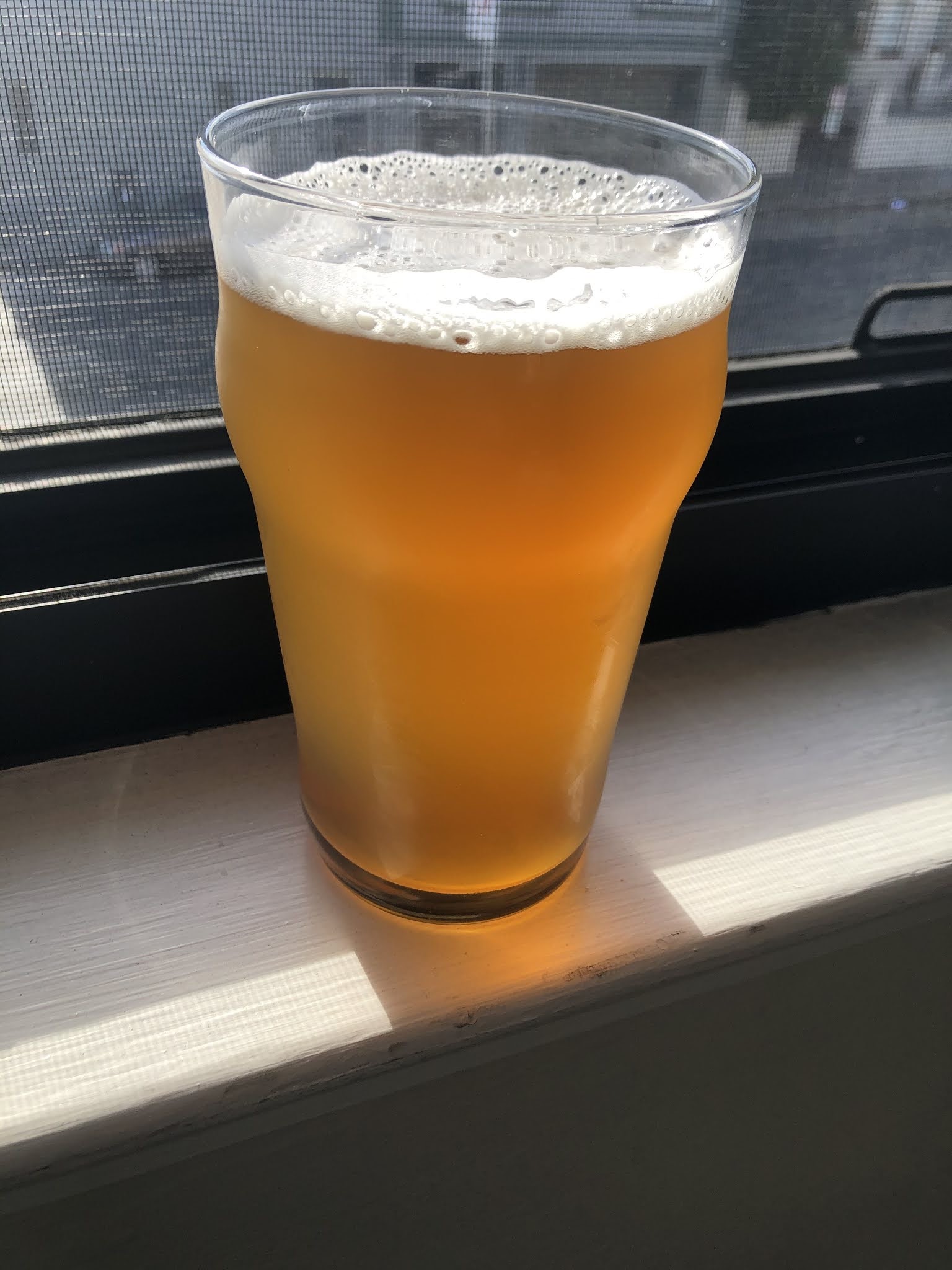
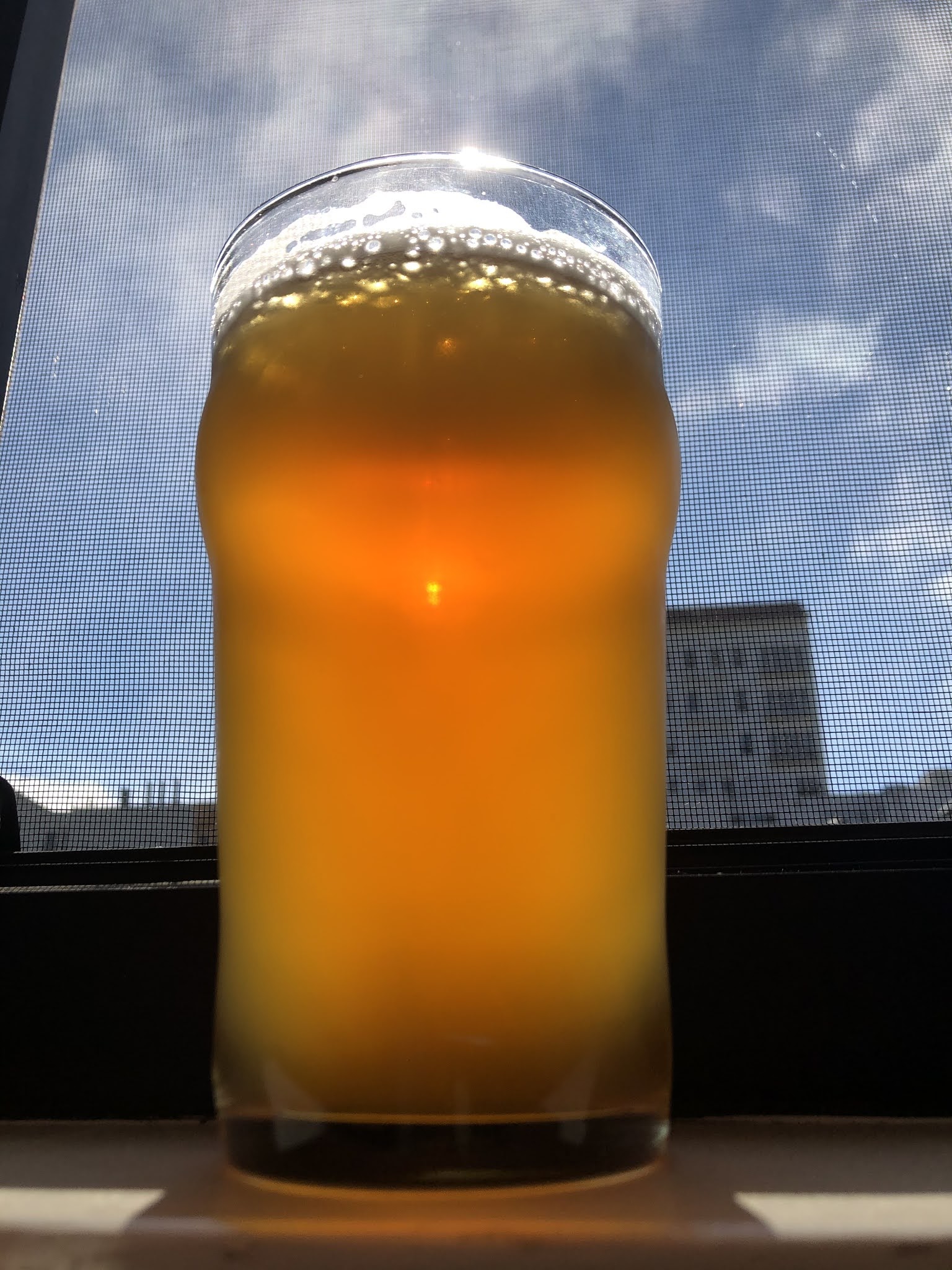
Appearance: Surprisingly clear after a few weeks in the keg. Small very white head with nice bubbles lasts throughout. Head was larger previously but this hasn’t had any CO2 added in a while. Color is somewhere between a copper and gold depending on the glass and lighting. All around a very appetizing look to my sensibilities. Nice lacing shows as the glass empties.

Taste: Leads off very subtly but the malt, hops, and bitterness catch up and come through late in the swallow. The malt slightly leads with lightly toasted bread, honey, and graham cracker. This is followed by mild green/herbal/earthy notes that are reminiscent of black tea followed by a moderate bitterness that helps balance the subtle malt character and lead to a surprisingly long finish that includes characters from the malt, hops, and bitterness. The malt character builds some as I continue to drink but it all seems well I’m balance. None of these characters are strong but everything about this beer seems more interesting and characterful than a 3% abv has any right to be.

Mouthfeel: One of the things that initially jumps out, even when pouring, is that, as intended, this beer is very lightly carbonated. This probably wouldn’t appeal to a lot of American palettes but I find it very nice for letting the subtle flavors shine through. The body is fairly light but doesn’t feel too thin due to the low carbonation, moderately low attenuation, and maybe the torrified wheat.

Overall: I don’t think this is a great beer and most of the people who have tried it (albeit mostly non-beer drinkers) haven’t been very impressed. I don’t drink many ordinary bitters (in part due to them being very hard to find in the US) but I doubt this would be considered an exceptional example of the style. That said, this is a beer I’m extremely happy to drink and proud to have made. Nothing about the beer is necessarily exciting yet every time I pour a pint of it and raise it to my lips I find a big smile come across my face. Everything in the glass is enjoyable and balanced. The homegrown hops don’t exactly shine through but they seem well integrated with the malt and I’m happy with the decision to have used them here. Like some of the other pale British beers I’ve made over the years it’s a nice beer that I’m happy I made and my only real complaint is that I don’t have a nice dimple mug to quaff it from.

9/11/22
Brewday. No real notes beyond what's listed above.

9/15/22
Kegged with very little pressure (10PSI in several short bursts). Aiming for just over 1 vol CO2 for a cask-like effect. Beer is surprisingly flavorful but unfortunately it’s mostly malt flavor. A small herbal note but hard to tell if that is from the fresh hops. At worst this seems like a pretty enjoyable and ultra-low gravity drinker, if not the best expression of my homegrown hops.

9/16/22
Hit the beer with another short burst of CO2. Pours pretty well off the stout tap giving a nice big head and a lovely copper to gold body (lighter than it appears in the photo). A touch hazy but no complaints for less than a week grain to glass. Hops are still subdued compared to malt but there seems to be a lot going on for a 3% abv beer and overall it’s quite nice. One of those beers that makes me wonder why I don’t brew beers like this more often.

9/22/22
Found a few hops that were either missed during the harvest or were late bloomers. Added a comet cone to a glass of this beer, no obvious flavor impact but a fun visual.


9/28/22
Finally recovered enough to provide the full tasting above.

Tuesday, August 25, 2020

English-ish IPA


After a bit of a break from brewing I realized that while I had some interesting and enjoyable beers on tap (a hoppy saison, a smoked helles, and a few sours) I didn't have anything crushable. With COVID-19 still affecting both my accessibility and desirability to visit bars and breweries I was missing having English style ales that I would often enjoy from Bay Area producers like Freewheel and Barebottle. Combining those factors with a desire to use up ingredients on hand before buying new ones, I set out to make an English-ish ale, and used the Georges and Co. Pale Ale from 1889 (which I had previously made as part of a parti-gyle with a Strong Ale) as the basis. The resulting recipe uses some distinctly non-English ingredients (Cali yeast, Viking Xtra Pale 2-Row, and Dark Munich) but hopefully somewhat approximates an English historic pale ale/modern IPA and produces a drinkable, if fairly bitter, beer with a defining English hop character.

7-31-20
Brew day. Collected 8 gallons of water and added K-Meta along with a gram each of CaCl, Gypsum, CaCO3, and NaCl. Following a 1 hour mash a short batch sparge was done with most of the remaining water. The last 1 gallon of runnings were collected separately and boiled for nearly an hour to a moderately thick and significantly darker caramel that was then added back to the rest of the batch. The half pound of Fuggle hops were split between half at the 60 minute mark (following a prior 30 minutes of boiling) and the remaining 4 ounces split evenly and added at 30 and 0 minutes.

After chilling to 75F and racking to a 6 gallon plastic carboy it ended up a little below target gravity at 1.060 (still trying to dial in the mill settings) and below target volume with only about 4.5 gallons (probably due to caramelizing the last runnings). I boiled 4 ounces of Sugar in the Raw turbinado in 1.5 quarts of water, cooled and added to the carboy to bring it closer to the goal volume, without diluting the gravity too much further. Yeast was pitched directly rather than following the recommended rehydration instructions. I plan to keep this at room temperature around upper 60s/low 70s.

8-1-20
Vigorous signs of fermentation less than 12 hours after pitching. Some of the strongest airlock bubbling I've ever seen. Sitting at room temperature in the upper 60s it's on the upper end of the temperature range for the yeast but not too hot, this one just seems to be a ripper.

8-5-20
Fermentation activity slowed down, appears to be almost done fermenting already. Added 1 oz EKG. Plan to sample in a few days and keg if ready. Might add additional keg hops and will probably naturally carbonate in the keg for a more authentic English experience.

8-7-20
Fermentation appears complete but taste is a little overly bitter and mineraly. Added 8 ounces of turbinado and 2 ounces of honey boiled in 2 quarts of water. Plan is to give this a day or two to ferment before kegging and allowing to naturally condition. Vigorous fermentation showing again less than an hour after adding the sugars.

8-9-20
About 36 hours after adding the sugar water. Tasting much better and already back down to 1.006. Flavor is tea like with solid but not extreme bitterness and some light caramel and sugar sweetness. Transferred to keg and placed in keezer set to 45F. No CO2 connected, if it doesn’t seem to be naturally carbonating in a day or two I’ll hook it up but wanted to try making this a “real ale”, at least to begin with. My biggest fear about not adding CO2 is that it does not continue to ferment and gets oxidized, but that’s a risk I’m willing to take. I decided not to add any EKG to the keg since I’m happy with the flavor at this point but if I end up needing to connect CO2 in a few days I might add some then, especially if there are any signs of oxidation that I might be able to cover up with hops.

8-11-20
Doesn’t seem to have been much more fermentation after kegging so I’m very gently pushing this one out with just a few PSI of CO2. Very similar to my previous batch with a little more bitterness. Easy drinking with moderate earthy, herbal, and tea like hop flavors blending with light caramel and bready malts. A touch drier and more minerally than I would have liked, using an English yeast and English malts probably would have given less attenuation and more body but it’s completely fine as is.

8-25-20
This one has been on tap for a few weeks. I ended up adding a little bit (~5psi) of CO2 to make it pourable, it seems like the second sugar addition was too fermented out by the time it was kegged to condition naturally. It’s been tasting pretty good and I find myself grabbing a pint or two a few times a week.

Tasting notes:
Appearance- gold with poor clarity, though it’s no hazy IPA. I had intended to use Irish moss but forgot, which combined with the early kegging and no keg finings didn’t give clarity much of a chance. Small white head fades quickly, between the low carbonation and high sugar levels in the beer I’m not too surprised. I plan to use some torrified wheat in future English ales to partially help with that.

Smell- light sweet and bread malt, meadow-like herbal, earthy and floral notes and a small touch of citrus. Pretty low aroma given the low carbonation.

Taste/Mouthfeel- strong tea like character with a blend of herbal, earth, and fruity flavors. Bitterness is moderate but nicely balancing. Some honey and cookie like sweetness with a little bit of oatmeal cookie flavor. Finish is bitter and tea like, but creamy and not astringent.

Overall- another enjoyable, if otherwise unremarkable, English style homebrew. The flavors really balance well with the malt, hops, and yeast giving synergistic flavors and finding a nice balance between sweet and bitter. I was a little worried about using so much hops (8 ounces in the boil) but the end result was really nice and I think a bigger dry hop may have even added more. A really middle of the road beer that is surprisingly strong at over 6% ABV. Easy drinking but with enough going on to bring me back for more, and just enough bitterness to keep it from being too crushable.

Saturday, March 28, 2015

Old Horse and Jockey Version 2

Less than 2 weeks ago my beloved grandmother passed away. A brave world traveler who lived through wartime bombings, moved half way across the globe as a young woman, and managed to visit all 50 states and all 7 continents, she helped inspire my desire for travel and my general curiosity about the world around me. The name Old Horse and Jockey comes from the, now long defunct, pub managed by my grandmother's grandfather (my great-great-grandfather) and for one year after his death her grandmother (my great-great-grandmother) in Bristol, England from 1921-1945. My grandmother spent much of her youth in and around this pub and always spoke of it with such fond memories and the Old Horse and Jockey Porter is brewed in loving memory of her, her hometown of Bristol, and the pub she called home.

From what I can tell the pub was owned, and would have served beer brewed by, The Bristol Brewery Georges & Co. Ltd. brewery. While the brewery had begun as a solely porter producing operation, by the 1920's the porter style had all but faded from existence in England and I can't tell whether the brewery (or one of their many acquisitions) made the style during this period. Nevertheless I decided to brew a somewhat classic porter recipe that includes brown malt and no black patent.

Sentimental stuff out of the way, this porter also means a lot to me as a brewer. I want to renew my passion for brewing and really evaluate my processes, ingredients, equipment, and techniques in a new light. This is the second version of the Old Horse and Jockey, and while the first (an extract brew) came out well, I'm hoping to really start to hone this recipe in.  The first step is taking more notes and more accurate notes, the second is putting more time and focus into the little details.  Instead of knowing that what I'm making will be beer, I want to know that what I'm making will be Good Beer. At a minimum if what I create isn't great then at least I will have solid explanations for why and can be sure that I continue to progress as a brewer.

For this batch I used 5 malts, all from either Crisp Malting or Bairds Malt, bought online, milled, from Morebeer. Below is a breakdown of the smell and flavor of each prior to being added to the mash:
  • 10 lbs Floor-Malted Maris Otter (Crisp): Smell: toast, grassy, hay-like. Taste: lightly toasty, grainy, grassy.
  • 1 lb. Carastan (Bairds): Smell: toffee, fresh baked bread, pastry dough. Taste: sweet, doughy
  • 1 lb. Brown (Crisp): Smell: pizza crust, just burnt toast.  Taste: fire cooked pizza crust
  • 1/2 lb. Chocolate (Bairds): Smell: herbal, woody, pinecone. Taste: burnt marshmallow, heavily burnt toast.
  • 1/2 lb. Crystal Malt 135/165 (Bairds): Smell: Plum, fresh fields (soil and floral elements), light toast, freshly baked dark bread. Taste: Slightly burnt caramel, cherry, bread crust, black tea.

I measured my water additions by weight adding 6g of chalk and 2 grams of gypsum to the mash water.  I hit my numbers pretty well mashing in with 4 gallons of 162 (Fahrenheit) strike water for an initial mash temp of 156 (target of 155). After a 1 hour mash rest I added ~1.5 gallons boiling water to raise to a mashout temp of 170. After the 15 minute mashout I ran off all the mash water and added the final 2 gallons of water (at 105 F) which was held for another 10 minutes prior to runoff.

For hops I used .75 oz of Target (8.9% AA) for 60 minutes, with WGV (5.3% AA) at 15 minutes and flame-out. The target has a earth, pine, grass, herbal, mint smell with the WGV having some similarities but also having a big juicy fruit character blending with the dank and earthy characters.                                                       

The finished wort appears to have a nice deep brown color. Cooled to 72 (about room temp) after 1.5 hours. The ice bath water was still cold but this method is just super ineffective and I need to find a better way. Added the 11g packet of yeast then moved the bucket to the keezer set at 60F (fortunately there was some empty space due to a number of kegs kicking recently and the only beer on tap is a bitter that can handle being served this warm). I should have waited to pitch the yeast until it had cooled a little further but on the positive side the yeast immediately took off puffing up with foam and throwing off yeasty smells, I hadn't brewed with dry yeast in a while and don't remember them taking off so quickly.  OG was 1.062, slightly beating my (low) efficiency expectations.

4/3/2015
Not too surprisingly this beer came out sweeter and less roasty than I would have liked.  A pound of brown malt just doesn't go very far, and the half pound of chocolate wasn't enough, while the 1.5 pounds of crystal malts was too much for an already moderately attenuative beer.  I decided to add half an ounce of bourbon soaked oak chips.  Next time I brew this recipe I plan to knock down the crystal malts by at least a quarter pound and increase the roast malts by at least half a pound.

Saturday, February 1, 2014

#32 - Best Bitter Recipe and Tasting

This is a replacement post for one that disappeared while I was creating it and will probably be a little short on detail.

I brewed this Special/Best/Premium Bitter in the Fall when my desires turned to beers which were fairly light in alcohol but had both moderate malt and hop characteristics, as displayed by the previous brewed Altbier.

The base of this beer was primarily English Pale Malt.  I had originally planned to use Maris Otter but they were almost out at the LHBS so I augmented with equal parts Golden Promise and a non-specified Maltster's British Pale Ale malt.  Part of this recipe design came from tasting a wort sample made with Victory malt and the craving for a traditional pint of bitter as I experienced in London, leading me to use .5 lbs of crystal 60 malt.  Hops were entirely East Kent Goldings to have a very traditional flare and Bedford British yeast was used after being unable to find the intended strain and reading rave reviews on The Perfect Pint.  Below is a tasting now more than 3 months after bottling.

A- Slightly hazy copper.  Pours with a thick off-white head that recedes to a half finger layer and leaves good lacing.  It certainly looks the part of a bitter.

S- Malts predominate on the nose giving toffee, cookie and fresh bread with the EKG aroma having fallen to just a touch of woodiness if you really search for it.  Hop aroma was certainly better when fresh, but it never exactly leaped out of the glass.

T- While malts again dominate up front with a toffee and biscuit character, the EKG hops shine through much more here with the characteristic flavors of light citrus, savory herbs and wood.  There's also the slightest peppery character that I don't recall being there when fresh.

M- One of the biggest changes in this beer over time is that it has unfortunately grown increasingly carbonated.  I had envisioned this beer having a very low carbonation to mimic the traditional cask ale.  While the beer was great at this level after a few weeks it slowly rose beyond that point to upper levels of carbonation that would be more fitting for a Belgian style than British.  The mouthfeel in the end comes out a bit overly spritzy and dry instead of the full bodied but sessionable body expected for the style.

O- This beer came out alright but not phenomenal.  When I first tasted it I thought I might have a contest entry, but over time the aroma and taste went down and the carbonation went up, leaving this one just an ok beer and not a strong representation of the style.  That said, it is nice to have a nicely balanced beer that I can have a few of without feeling the effects and to that end, its a fairly good beer.