Showing posts with label recipe. Show all posts

Sunday, May 7, 2023

Cherry Tree - Smoked Lagers


I’ve probably had the idea of making a beer that uses both cherries and cherrywood smoked malt for over a decade but never actually went through with it. After purchasing 10 pounds of cherrywood smoked malt nearly a year ago and only using a pound of it in my Smoked Helles, I finally decided to take the plunge. For this recipe I decided to go with a super simple SMaSH recipe: 9 lbs Sugar Creek cherrywood smoked malt, 1 oz. hallertau mittelfruh, and a lager yeast. I only added the cherry fruit to part of this beer at secondary in order to have both a fruited and unfruited version.

Tasting:

Unfruited Version:

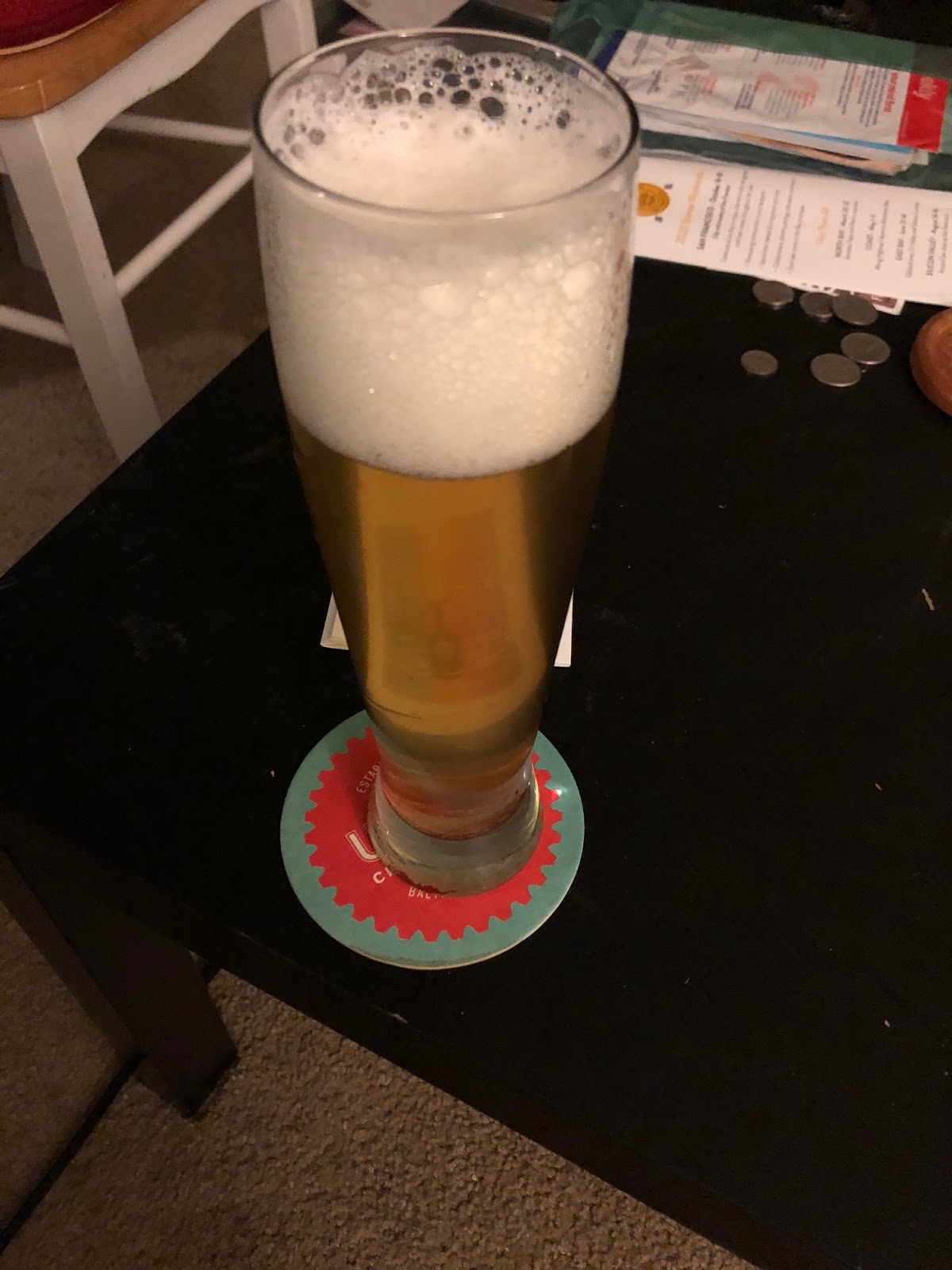
Appearance: Pours a nice light golden color, with a white medium sized head that fades somewhat quickly but leaves a small solid layer (the photo is about 5 minutes after pouring). Slightly hazy, not entirely surprising with a bottle conditioned beer and I may have not poured quite as cleanly as I could.

Aroma: The sweet, fruity, and phenolic notes that I associate with cherrywood smoke stand out but this is a fairly subtly smoked beer compared to many rauchbiers. Light grainy and honey malt sweetness from the malt and a very low note of sulfur from the yeast also appear. Not surprisingly the hops aren’t noticeable on the nose.

Taste: Sweet neutral malt leads the way followed by moderate smoky phenols and some fruitiness from the smoke. Finish is just lightly bitter with a lingering fairly light smoke character. Some would definitely find this very smoky but compared to other smoked beers it isn't very strong.

Mouthfeel: Medium low in body with medium carbonation, could maybe be a little more carbonated but I like it for this beer. The smoke phenols seem to linger and tingle the tongue and pull at the back of the throat a bit in the finish and aftertaste but I find it more refreshing than off-putting.

Overall: I’m extremely happy with this beer. The smoke is noticeable but not overpowering and I find it extremely drinkable and thirst quenching. I lost track of taking notes during this tasting as I kept just going back for more. The cherrywood smoked malt from Sugar Creek might be the least smoky smoked malt I’ve used but the character it does have is very enjoyable. This is the 4th time I’ve made some version of a smoked helles using cherrywood malt and it’s pretty clear why I keep coming back to that idea - it’s tasty. That said, less of the smoke character, a slightly thinner body, and a touch more carbonation would put this more in line with what I want out of a lightly smoked pale lager.
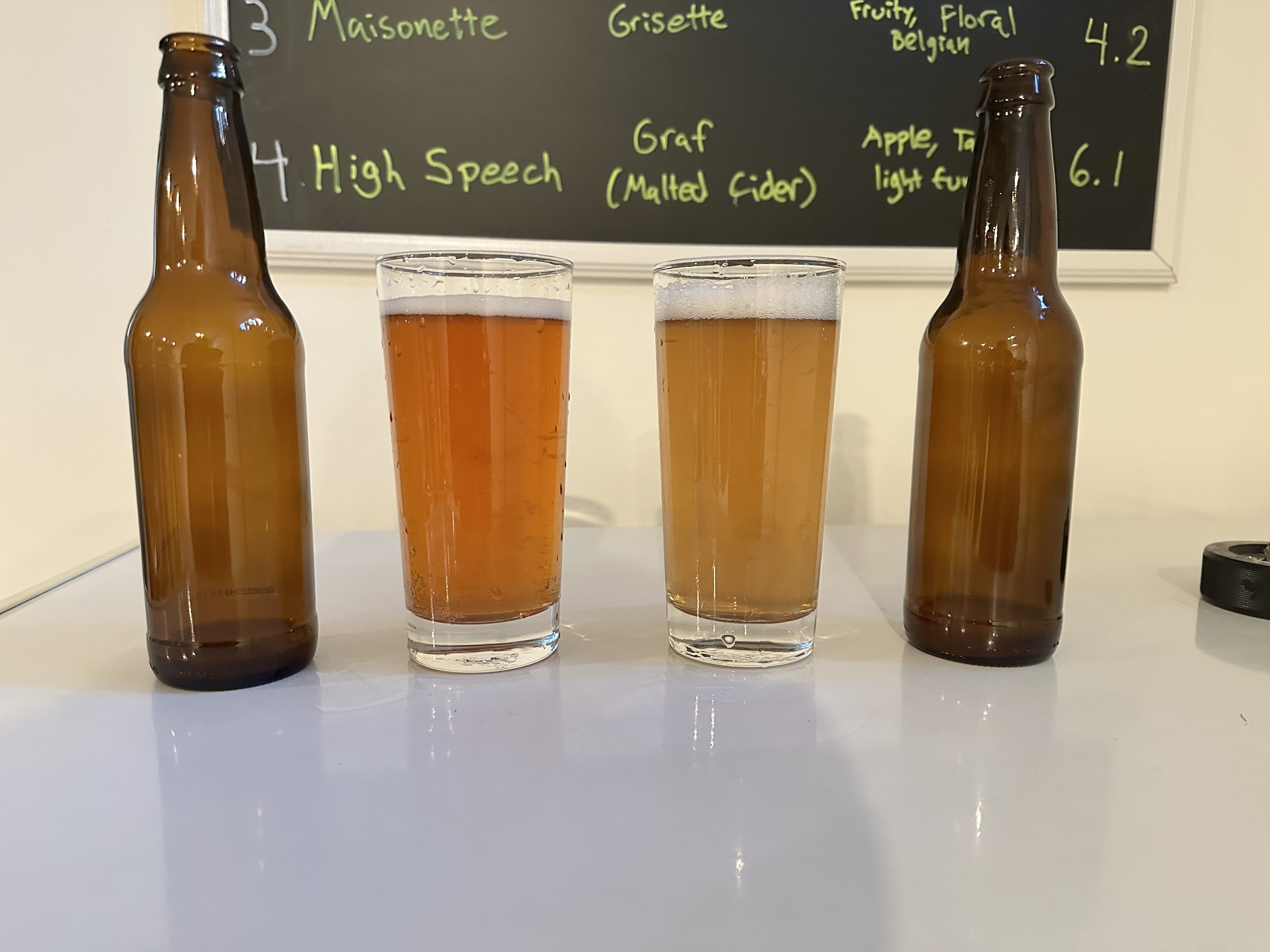
Fruited on the left, unfruited on the right

Cherry Fruited Version:

Appearance: Slightly orange/pink tint from the cherries. Head was very small and white and quickly faded to just a small ring. Haze is a touch higher than the unfruited version though that may have just been this pour.

Aroma: Light cherry is the dominant note. While the fruit isn’t strong the smoke is much subtler than in the unfruited version and I have to search hard for it. The light cherry aroma also seems to block the yeast and malt derived aromas as well, though I can just find some grainy sweetness when really trying. As it warms the fruity cherry aroma shows up more and more and phenolic smoke fades even further.

Taste: Moderate cherry flavor fills the mouth. Finish is lingering with just a touch of bitterness and phenolic character. While the cherry character isn’t strong it seems to dominate everything else and what does come through seems more like an off note to the cherry than smoke. The aftertaste has a strange tongue coating sensation that is likely the phenols but there still isn’t a smoky taste.

Mouthfeel: Similar medium level of body as the unfruited version but with a little less carbonation. This is probably due to using the same amount of priming sugar in this batch despite it being slightly larger. Higher carbonation would probably improve a few things, including the head and the ability for the smoke and fruit to pop more, but it’s not totally flat.

Overall: Not bad in any way and for a weird beer experiment that’s probably a win but this one doesn’t quite work. The fruit doesn’t so much compete with the smoke as the cherry flavor subdues any smoke into submission, making it seem more like a slightly strange cherry beer than a smoked beer with cherries. If I were to attempt this again I would likely use less cherries per gallon and/or a more prominent smoked malt. Using both more fruit (cherries or otherwise) and a much smokier malt (e.g. the stjordal style malt) might also be a fun experiment.

12/17/22 Brewday:

Ran into some issues milling as the battery on my drill overheated at one point, then the battery died after cooling down and had to be recharged. Dealing with this caused me to spill some grain and likely caused a slightly higher amount of the malt bill than usual to go uncrushed. Last pound or so of grains were milled and added once the battery had recharged, about 10 minutes after the initial mash in.

Treated 5 gallons water with a quarter campden tablet. Mashed in initially at 148F before adding boiling water about 5 minutes later to raise mash temp to 157F. Temp had fallen to 150F after an hour which is more of a drop than usual but I added some of the grain later, it’s cold out, and I stirred several times. First runnings gave 3.5 gallons wort with gravity measuring 1.051.

Batch sparged with 3 gallons campden treated water at ~120F giving 1.020 second runnings and a combined 6.5 gallons at 1.041

Wort had moderate smoke and barnyard aromas, not nearly as strong as when I made the 100% Stjordal smoked beer and with a very different character of barnyard, fruit, and breakfast cereal in addition to phenolic spicy smoke.

Ran into a few issues during the brewday, including the propane running out at some point during the boil when I wasn’t watching so I boiled for an additional 15 minutes after switching tanks.

After cooling to 60F the wort was transferred to a 6 gallon carboy and placed in a chest freezer set to 50F with the temperature gauge attached to the outside of the carboy. After 3 hours the temperature probe was reading 50F and I pitched a pack (12g) of Cellar Science "German" dry yeast which I have not used before but appears to be their version of W-34/70.

12/18/22: Increased temperature to 53 as there haven't been any real signs of fermentation after nearly 48 hours.

12/19/22: Still no real signs of fermentation more than 48 hours after pitching and I'm a little worried. The yeast packet recommended rehydrating, which I didn't do, and also recommends fermentation temperature of 54-62°F which is higher than it has been for most of the past few days. Gravity sample shows it is down to 1.040 which is down from the original gravity that was around 1.050. Increased chest freezer temperature to 55F to try and get it to really kick off fermentation. Taste of the gravity sample is good, fairly strong but not overly overpowering or phenolic in the smoke character but also with a lot of sweetness that needs to ferment out. Will be interesting to see how this one changes once fermentation really kicks in.

12/20/22: After a night at the slightly higher temperatures a nice layer of krausen and airlock activity show that this one is fermenting strongly now. Dropped the temperature by a degree to 54F, plan to slowly drop it further over the next week.

12/21/22: Dropped temperature to 52F. Still fermenting strongly.

12/22/22: Dropped temperature to 50F. Still showing strong signs of fermentation. Gravity reading at 1.028.

12/23/22: moved out of chest freezer to an area of the basement near a door where temperatures are measuring between the upper 50s and low 60s. Plan to leave for diacetyl rest/completion of primary fermentation before returning to the chest freezer for lagering.

12/29/22: 

Cherry version on the left, still transferring unfruited version on the right

Racked about half of the batch onto 3 lbs of Oregon Red Tart Cherry puree in a 3 gallon carboy and the remainder into a separate 3 gallon carboy. Plain version was placed in fridge at 32F to lager while the other version was left at room temperature to allow full fermentation of the fruit.

1/16/23

Racked unfruited version into bottling bucket with 1.8 oz table sugar boiled in 1/4 cup water. First time bottling in nearly a year and first time using a bottling bucket in as long as I could remember.

1/26/23

Followed the same bottling process as the unfruited for the fruited version. Tasting pretty nice with noticeable but not intense Cherry and drying phenolic smoke still coming through. Cracked open a bottle of the unfruited version - undercarbonated and still a touch sweet but very enjoyable with only moderate phenolics at this point. Will be interesting to taste both side by side once carbonated.

2/6/23: Brought a bottle of each to a bottle share where they were both pretty well received.

3/7/23: Tasting notes above.

4/2/23: The unfruited version of this beer received a 36 and placed first in the Wood and Smoke beer category at the DC Homebrewers Cherry Blossom Competition. I'm not entirely shocked to see this do well as a Smoked Helles in a BJCP competition, it was tasty, clean, and with a noticeable but not abrasive smoke character. One judge noted that more breadiness would help with the balance, and I think they have a good point and will likely use some Vienna malt in addition to less smoked malt the next time I make a smoked helles.

5/3/23: This beer didn't place in the Smoke, Historic & Wood Beer category of the BURP Spirit of Free Beer competition scoring a 20!? :The scoresheets don't really make sense, claiming a clorophenol(?) character that I don't get at all. While this beer is smokey for a smoked helles, and definitely has some smoke phenols, it is not an extremely smokey beer (like the Stjordalsol was) and I also don't get any of the faults the judges noted. It's tough when entering a beer in these types of styles because some people's taste thresholds are very different, as seen by the polar opposite scores this beer received in the two competitions. It's possible the beer is dropping off in quality after a few months but after having a bottle tonight I would still consider it very good.

10/27/23: had a bottle of the unfruited version for the first time in a while and it is still really drinkable. It has also gotten extremely clear at this point, by far the clearest bottle conditioned beer I’ve made. Really a nice beer that I may brew again at some point, even if I go closer to my regular smoked helles next time.

Maisonette ‘23 - Mosaic Grisette


Appearance: Fairly hazy light gold color with a nice fluffy white head of small bubbles with good retention. Pretty much exactly what I’d expect in a saison.

Smell: Earth, spice, pine, citrus. Slightly more herbal (oregano/sage) and earthy/grassy than the floral and fruity chamomile and juicy-fruit gum I would ideally get. There are light elements of those fruit/flower components and enough white pepper to clearly be a saison though.

Taste: Leads with a moderately grainy malt flavor that then segues into some light juicy-fruit and pear like fruitiness with some grassy and herbal hop bitterness and moderate peppery phenols at the finish.

Mouthfeel: Moderate body and carbonation, surprising how full it feels given the low finishing gravity, though the yeast may have produced some glycerol that gives that effect. The carbonation being less than very high also doesn’t help the body and may be the biggest fault this beer has as far as a saison.

Overall: I’m not surprised this beer didn’t do well in one competition - while it’s a beer I like a lot, the mosaic hops always seem to cause confusion when this is entered as a saison. That said, I’m happy with the beer and find it to be similar to a lot of previous batches I’ve made, though not the best examples. There was a short period when the hop aromas had just started to fade where this beer seemed to be at the edge of what I’m aiming for but I now have to search hard for the floral and fruity characters I’d like to see pop here.

Notes for the future: I’ll likely go back to a Pilsner or Pale Ale Malt base for future batches and won’t necessarily go back for spelt over malted or unmalted wheat, I also think dialing back the wheat/spelt percentage would probably be a good idea. The Napolean and Rustic yeasts seemed to work really well here and I wouldn’t hesitate to use them again, although I might aim for a slightly higher fermentation temperature to increase the fruity esters. I also don’t think the higher hop load was a bad change, though doing a longer hop steep at moderate temperatures might be better than the flameout hop addition and I’m not sure the extra ounce+ of hops made much of an impact so I’ll likely go back to the 4 oz version in the future.

2/20/23: Brewday

Grain Bill: 5 pounds 6 row (Rahr), 1 pound Pilsner (Sugar Creek), 2 pounds spelt malt (Best Malz)

Hops: 5.35 oz Mosaic

Mashed at 152 for 30 minutes, which fell to 145 over that time before adding additional water to bring to 158 for another 30 minutes. Batch sparged at 170F.

.35 oz mosaic added at first wort and boiled for 60 minutes, 1 oz flameout hops added when cutting flame and immediately rapidly chilled. After reaching 170 the chiller was stopped and 2 oz mosaic added and let sit for 10 minutes. Temperature fell to near 150 during this time and chiller was started briefly to bring to 140. 2 more oz of hops were added and let sit for 10 more minutes before slowly chilling to 80F. Ran off wort into carboy, collected 5 gallons at 1.042 and pitched a pack of Imperial Rustic. Because the wort was under intended volume and over intended gravity, I boiled, chilled, and added another half gallon to reach 5.5 gallons at 1.038.

2/21/23: yeast is fermenting strong less than 24 hours after pitching with a decent sized krausen and plenty of airlock activity.

2/23/23: Krausen has fallen and the beer is no longer showing any signs of active fermentation. Sample shows 1.008. Smells terrific with juicy fruit gum and a touch of pine aroma but weirdly the sample is thin, not very flavorful, and roughly bitter, hopefully it just needs some time. Added Napolean yeast harvested from Hoppy Black Saison to attempt to dry it out further and do what it does.

2/24/23: No signs of activity, moved to a warmer area in the basement near a vent.

2/26/23: Gravity sample shows the beer has dropped slightly to 1.006 and is also tasting much better and fuller at this point, may have just needed more time but the Napolean may also be adding some slight character that improves the overall impression.

3/1/23: Kegged.

3/17/23: Tasting (notes were somehow lost, will need to redo, but photos below)


4/2/2023: This beer did not place in it's category at the DC Homebrewers’ Cherry Blossom competition receiving a 27 (which seems harsh in my opinion). One judge commented that everything in the beer seemed too subtle (I wouldn't agree with that) while the other knocked it for being too fruity and tropical (that's probably accurate). This beer isn't brewed "to style" for a saison so while other variations of Maisonette have been received well in competitions that use audience favorite style judging or when entered in specialty categories, I don't think it's worth entering in any more BJCP style competitions as a saison (other than the one that I've already sent it too).

4/4/23: Tasting, notes above.

5/1/23: This beer surprisingly placed second out of twelve entries in the Belgian Ale & German Wheat category at the BURP Spirit of Free Beer competition. The beer scored a 34 and was only beat out in the category by another saison that went on to win Best of Show for the entire competition.

Monday, January 30, 2023

Glass Mountain American Lager


American Lager

Recipe:

5 lbs Rahr 6-row
2 lbs flaked maize
2 lbs flacked rice
.5 oz hallertau mittelfruh (60 min)
.25 oz hallertau mittelfruh (15 min)
2 packs Diamond lager yeast (1 per 3 gallon carboy)
Came in just under expected OG at 1.044

Brew date: 12/10/22
Chilled to 60F, pitched yeast and moved to 50F chest freezer.

12/15: increased chest freezer temp to 55F to finish primary fermentation and move towards diacetyl rest

12/16: increased chest freezer temp setting to 65F for diacetyl rest

12/17: moved out of chest freezer into room in the mid to upper 60s to finish diacetyl rest

12/20: Gravity reading 1.006, lower than expected but not too low. Taste is pleasant and mild with some light corn and grain character but is also a little more fruity and flavorful than expected, possibly due to the diacetyl rest being too early/warm/long or the late hop addition coming through more than anticipated. Hopefully it cleans up and loses some of that character during the lagering period. No diacetyl detected so it was moved to the chest freezer currently set to 55F. I plan to lower temperatures further over the next few weeks once the other beer (a 100% cherrywood smoked lager) currently fermenting in there finishes primary fermentation.

12/23/22: began lowering temperatures by 5 degrees

12/25/22: lowered to 32F. Will stay at this temperature for a few days before kegging.

12/29/22: Racked both carboys into a single 5 gallon keg and harvested yeast. Keg was placed in chest freezer at 32F and 30 PSI to burst carbonate overnight. Flavor is still a bit fruitier than intended and has a touch of sulfur but not bad.

1/12/23: tasting notes

Appearance: pale and bubbly, maybe just a touch darker than I would expect for the style but that might have more to do with the clarity being less than crystal clear. If I brew this style in the future I’ll need to either add gelatin or use another means to clarify it. Head is big, fluffy, and white initially and quickly fades to a small layer that leaves nice lacing.

Smell: Smell isn’t very strong, especially when initially pouring in the low 30s. Some light sweet graininess that seems malty without much noticeable corn or rice character. There is a slight cider and pomme fruitiness with just a whisper of herbal character. Apple aroma increases significantly as it warms up giving more green apple (probably acetaldehyde).

Taste: Like the smell (and as expected) the flavors are subtle. Sweet and subtly grainy malt dominates with a slightly herbal and earthy character in the middle and a very light bitterness on the finish. Some light apple like fruitiness shows more as it warms, possibly acetaldehyde but possibly yeast derived ester fruitiness due to the diacetyl rest occurring earlier and warmer than it should have. The fruitiness increases as it warms but so do the grainy and herbal characters to keep it from overwhelming.

Mouthfeel: This may be the area this beer is most off from the style as it feels more full bodied and round than I would expect. The beer is fairly highly carbonated though I was having some foam issues initially and have lowered the CO2, but even with the high carbonation it feels surprisingly full and rounded on the palate. If I was to brew this again I would likely mash lower and use a different yeast.

Overall: I’m really enjoying this beer for what it is. In some ways it feels between an American Lager and a German Helles, perhaps due to the Hallertau hops and use of German yeast. The rice and corn (and 6-row) don’t stand out as obvious ingredients to my palette but I wonder if others would be able to tell it apart from a beer made entirely with Pilsner malt. If I were to try brewing this style again I would make a number of changes but this recipe delivered an enjoyable, if flawed, beer.

1/28/23: Keg kicked less than a month after packaging. It was pretty enjoyable and easy drinking and with a few parties at the house this one went very quickly. Not a style I'm dying to brew again but something I'll probably come back to in the future and aim to brew more to style.

Wednesday, April 13, 2022

StarTropics ‘22

My dog enjoying play time during the brew day

Yet another rebrew of a recipe that I’ve enjoyed in the past. As with my last brew (Breakfast Stout) I attempted to aim for my favorite of the versions I had previously made but there’s no guarantee I’ll get the same results. This hazy/New England style IPA recipe has changed a lot over time but for this attempt I’m going back to the version that was co-crowd favorite at the DCHB BBQ at 3 Stars brewing many years ago. While I did make a blog post about that beer and have what seems to be the recipe (it was only labeled as StarTropics and I've lost most of my recipes over the years) I don’t have a lot of my notes, including the water profile, mash temperature, and the temperatures for the hop rest. I’m also not sure these were the exact hop additions used, including the ratios being different than I remember and the 60 minute hop addition seeming fairly large. With the hoppy saison I recently brewed already tasting more hoppy and bitter than expected I decided to lean towards a less hoppy recipe for this one and cut the 60 minute hop addition (in this case a first wort hop addition) from 1.5 oz to .5 and used the Comet I have on hand in place of Nugget. I considered cutting the boil hops entirely but did not want to stray too far from the previous recipe and didn't particularly care for the last no boil hop NEIPA I brewed.
Due to the lack of notes from that recipe I decided to take detailed brew day notes this time in case this batch also turns out particularly well (or to have a reference if there’s things to improve upon).

Tasting Notes:
This beer never fully turned around (detailed process notes below) but I'll do a full set of tasting notes anyway.

Appearance: Nice golden hue and substantial, but not offensive to my tastes, levels of haze. Finally pours with a small head though it recedes to a small ring fairly quickly. Looks the part of a hazy IPA in most ways.

Smell: Sweet overripe fruit (melon, papaya) and earthy, hay-like, sweet malt dominate with a light touch of citrus peel and pine.

Taste: Subtle fruity and dank characters lead with a big sweet malt middle finishing with a piney and herbal bitter ending. Touches of lemongrass, pine, earth, and melon throughout but none of the big, bold, tropical fruit character I would expect from the hops used. Adding the acid and calcium chloride seems to have knocked out most of the rough edges but may have also tampered down on the desirable hop characteristics.

Mouthfeel: Relatively low carbonation but moderate body, there's a lingering effect in the mouth that I believe is due to the calcium chloride but may also be from the oats or hops. While it could still probably use a little more carbonation it's not unenjoyable at this level.

Overall: A relatively disappointing beer. Far from the worst I've made but the hops just don't pop with the fruity, juicy, tropical character that they should and instead the overall impression feels a bit green and lackluster. Next time I will likely cut out the sugar and golden naked oats and use all 2-row rather than Maris Otter to keep the malt bill more straightforward (though I might add some wheat), shift to using more of the hops in the boil and late hop stand and filter more of the hops during the transfer to the carboy in order to reduce the grassy/green/polyphenol characteristics, and probably adjust the water chemistry to use less calcium chloride or at least less in proportion to the amount of gypsum. In the end I don't hate this beer and have no plans to dump it but it doesn't excite me like the best versions of my StarTropics recipes have.

3/18/22
Weighed and milled grain in preparation for brewing today. Collected 4 gallons and added 2g CaCl and 1g Gypsum for the mash water. I had planned to use twice as much of each but ran out of gypsum. I also collected another separate 4 gallons for the sparge and added a quarter campden tablet to each.

All grains for the mash bill mixed together

3/19/22
Brewday

Mashed in with 3 gallons of 180F strike water hitting my target 155F.

Hop smells from freshly opened 2021 hop pellet bags from Hops Direct:

Comet: Light pineapple and mango, some other tropical and citrus aromas. Light grassy and earthy aromas.

Citra: more pungent papaya and mango. More lemongrass than grass/earth.

Azacca: again similar with some light pineapple and red papaya. Lighter earth/grass than comet but not really the lemongrass of Citra.

Galaxy: very different. Still some pineapple and tropical fruit smells and lemongrass but with a pungent pine/dank/funk character

All 4 smell enjoyable and carry similar tropical fruit notes. After walking out of the room the hops were in then re-entering I was hit with a huge blast of tropical fruit hop aroma, hopefully some of this makes it into the beer.

After 55 minutes I added about 1 gallon of water at 180F to the mash, stirred and then let sit for 5 more minutes. After vorlauf first runnings were run into kettle with 8 oz Batey’s turbinado sugar and 0.5 oz Comet hops. Stirred occasionally to well mix sugar during run off. Added last 4+ gallons of sparge water to mash and let sit for a 5 minute batch sparge before running off. After about 15 minutes of running off the kettle had reached 6.5 gallons and was put back on the burner to boil.

Preboil gravity of 1.042. As with my last batch this is a touch lower than estimated but shouldn’t be too far off by the end of the boil (estimated 1.050 instead of the expected 1.055). 45 minutes into the boil I added the immersion wort chiller. 15 minutes later I cut the flame and began chilling.

Overshot chilling slightly at got down to 170F before realizing. Cut chiller and added first 3 oz hop dose. Let sit for about 25 minutes before returning. Temperature had fallen to 150F so I added the second hop dose and started the chiller again. Stopped chiller after about 5 minutes and let sit at 120 for another 10 minutes. After chilling to just under 80F wort was transferred to a 6 gallon carboy and a pack of Wyeast London Ale III pitched. OG measured as 1.052, just a touch below expected. I'll need to either tighten my mill or just slightly lower my efficiency expectations going forward. No filter was used when transferring from the kettle so this one has a lot of hop particulate, hopefully this only helps provide additional character and doesn't cause any issues.


3/20/22
Showing active signs of fermentation about 24 hours after pitching. Turbulent and brightly green in appearance, there is plenty of hops moving around in this one.

3/21/22
Still bubbling with a big krausen nearly taking up all the head space. May need to remove the bung temporarily if it gets any bigger. Inspecting the recipe further after brew day I recognized that the recipe shows only a 45 minute boil, so maybe the 1.5 oz of hops were used in the past batch but not boiled for a full hour, if so this beer should be lower in bitterness than that batch.

3/22/22
Bubbling has slowed, may be in part due to the ambient temperature cooling off some. Still a large krausen though not as voluminous as yesterday.

3/24/22
Gravity at 1.017 so it should still have a little ways to go. Taste is a bit harsh and more bitter than expected but not terrible. Hoping the harshness is just due to the amount of yeast and hop particulate in the sample at this point and fades with another week or so of fermenting and some conditioning. Added the first dry hop dose directly to the carboy.

3/28/22
Gravity down to 1.012 which is the expected FG. Taste is alright but more piney and astringent than desired without the level of tropical fruit character intended. I might keg this one sooner than expected to get it off the hop material, although I do plan to add keg hops.

3/29/22
Added 1g CaCl boiled in 100mL of water and 2mL 88% lactic acid. The acid addition was inspired by this post from Scott Janish showing a possible reduction in the grassy and astringent bitterness character when pH is reduced. I'm hoping these additions improve the beer but I intentionally went fairly low on each as I can always add more during or after kegging.

3/30/22
Transferred to keg in 31F keezer with last 3 oz. dose of hops in a stainless steel tube. Taste is a bit muted and overly harsh but not terrible. Hopefully some time at cold temperatures will help it clean up and the keg hops can add some brightness but I don’t think this one is going to fully turn around.

4/2/22
Was able to serve this at a housewarming party. Probably the least popular of the 4 beers on tap and definitely a bit undercarbonated. Not bad but not a particularly good hazy. We'll see what a little more time and carbonation does for it.

4/12/22
Tasting date, tasting notes above.

Maisonette ‘22


After recently moving to a new house back on the east coast it seemed like a good idea to do a simple, easy, tried and true recipe for my first batch in a new environment and with new equipment. While most of my brewing gear from San Francisco made the trip with me I now have a yard and so am able to brew outside on a burner again for the first time in about 5 years. In addition to buying a Bayou Classic burner I also needed to adjust to other variable including a new (leaky) hose for providing water to the wort chiller, a new location for fermenting, and a new-ish water source (still WSSC water so it should be similar to what I used at my parents’ house)

In addition to a few new variables I also chose to make this specific recipe due to being super busy moving in and preparing my new house. In addition to brewing this beer today I am also building the collar for my keezer, assembling a grill, prepping for painting, and moving furniture in multiple rooms this week. Productive but exhausting work that only left room for an extract brew day with minimal interaction.

The recipe is pretty similar to a doubled volume version of the very first batch I made of this beer: dry malt extract, mosaic hops, saison yeast. One big change is that in the first version I made it used only about one third wheat DME whereas this really upped the wheat content with 100% Briess Bavarian Wheat DME. It will be interesting to see how this beer turns out with this high of a wheat content, I expect it to be fine but maybe not quite as enjoyable as the ~20% I usually aim for.

Tasting Notes:

Appearance: Light gold with moderate haze. Large white head with great retention. Looks somewhere between where this beer usually falls and a classic hefeweizen, darker and hazier than ideal but within range for a farmhouse style beer and pretty appealing all around.

Smell: Fruit and spice from the yeast dominate giving an even balance of banana and bubblegum with Christmas/baking spice aromas of clove and allspice. Moderate malt presence then shows with sweet honey and breakfast cereal character. Hard to pick up the hops specifically but the mosaic character seem to be just there, blending into the fruit and spice character giving slight berry and herbal characters.

Taste: Fruity up front with banana/bubblegum/berry character that quickly blends into a mix of honey-like malt notes, leafy bitterness, and a lingering peppery and clove like spice that lasts into the finish. As it warms the Mosaic hop character comes out a little more but is still largely drowned out by the pepper/clove and banana from the yeast.

Mouthfeel: Moderately low in body and moderately high in carbonation, keeping this one very drinkable. There is a touch of astringency in the finish but it isn't off putting.

Overall: This beer is a fine grisette/saison but lacks some of the subtlety of yeast character and complexity of hop character I go for with this recipe. The hops don't show through to the normal level I look for and the yeast seem to have produced both more clove like esters and more banana/bubblegum than the more subtle "Juicy Fruit"/Chamomile/pineapple characters I aim for. Part of that may be the temperature conditions being lower than expected in the beginning then fairly high, and part of it may be due to adding the hops at warmer temperatures in the hop stand than usual. Next time I will likely go back to all grain, cut down the wheat percentage to my usual ~20% and add most or all of the post boil hops closer to 140F. 

3/6/22
Brewday:
Measured out 6.5 gallons of tap water, added half a campden  tablet, then began heating on my new bayou classic burner. Added DME and stirred as much as possible until dissolved. Added .35 oz mosaic hops at boil. Added 1 oz at flameout and began cooling. After ~10 minutes stopped cooling and added another 1 oz hops at ~180F. Let sit for 10 minutes before cooling again. Added 1 oz at 150F and stopped cooling again for ~20 minutes. Cooled to 95F and moved to 2 separate 3 gallon carboys, each with half of remaining .65 oz of hops. Pitched half a pack of Wyeast Belgian Saison in each. Plan to add Wyeast French Saison to dry it out after giving the Belgian Saison a few days to create character.

3/11/22
Pitched an inflated pack of Wyeast 3711 French Saison split into each carboy. Yeast appeared to still be active but very slow. Ambient temperatures are far below ideal for saison strains in the low-mid 60’s.

3/16/22
Still showing slow signs of fermentation. The beers were placed next to the actively fermenting oatmeal stout in hopes the heat generated by those carboys would help kick start these but while those are overflowing with yeast activity these continue to just very slowly bubble with a thin layer of krausen.

3/17/22
Hydrometer reading shows this is only down to about 1.030 so it has hardly fermented. Taste is very sweet with a surprisingly high hoppy bitterness. Moved to an upstairs bedroom at around 72F (instead of the 62-64F basement). Hopefully the warmth re-ignites the fermentation but if not I'll probably add a yeast more capable of fermenting at the cool to moderate temperatures in a few days.

3/21/22
Gravity reading shows this has fallen to 1.015 so the higher heat definitely seems to have helped, but it should have a few more points to go. Sample is very tasty with lots of juicy fruit gum and grainy sweetness finishing with a pronounced but not overly strong bitterness. I don't think this will be one of my best batches yet but has shaped up nicely over the past few days and should be ready to keg soon.

3/24/22
Bubbling very slowly, seems about ready to keg.

3/26/22
Gravity down to 1.014, doesn’t seem to be going any further. Transferred both carboys to a single 5 gallon keg. Didn’t do a great job avoiding the trub and got more yeast and hop particulate than desired, hopefully that will settle out. Set keg to 10 psi in keezer at 32F.

3/27/22
Increased PSI to 15 and keezer temp to 40F.

3/30/22
Dropped temp back down to 33F and lowered PSI slightly. Seems fairly well carbonated. Taste is fairly fruity but a bit more bitter, rough, and hazy than usual. I think the higher percentage of wheat and adding a large amount of the hops as high as 180 may be part of the issue. Hoping a couple more days at cold temps clears some things up but doesn't seem like a bad beer as is.

4/2/22
Probably the most or second most popular of the 4 beers on tap for a housewarming party. Overall it's not my favorite version of this beer but is definitely a Saison with fruity and spicy characters and a touch of the things I like most about Mosaic hops.

4/13/22
Tasting night, notes above.

Tuesday, April 12, 2022

Breakfast Stout '22

Full pour off the stout tap


I've brewed several versions of an oatmeal stout in the past, usually with very good results. For this batch I decided to repeat the coffee version that I made in my second attempt for a nice breakfasty stout. This recipe is extremely similar to Yooper's Oatmeal Stout and it's easy to see why that's such a popular recipe. The differences between the recipes are that I have increased the amount of oats and switched from flaked to rolled, cut the flaked barley, replaced the chocolate malt with more pale chocolate, added a small dose of Golden Naked Oats, and changed the yeast. Ok, that seems like a lot but I think the essence of the beer is probably still very similar to that recipe.

I did make a mistake when ordering for this batch and bought crystal 60 instead of 80 and this will probably lead to a little more sweetness and less dark fruit character but should still make for an enjoyable silky smooth stout. This is my first all-grain batch at my new house/with my new setup so repeating a previously enjoyable recipe should help me continue to dial-in my processes.

Tasting Notes:
Appearance: Pours jet black with some mocha and garnet highlights in the light, so it's not entirely opaque. Large off-white to tan head off the stout tap. Looks like a solid stout.

Smell: Coffee up front with a blend of roast, ash, chocolate, and a light green pepper note. Hard to pick out other characters from the coffee since they are also mostly coffee/chocolate/roast but there is some toffee and graham cracker sweetness. No noticeable yeast or hop derived aromas.

Taste: While the roasty characters of chocolate/coffee/burnt marshmallow dominate the coffee is less apparent here and blends in more to the toffee/caramel sweetness and blend of earthy and subtly vegetal/fruity notes. There is a bit of a medium malt/oatmeal character in the middle before finishing with a slightly acidic and moderately bitter finish that is both coffee like and vegetal.

Mouthfeel: Fairly thick and smooth with moderately low carbonation. In a lot of ways the mouthfeel seems to be where it should be but the finish feels long and awkward rather than silky and enjoyable, possibly due to the calcium carbonate additions.

Overall: Not the best oatmeal stout I've made but it has certainly improved a lot over time. With the other half of this batch still sitting in the carboy and having not received the coffee, oak, or mineral additions I am interested to see how that compares and if what I had earlier perceived as issues were merely due to drinking it too young. If I were to brew this again I would probably switch back to the WLP002 or similarly clean English yeast, switch the Magnum hops for Target or another English variety, and maybe reduce the golden naked oats to simplify the malt bill. I also won't use the Trader Joe's Colombia Supremo coffee again as I found this batch to not be great in this beer or when drinking my morning cup of joe.

3/13/22

Weighed and milled malt in preparation for brew day.


3/14/22
Brewday:

Scheduled a vacation day to be able to recover from a busy weekend/week/month and also to get an extra chance to brew. Collected 4 gallons of tap water in two separate pots, added a quarter Campden tablet to each and began heating one for initial mash in. Missed mash in temp hitting only ~148F with the first ~3.5 gallons of 170F water but added about half a gallon of boiling water after 5 minutes to bring up to 156F. Ran off slowly after 1 hour while heating sparge water to 170F. Used the first half of sparge water on a fly/hybrid sparge that was added while first runnings were still running off. Put pot holding first ~4.5 gallons of first/second runnings at 1.052 OG onto burner and performed batch sparge with last ~2 gallons of sparge water. OG of last runnings was 1.027, giving a combined pre-boil OG of ~1.044, a little lower than expected but not terrible (depending on the boiloff this would give an efficiency in the low 70% range rather than the near 80% anticipated).


I had a slightly smaller amount of Magnum hops than anticipated (.6 oz rather than .75) but added them pre-boil to try to get the maximum extraction of alpha acids. Given the slightly lower gravity this beer appears to have and the slightly higher alpha acid content of the hops (14.8 vs 12.6) the smaller amount of hops might be better for balance.


Refractometer measured OG of 1.057 ended up being only a touch below expectations. I find the pre-boil often measures much lower than expected when measuring pre-boil and post-boil OG and so I generally don't make any adjustments based on the pre-boil gravity.


3/16/22
One carboy blew its bung and was allowed to open ferment. About 12 hours later I found the other carboy's airlock had overflowed with krausen. Clearly this is a traditional top fermenting yeast and needed more room than provided in each carboy. I cleaned, sanitized, and re-applied the airlocks and bungs to each but placed on loosely so they could easily be pushed out by the yeast if it again gets that active.

Not sure how this photo got in here but I do love Spanish Love Songs and saw them the night before brewday so ¯\_(ツ)_/¯

3/17/22
Fermentation activity seems to have calmed down. While one bung was dislodged overnight the krausen on both carboys has fallen back down and the bungs were re-inserted fully. Still a decent sized layer of thick yeasty krausen and plenty of bubbling in the airlock but not nearly as active as 24 hours earlier.

3/22/22
Gravity reading shows 1.013, slightly lower than expected. Taste is a little astringent and muddled, hoping it just needs some time to settle down.

3/26/22
Gravity still showing 1.013. Less yeasty taste in the sample but still a bit astringent, with some acrid ashy roast. I probably should have capped the mash with the roasted malt but hopefully it’s not too aggressive once carbonated. Added .25 oz Peet’s Major Dickason’s Blend and .5 oz Trader Joe’s Colombia Supremo to one carboy along with 1.2 oz of boiled oak cubes. Should be ready to keg in a couple of days. Unlikely to get much oak character in that short amount of time but hoping it will help to round it out a bit.

3/28/22
Transferred coffee version to keg. Coffee aroma is fairly strong but coffee flavor is a little subdued. There’s still some astringency and acidity that I assume is from the dark malts in the mash and not adjusting water chemistry. To try to resolve these issues I added the coffee and oak to a mesh bag and added it to the keg. I also boiled 4g Chalk (CaCO3) and 1g Calcium Chloride in 1 cup of water and added it to the keg. Will taste from here and remove the coffee when flavor seems right and add additional water salts if needed.

4/2/22
One of the four beers on at a housewarming party. Not the most liked by most but a few people enjoyed it. The coffee does seem pretty strong at this point and the off characters seem to have subsided (or been hidden).

4/7/22
Tasting day.
Not part of the tasting but I will note that the Intertap stout faucet seems to work about as expected causing a lot of the carbonation to be released during the pour. While this give a good looking pour that resembles a nitro stout, reduces the carbonation in the beer for a good mouthfeel, and produces a big (usually too big) head, there are some downsides to the faucet. My main issue with it is that the design of it seems to cause a lot of beer to stay trapped inside leading to a large amount of splashing and dripping later on when it does finally fall out. While this isn't a huge deal it does seem to cause more lost beer and more of a mess than the other Intertap faucets that I am otherwise very happy with. Probably more of a novelty than something I'll regularly use, I did this tasting with a beer poured off the stout faucet but might change it up in the future to see how much of an effect it has.

Das Hund Maibock


I brewed this beer in January 2022 on my Dad's brewing setup. The recipe is posted here, tasting notes and cellaring notes from late in the process are below. A pretty simple recipe overall with ~60% pils and 40% vienna malt, a decent bittering charge of Magnum plus some small Hallertau Mittelfrüh additions late in the boil, fermented with a classic Munich lager yeast.

I can't seem to find any of the notes or photos from the brewday and have just one photo showing a temp reading a couple weeks later so I've included what process and tasting notes I do have below

Tasting Notes:
Appearance: Bright gold in color, certainly darker than the average Helles but not to the amber of a Vienna lager. Not as clear as I would like for the style but not a "hazy" beer by any means. Large white fluffy head fades slowly and looks very appealing. Overall it is maybe more of a "keller" Maibock than a traditional one but looks appetizing none the less.

Smell: Lightly earthy/grassy/leafy hop and malt character quickly gives way to sweet/cookie/caramel aromas. There's a touch of cider-like/apple fruitiness that may just be a combination of the hops and malt or may be yeast derived.

Taste: Starts off with a smooth enjoyable grainy/pilsner malt sweet malt character before transitioning to a much heavier caramel, cider, and vegetal finish which lingers with caramel/cookie/vanilla and some earthy hop character.

Mouthfeel: The booziness is only slightly apparent with a thinness that underlies the otherwise relatively sweet and thick body. Carbonation is moderate but seems about right for the style. The lingering sweet finish seems to be more due to the flavors than any astringency or specific mouthfeel character.

Overall: For a first attempt at the style I'm not unhappy but I don't think this would be considered a very good Maibock. The caramel and cider characters are much too high though I'm not entirely sure where they're coming from as the fermentation was kept cool for at least a decent amount of time during the early fermentation of the beer (though an unexpected hot streak in early February may have played a part?) and the malt bill doesn't contain any caramel malt. It's possible there was some caramelization due to the high burner heat and extended boil time and the fermentation was done in a cold basement, not controlled temperature conditions, which could have fluctuated more than expected and allowed some of the fruity/apple characters to come out of the yeast. Overall the beer is perfectly drinkable, maybe even too much so given the ABV, but it's not exactly what I was going for. I'm not sure I will re-brew this style any time soon as I find a lower ABV pale lager is often what people want and a more robust and characterful doppelbock is often what I want. If I do make another Maibock I'll increase the late hop additions to balance the malt sweetness and look to control the fermentation temperature better.

Kegged on 3/2/22 and Munich Lager yeast saved in mason jars for future use. Tastes a lot like my helles recipe which I guess makes sense given it's a helles bock, but it’s thinner and less malty than I had expected. Will see how it changes with carbonation.

3/12/22
Set in chest freezer at 32F.

3/26/22
Connected CO2 at 10PSI

3/27/22
Increased pressure to 15PSI and temperature to 45F. Poured a sample. Tasting stronger/boozier and thinner than expected. Hopefully some more time and more pressure will help round it out but doubt it will change too much.

4/2/22
Probably the most popular of the 4 styles I have on tap for my housewarming. Multiple people just described it as an enjoyable German lager though some pointed out some of the sweetness and "vanilla wafer" type qualities. To my taste it is more on the sweet and caramel-y side than I would like but no major off flavors, will need to do a deeper tasting soon.

4/10/22
Tasting date (tasting notes above).

Sunday, March 29, 2020

Munich Melon Hülles Lager

Nelson Version
I took a bit of a break from brewing (and even more of a break from blogging) but got back to it in January with a hoppy lager that is partially inspired by a line from Scott Janish's great book The New IPA. Specifically there's a note that Hüll Melon (sometimes written Huell Melon) is high in the 2MIB (2-methylbutyl isobutyrate) thiol which gives an apricot-like character, and can be enhanced even more with a lager fermentation. Some of these ideas are explored in this blog post by Scott. A fruity, (especialy apricot-y and melon-y) Munich Helles might not be classic but the subtle malt sweetness and graininess should lend balance and space for the hops to shine, without this coming out as a hazy IPA (or IPL). Searching around the internet it seems that a Helles with Hüll Melon has been done before by several breweries, including one of my favorite East Bay brewers, Original Pattern, with their Hella Hüll Helles Lager. I'll have to track down a can to compare with my version.


1/20/2020 Brew Day
Made a vitality starter of 8 oz DME, 1g Fermaid-k, 1800 mL water, 2 moderately old packs of Wyeast 2308 Munich Lager and a blend of lager yeast saved from my SMaSH Pils.

After several recent batches came out with a strange, harsh character I decided to not treat the water for this batch at all. While I'm not sure water chemicals are the cause of my recent issues I've narrowed it down to a few possible factors and this seemed like the easiest one to test. If this batch experiences the same issues I'll try adjusting my mill settings and do a full inspection of my equipment and review of my processes to see if there's another possible culprit. I'm including extra notes on this batch here to be able to pinpoint the cause of the issue if it happens as well too

Measured and milled 7.25 pounds Weyermann Pilsner malt and 9 oz Briess Goldpils Vienna. I planned to use Carahell but forgot I was out, should come out a little crisper and maltier with the Vienna but with a similar color.

Hit 152 on the direct infusion (a few degrees cooler than expected but close enough). Added half an ounce of hops to the first wort and began heating while batch sparging. Hit a combined pre-boil gravity of 1.039, about what was expected for the target 1.047 OG. Boiled for 1 hour then rapidly cooled with immersion chiller (added 45 minutes into boil) to 160. Added the 1.5 ounces of whirlpool hops then continued chilling for about 15 minutes to 68F (room temp). Ran off to plastic carboy through silicon tubing and moved carboy to chest freezer set to 50F. Pitched yeast a few hours later.

1/24/2020
Fermentation still going moderately with a medium sized krausen. Plan to move out of chest freezer to ~65F room temp for a few days once fermentation begins to drop. Smell from fermentation is strong with sulfur stink, hopefully that's being pushed out and won't carry to the final beer.

1/25/2020
Left in chest freezer but adjusted temperature up to 65F. Will likely take a few days to warm that high.

1/31/2020
No noticeable diacetyl on tasting and gravity down to 1.014. Set chest freezer to 32F for quick lagering.

2/6/2020
Split between 2 separate 2.5 gallon kegs, one plain one with an ounce of Nelson Sauvin hops.


2/19/2020
Plain Version
This one has been on tap for a couple of weeks and is a pretty enjoyable helles at this point. While there was a decent amount of fruitiness from the hops in the non-dry hopped version originally that has largely faded into a bready malt forward easy drinking lager. The dry hopped version was terrific early on, then seemed to experience some hop creep and had diacetyl, it was removed from the chest freezer for a few days and seemed to clear up but the hop character mostly faded as well.

3/28/20
Nelson half kicked, it was a really nice easy drinker with just enough fruity hop character to keep it interesting. The un-dryhopped version is much more straight forward, it's extremely easy to drink but is arguably too clean and many craft beer lovers would probably find it boring.

Thursday, February 28, 2019

Tranquility Base Bock

When I think of the great lagers I've enjoyed my mind goes to a few locations: Festbier in a tent at Oktoberfest in Munich, unfiltered Pilsner on the anniversary of Pilsner Urquell in a bar in Prague, and Doppelbock in a big field in the Virginia Mountains. The last one might not be as iconic but let me explain...

My version in a glass stein
Nestled in the Blue Ridge Mountains in Virginia is a surprising wealth of breweries: Hardywood, Champion, South Street, Random Row, Pro Re Nata, Starr Hill, and Three Notch'd can all be found in Charlottesville or nearby Crozet. During the two years my wife was attending grad school at the University of Virginia I visited almost all of these breweries and had plenty of beers from all of them, more often than not appreciating the diversity and quality of offerings. It was a little surprising to see how strong the beer scene could be in this area when the place I lived at the time, the larger and more densely populated Arlington, Virginia, only had a couple of brewpubs that turned out mediocre fare and often shut down shortly after opening.

Not far away from the Charlottesville area, just south of Shenandoah National Park, and near plenty of hiking and outdoor activity areas, is Route 151. Taking this road south takes you straight to countless drinking destinations: Blue Mountain Brewery, Wild Wolf Brewing Company, Silverback Distillery, Bold Rock Hard Cider, Blue Toad Hard Cider, Veritas Vineyard, Flying Fox Vineyard, and Cardinal Winery just to name a few. While I had made the trip this direction a few times for different reasons, in February of 2017 I made it further south on the road, nearly an hour from Charlottesville, where, for the first time, I visited one of the best known breweries in the area: Devils Backbone's Basecamp Brewpub.

Devils Backbone is a brewery that is both loved and hated in Virginia and further abroad due to their great lagers (Vienna Lager is their flagship beer and a great example of the style) and their 2016 sellout to AB-InBev. One of the many Craft breweries to be bought out by what used to be Anheuser-Busch, Devils Backbone may be known as much for their vast marketing and availability as the quality of their products.

This is the pint that I fell in love with
While their sale to AB-InBev, and subsequent tactics by their owners to market and distribute their beers at the expense of Craft offerings, rubbed me the wrong way, I still believe they are the best producers of lagers on the East Coast and would happily drink a Schwarzbier or Baltic Porter from them any day of the week. So, with minimal reluctance, I found myself at the brewpub deciding what to order and the decision ended up being easy. While they had all sorts of terribly gimmicky beers (ginger Bock and fruited Hefeweisse to name just a few) the Basecamp Bound Bock seemed like an easy choice. And oh was it the right one.

Rushing into my mouth were waves of chocolate, deep rich melanoidin laden malt, full creamy mouthfeel, but also nuanced light fruit, fresh grain, and subtle spice, all ending in a crisp, dry, refreshing, and obviously lagered finish. I'm not ashamed to admit I drank a couple more while playing Kubb on their spacious lawn (fortunately I wasn't the one driving).
This is the long way of saying: I discovered how great Bock could be not from my travels to Europe but from an AB-InBev product in the middle of Virginia, go figure. I subsequently found out that this beer was actually the bigger brother style of Doppelbock and was even more impressed with the drinkability. The beer weighed in at a fairly hefty 7.6% ABV (it's a good thing I wasn't driving!). While Devils Backbone's site didn't provide much information (this link used to go to details on this beer but no longer does...) about the beer I knew that one day I would have to try to recreate it.

This brings me to June 2018, on the other side of the country, where I set out to brew a beer that rides the line between Bock (or by the 2015 BJCP definitions a Dunkles Bock) and Doppelbock, with a particular emphasis on noticeable, but not overwhelming, chocolatey character without coming off roasty or finishing sweet. Essentially I wanted this to be a bock/doppelbock that had the harmonious blend of complexity and simplicity only a malty lager can show.

Less dark in this smaller pour than other images
While I wouldn't call my Tranquility Base Bock a clone of the Devils Backbone beer (I doubt their version used Pale Chocolate Malt or some of the other less orthodox ingredients), and while it also didn't turn out perfect, I think I nailed my goal of a super drinkable, surprisingly strong, plenty malty, ever so noticeably chocolatey, refreshing lager.

I was not as rigorous with brewing notes on this beer as most batches but here is what I remember/jotted down:
Brewed on the stove top. Cooled down to 50F overnight then pitched almost expired packs of Mangrove Jack's Bavarian Lager and Fermentis Saflager W-34/70. Raised temp control and fermented at 55F for 5 days before being allowed to rise up to 68F for another 5. Tasting at that point showed no signs of diacetyl so it was cold crashed slowly over 3 days to 33F. After another 5 days it was transferred to keg, carbonated, and kept at 33F for another 4 days before raising the temp to 45F. The temperature in the kegerator has fluctuated between as high as 55F and as low as 19F (I didn't notice the thermostat fell out and the temp controller got the freezer cranking) but the beer has only seemed to round out more over time.

Tasting:

Appearance: Deep brown but not black. Early pours were very clear due to gelatin but late pours (as this one is) have some floaters.

Smell: Very malt forward: chocolate milkshake and fresh baked bread linger together. Some hints of toast and earth but hard to tell where that comes from, otherwise no obvious yeast or hop derived components.

Taste: Lighter on the chocolate than the nose would imply but still a nice light milk chocolate character mingles with the more pronounced notes of toast, bread, and a subtle but growing in the finish clean bitterness. Again, no real hop or yeast character present.

Mouthfeel: Medium-high body with medium carbonation, hit this one exactly where I'd like for the style so that it fills the mouth but doesn't linger too long.

Overall: Again, a beer that I'm very happy with even if it isn't exactly to style. I would decrease both the dark munich and pale chocolate malt slightly if I were to brew this closer to a traditional bock and increase the regular munich a touch if I were to re-brew with a doppelbock in mind. That said, I don't know that I'd want to change this beer much unless I was trying to win a competition.

10/9/18
Bottled 3 bottles from the keg and entered into California State Homebrew Competition under category 9A: Doppelbock.

12/8/18
Still on tap and still tasting great. The beer scored a 36 and received 3rd place in the Strong Euro Lagers category at the California State Homebrew Competition, a good result for a beer not brewed exactly to be a classic Doppelbock and at the low end of the category.

2/28/19
Thought this one had kicked but found out there were still a couple pints left and created the above tasting notes, still a super enjoyable beer more than 6 months after brewing.

Saturday, December 12, 2015

(Coffee) Oatmeal Stout

I was very happy with my last oatmeal stout and with the cold weather coming soon to the area I figured now would be a good time to rebrew it.  While I was very happy with the original it was slightly more berry/fruity and less coffee/roasty than I would have liked. I also currently have a large quantity of American 2-Row that I am using in place of the Maris Otter so a few substitutions were required. To reduce the fruity character I dropped the 4 oz. of Special B and instead upped the Crystal 80 by 2 oz. and switched the yeast from the West Yorkshire strain to WLP002.  To make up for the lack of biscuity character from the Maris Otter  I added a quarter pound of Munich malt and a couple extra ounces of Victory.  Lastly, I slightly increased the roasted barley amount to increase the coffee character that I desire in a stout.  I did make sure to keep the 2 pounds of Oatmeal which seemed to give the original batch a great nutty and silky quality.

I managed to mess up my mash temperature somehow, initially hitting only 146 instead of the 154 I was aiming for. After 10 minutes I added about half a gallon of boiling water to bring it up to 156. I'll be interested in seeing how this affects the attenuation and body of the final beer.

Cooled to 75 F then placed in 65 degree basement and added the yeast.

11/6/15
Racked one carboy to 3 gallon keg. Added .5 oz of medium toast oak cubes to the other carboy, with plans to also add coffee in the future.

11/27/15
Added .25 oz Peet's Major Dickason's Blend and .5 oz Eight O'Clock Coffee Original to the carboy with oak.  Keg kicked of straight version.

11/29/15
Racked to keg at 10 PSI.  Coffee flavor is very strong but not overwhelming in still sample.

Tasting of Coffee Version:

Appearance: Very dark black, almost entirely opaque. Pours with a moderately big head despite the slow exit from the tap. Head is tan and lasts shortly before falling to a foamy covering that sticks around.  Pretty good all around.

Smell: Roast hits the nose first and dominates the aroma with heavy face-in-the-bag-of-coffee-beans character being augmented by a sweet cream-caramel and victory malt toasty/nutty malt characters.  Just a touch of ash that may be from the malts or the heavily roasted coffee.

Taste: Subtler than the nose, the coffee is present but blends smoothly with other roast characters, light creamy caramel, and a moderate to low bitterness.  The coffee character isn't overwhelming but is certainly present.  Oak flavors aren't particularly noticeable, every once in a while I get some definite oak character but it's only just there.

Mouthfeel: Smooth and fairly dry.  The body is a bit lighter than I would like but comes in creamy and goes down easy. I'm not sure if the oatmeal or oak give it the creamy impression despite the dryness or whether that is more a factor of the moderately low carbonation, but it certainly works. The dryness is likely related to the error with the initial mash temp, but it didn't fully sink this beer.

Overall: I can't find too much to complain about in this beer, it's smooth, easy drinking, refreshing, and has just enough coffee and roast to keep things interesting.  While I think the beer could be a little better with Maris Otter instead of 2-row I don't know that I would change anything else about it. If I wanted to give more oak flavor I would probably either double the dosage or contact time, but I don't know that it would necessarily benefit the beer.

The un-oaked, un-coffeed version was enjoyable but without the Maris Otter malt character and a slightly higher attenuation and cleaner yeast profile than the previous batch it came off a tad boring. This version seems to have taken it up a notch without overwhelming the base beer.

Friday, October 2, 2015

Fast Lagered Oktoberfest

I haven't been very active with this blog in a while.  Part of it is that I have been busy with work.  Part of it is that I haven't brewed anything in a while. Part of it is also that I recently moved.  The main part is that I have been lazy.

Breaking the habit of not brewing and not posting, and making use of my new brewing environment all at once, I decided to set out and make my second lager beer: a traditional Marzen/Oktoberfest.

After my visit to Munich last year to celebrate at the Wiesn I knew that I needed to eventually brew a beer in the oh so quenchable yet complex style.  Taking advantage of my new barley crusher (that took me about an hour of finagling to work with my underpowered cordless drill, but hey I got it to work!) I was able to crush the grist of relatively equal parts continental Pilsner, Vienna, and Munich malts, with just a little Carahell for extra color and flavor. While I didn't do a decoction mash or anything overly interesting with the wort production I did get to try out a few new toys, using my pH meter during the mash and refractometer throughout to ensure everything was on track.

Despite my new toys, the most interesting aspect of this brew might be the lagering schedule.  Using techniques I have pulled from a number of sources, most recently Brulosophy, I set out to make a fast lager.  My last lager, a Bohemian Pilsner, turned out fairly well but took a long time from grain to glass and had some diacetyl issues. I am hoping that the fast lagering method is able to reduce off characters and fermentation time for this beer.  I'm also under some serious time constraints as I plan to serve this beer at the DC Homebrewers 4th annual BBQ in late September as part of their homebrew presentation/competition. As such this beer needs to be delicious and ready to drink in less than a month. Challenge accepted.

Fermentables:
Amount
Fermentable
Maltster
Use
PPG
Color
4.0 lb
 Vienna (DE)
Avangard
Mash
37
5 °L
3.5 lb
 Pilsner (DE)
Weyermann
Mash
37
2 °L
3.0 lb
 Munich (DE)
Avangard
Mash
37
8 °L
0.44 lb
 CaraHell (DE)
Weyermann
Mash
34
11 °L
Hops:
Amount
Hop
Time
Use
Form
AA
0.5 oz
Magnum (DE)
60 min
Boil
Pellet
12.1%
0.5 oz
Hallertau (DE)
15 min
Boil
Leaf
4.5%
Yeast:
Name
Lab/Product
Attenuation
Czech Budejovice Lager Yeast
White Labs WLP802
77.5%
Stats:
OG: Measured 1.055
FG: predicted 1.012, measured 1.014
IBU: Calculated 24

Notes:
8/28/15 Brewday
Added 1 tsp CaCl to 7 gallons distilled water, 1.5 gallons bottled purified water
Mash Water 3.5 gallons
Mash Thickness 1.28 quarts/lb
Strike Temperature 165.2
Mash Temperature 151.9
Mash pH: 5.19
Mash Time 60 minutes
Sparge Water: 8.5 gallons
Sparge Temperature: 169.2
Sparge Time: 45 minutes
Boil Time: 75 minutes
Cooled to ~80 degrees then transferred to 48 degree fermentation chamber. 2 quart yeast starter pitched 8 hours later.

8/31/15
No obvious signs of fermentation (airlock bubbles or krausen) after 3.5 days had me worried but gravity showed 1.038, so it should be fine.
9/3/15
Increased temperature to 63 +/- 2 degrees after 5 days. Plan to begin slowly decreasing again on 9/7 assuming FG is reached.
9/6/15
Beer is showing minimal signs of fermentation, will slowly drop.
9/9/15
Down to 7.5 Brix (a calculated 1.013 gravity) at 53 degrees. This is near the estimated FG and the beer is tasting pretty good so I will add gelatin and continue dropping in temp.
9/14/15
Moved to keg. Tasted a sample post transfer and noticed diacetyl. Tasting very similar to my Czech Pilsner in that the diacetyl it is noticeably present, though not unbearably high. Running out of time to carbonate the beer but I decided to give it 48 hours at room temp to see if it clears up at all. Pretty disappointing given that I hadn't noticed it in my previous tasting, but I will have to live with it.


9/20/15
Tasted a sample this morning, not bad but still some noticeable diacetyl so I decided to take the latest version of Maisonette to the BBQ instead.

9/25/2015
Tasting:
A- Small but resilient white head over a hazy orange body. Perfect color though clarity is disappointing, I'll have to review my gelatin addition method.

S- Diacetyl is definitely the first thing I notice with that signature butter character. There's also some malt aromas of toasted grains and caramel, giving a sweet buttered toast impression.  No noticeable hop character.

T/M- The diacetyl is much less present in flavor than in the smell, with light grassy hops and bread crust malt giving way to a dry, lightly bitter finish which leaves just a touch of buttery slickness on the tongue. Carbonation is moderate, maybe a touch lower than I would like.

O- This beer is slightly disappointing in that I was hoping to avoid the butteryness and have more malt presence, but it is still a nice, easy drinking beer that suits the weather perfectly. I will likely use a different yeast and pay closer attention to my d-rest next time but other than that I'm fairly happy with the recipe and process.