Showing posts with label homebrew. Show all posts

Sunday, May 7, 2023

Cherry Tree - Smoked Lagers


I’ve probably had the idea of making a beer that uses both cherries and cherrywood smoked malt for over a decade but never actually went through with it. After purchasing 10 pounds of cherrywood smoked malt nearly a year ago and only using a pound of it in my Smoked Helles, I finally decided to take the plunge. For this recipe I decided to go with a super simple SMaSH recipe: 9 lbs Sugar Creek cherrywood smoked malt, 1 oz. hallertau mittelfruh, and a lager yeast. I only added the cherry fruit to part of this beer at secondary in order to have both a fruited and unfruited version.

Tasting:

Unfruited Version:

Appearance: Pours a nice light golden color, with a white medium sized head that fades somewhat quickly but leaves a small solid layer (the photo is about 5 minutes after pouring). Slightly hazy, not entirely surprising with a bottle conditioned beer and I may have not poured quite as cleanly as I could.

Aroma: The sweet, fruity, and phenolic notes that I associate with cherrywood smoke stand out but this is a fairly subtly smoked beer compared to many rauchbiers. Light grainy and honey malt sweetness from the malt and a very low note of sulfur from the yeast also appear. Not surprisingly the hops aren’t noticeable on the nose.

Taste: Sweet neutral malt leads the way followed by moderate smoky phenols and some fruitiness from the smoke. Finish is just lightly bitter with a lingering fairly light smoke character. Some would definitely find this very smoky but compared to other smoked beers it isn't very strong.

Mouthfeel: Medium low in body with medium carbonation, could maybe be a little more carbonated but I like it for this beer. The smoke phenols seem to linger and tingle the tongue and pull at the back of the throat a bit in the finish and aftertaste but I find it more refreshing than off-putting.

Overall: I’m extremely happy with this beer. The smoke is noticeable but not overpowering and I find it extremely drinkable and thirst quenching. I lost track of taking notes during this tasting as I kept just going back for more. The cherrywood smoked malt from Sugar Creek might be the least smoky smoked malt I’ve used but the character it does have is very enjoyable. This is the 4th time I’ve made some version of a smoked helles using cherrywood malt and it’s pretty clear why I keep coming back to that idea - it’s tasty. That said, less of the smoke character, a slightly thinner body, and a touch more carbonation would put this more in line with what I want out of a lightly smoked pale lager.
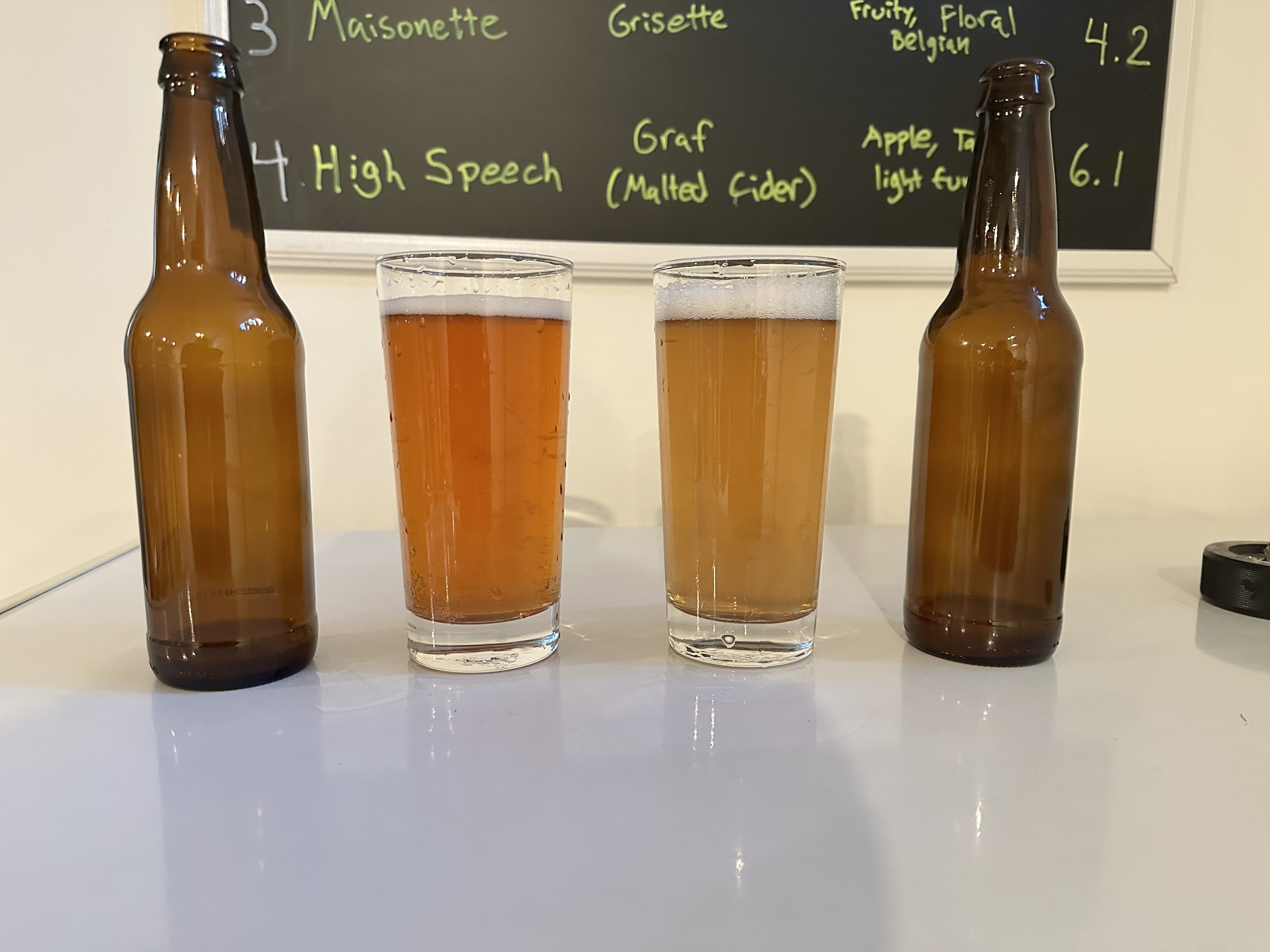
Fruited on the left, unfruited on the right

Cherry Fruited Version:

Appearance: Slightly orange/pink tint from the cherries. Head was very small and white and quickly faded to just a small ring. Haze is a touch higher than the unfruited version though that may have just been this pour.

Aroma: Light cherry is the dominant note. While the fruit isn’t strong the smoke is much subtler than in the unfruited version and I have to search hard for it. The light cherry aroma also seems to block the yeast and malt derived aromas as well, though I can just find some grainy sweetness when really trying. As it warms the fruity cherry aroma shows up more and more and phenolic smoke fades even further.

Taste: Moderate cherry flavor fills the mouth. Finish is lingering with just a touch of bitterness and phenolic character. While the cherry character isn’t strong it seems to dominate everything else and what does come through seems more like an off note to the cherry than smoke. The aftertaste has a strange tongue coating sensation that is likely the phenols but there still isn’t a smoky taste.

Mouthfeel: Similar medium level of body as the unfruited version but with a little less carbonation. This is probably due to using the same amount of priming sugar in this batch despite it being slightly larger. Higher carbonation would probably improve a few things, including the head and the ability for the smoke and fruit to pop more, but it’s not totally flat.

Overall: Not bad in any way and for a weird beer experiment that’s probably a win but this one doesn’t quite work. The fruit doesn’t so much compete with the smoke as the cherry flavor subdues any smoke into submission, making it seem more like a slightly strange cherry beer than a smoked beer with cherries. If I were to attempt this again I would likely use less cherries per gallon and/or a more prominent smoked malt. Using both more fruit (cherries or otherwise) and a much smokier malt (e.g. the stjordal style malt) might also be a fun experiment.

12/17/22 Brewday:

Ran into some issues milling as the battery on my drill overheated at one point, then the battery died after cooling down and had to be recharged. Dealing with this caused me to spill some grain and likely caused a slightly higher amount of the malt bill than usual to go uncrushed. Last pound or so of grains were milled and added once the battery had recharged, about 10 minutes after the initial mash in.

Treated 5 gallons water with a quarter campden tablet. Mashed in initially at 148F before adding boiling water about 5 minutes later to raise mash temp to 157F. Temp had fallen to 150F after an hour which is more of a drop than usual but I added some of the grain later, it’s cold out, and I stirred several times. First runnings gave 3.5 gallons wort with gravity measuring 1.051.

Batch sparged with 3 gallons campden treated water at ~120F giving 1.020 second runnings and a combined 6.5 gallons at 1.041

Wort had moderate smoke and barnyard aromas, not nearly as strong as when I made the 100% Stjordal smoked beer and with a very different character of barnyard, fruit, and breakfast cereal in addition to phenolic spicy smoke.

Ran into a few issues during the brewday, including the propane running out at some point during the boil when I wasn’t watching so I boiled for an additional 15 minutes after switching tanks.

After cooling to 60F the wort was transferred to a 6 gallon carboy and placed in a chest freezer set to 50F with the temperature gauge attached to the outside of the carboy. After 3 hours the temperature probe was reading 50F and I pitched a pack (12g) of Cellar Science "German" dry yeast which I have not used before but appears to be their version of W-34/70.

12/18/22: Increased temperature to 53 as there haven't been any real signs of fermentation after nearly 48 hours.

12/19/22: Still no real signs of fermentation more than 48 hours after pitching and I'm a little worried. The yeast packet recommended rehydrating, which I didn't do, and also recommends fermentation temperature of 54-62°F which is higher than it has been for most of the past few days. Gravity sample shows it is down to 1.040 which is down from the original gravity that was around 1.050. Increased chest freezer temperature to 55F to try and get it to really kick off fermentation. Taste of the gravity sample is good, fairly strong but not overly overpowering or phenolic in the smoke character but also with a lot of sweetness that needs to ferment out. Will be interesting to see how this one changes once fermentation really kicks in.

12/20/22: After a night at the slightly higher temperatures a nice layer of krausen and airlock activity show that this one is fermenting strongly now. Dropped the temperature by a degree to 54F, plan to slowly drop it further over the next week.

12/21/22: Dropped temperature to 52F. Still fermenting strongly.

12/22/22: Dropped temperature to 50F. Still showing strong signs of fermentation. Gravity reading at 1.028.

12/23/22: moved out of chest freezer to an area of the basement near a door where temperatures are measuring between the upper 50s and low 60s. Plan to leave for diacetyl rest/completion of primary fermentation before returning to the chest freezer for lagering.

12/29/22: 

Cherry version on the left, still transferring unfruited version on the right

Racked about half of the batch onto 3 lbs of Oregon Red Tart Cherry puree in a 3 gallon carboy and the remainder into a separate 3 gallon carboy. Plain version was placed in fridge at 32F to lager while the other version was left at room temperature to allow full fermentation of the fruit.

1/16/23

Racked unfruited version into bottling bucket with 1.8 oz table sugar boiled in 1/4 cup water. First time bottling in nearly a year and first time using a bottling bucket in as long as I could remember.

1/26/23

Followed the same bottling process as the unfruited for the fruited version. Tasting pretty nice with noticeable but not intense Cherry and drying phenolic smoke still coming through. Cracked open a bottle of the unfruited version - undercarbonated and still a touch sweet but very enjoyable with only moderate phenolics at this point. Will be interesting to taste both side by side once carbonated.

2/6/23: Brought a bottle of each to a bottle share where they were both pretty well received.

3/7/23: Tasting notes above.

4/2/23: The unfruited version of this beer received a 36 and placed first in the Wood and Smoke beer category at the DC Homebrewers Cherry Blossom Competition. I'm not entirely shocked to see this do well as a Smoked Helles in a BJCP competition, it was tasty, clean, and with a noticeable but not abrasive smoke character. One judge noted that more breadiness would help with the balance, and I think they have a good point and will likely use some Vienna malt in addition to less smoked malt the next time I make a smoked helles.

5/3/23: This beer didn't place in the Smoke, Historic & Wood Beer category of the BURP Spirit of Free Beer competition scoring a 20!? :The scoresheets don't really make sense, claiming a clorophenol(?) character that I don't get at all. While this beer is smokey for a smoked helles, and definitely has some smoke phenols, it is not an extremely smokey beer (like the Stjordalsol was) and I also don't get any of the faults the judges noted. It's tough when entering a beer in these types of styles because some people's taste thresholds are very different, as seen by the polar opposite scores this beer received in the two competitions. It's possible the beer is dropping off in quality after a few months but after having a bottle tonight I would still consider it very good.

10/27/23: had a bottle of the unfruited version for the first time in a while and it is still really drinkable. It has also gotten extremely clear at this point, by far the clearest bottle conditioned beer I’ve made. Really a nice beer that I may brew again at some point, even if I go closer to my regular smoked helles next time.

Maisonette ‘23 - Mosaic Grisette


Appearance: Fairly hazy light gold color with a nice fluffy white head of small bubbles with good retention. Pretty much exactly what I’d expect in a saison.

Smell: Earth, spice, pine, citrus. Slightly more herbal (oregano/sage) and earthy/grassy than the floral and fruity chamomile and juicy-fruit gum I would ideally get. There are light elements of those fruit/flower components and enough white pepper to clearly be a saison though.

Taste: Leads with a moderately grainy malt flavor that then segues into some light juicy-fruit and pear like fruitiness with some grassy and herbal hop bitterness and moderate peppery phenols at the finish.

Mouthfeel: Moderate body and carbonation, surprising how full it feels given the low finishing gravity, though the yeast may have produced some glycerol that gives that effect. The carbonation being less than very high also doesn’t help the body and may be the biggest fault this beer has as far as a saison.

Overall: I’m not surprised this beer didn’t do well in one competition - while it’s a beer I like a lot, the mosaic hops always seem to cause confusion when this is entered as a saison. That said, I’m happy with the beer and find it to be similar to a lot of previous batches I’ve made, though not the best examples. There was a short period when the hop aromas had just started to fade where this beer seemed to be at the edge of what I’m aiming for but I now have to search hard for the floral and fruity characters I’d like to see pop here.

Notes for the future: I’ll likely go back to a Pilsner or Pale Ale Malt base for future batches and won’t necessarily go back for spelt over malted or unmalted wheat, I also think dialing back the wheat/spelt percentage would probably be a good idea. The Napolean and Rustic yeasts seemed to work really well here and I wouldn’t hesitate to use them again, although I might aim for a slightly higher fermentation temperature to increase the fruity esters. I also don’t think the higher hop load was a bad change, though doing a longer hop steep at moderate temperatures might be better than the flameout hop addition and I’m not sure the extra ounce+ of hops made much of an impact so I’ll likely go back to the 4 oz version in the future.

2/20/23: Brewday

Grain Bill: 5 pounds 6 row (Rahr), 1 pound Pilsner (Sugar Creek), 2 pounds spelt malt (Best Malz)

Hops: 5.35 oz Mosaic

Mashed at 152 for 30 minutes, which fell to 145 over that time before adding additional water to bring to 158 for another 30 minutes. Batch sparged at 170F.

.35 oz mosaic added at first wort and boiled for 60 minutes, 1 oz flameout hops added when cutting flame and immediately rapidly chilled. After reaching 170 the chiller was stopped and 2 oz mosaic added and let sit for 10 minutes. Temperature fell to near 150 during this time and chiller was started briefly to bring to 140. 2 more oz of hops were added and let sit for 10 more minutes before slowly chilling to 80F. Ran off wort into carboy, collected 5 gallons at 1.042 and pitched a pack of Imperial Rustic. Because the wort was under intended volume and over intended gravity, I boiled, chilled, and added another half gallon to reach 5.5 gallons at 1.038.

2/21/23: yeast is fermenting strong less than 24 hours after pitching with a decent sized krausen and plenty of airlock activity.

2/23/23: Krausen has fallen and the beer is no longer showing any signs of active fermentation. Sample shows 1.008. Smells terrific with juicy fruit gum and a touch of pine aroma but weirdly the sample is thin, not very flavorful, and roughly bitter, hopefully it just needs some time. Added Napolean yeast harvested from Hoppy Black Saison to attempt to dry it out further and do what it does.

2/24/23: No signs of activity, moved to a warmer area in the basement near a vent.

2/26/23: Gravity sample shows the beer has dropped slightly to 1.006 and is also tasting much better and fuller at this point, may have just needed more time but the Napolean may also be adding some slight character that improves the overall impression.

3/1/23: Kegged.

3/17/23: Tasting (notes were somehow lost, will need to redo, but photos below)


4/2/2023: This beer did not place in it's category at the DC Homebrewers’ Cherry Blossom competition receiving a 27 (which seems harsh in my opinion). One judge commented that everything in the beer seemed too subtle (I wouldn't agree with that) while the other knocked it for being too fruity and tropical (that's probably accurate). This beer isn't brewed "to style" for a saison so while other variations of Maisonette have been received well in competitions that use audience favorite style judging or when entered in specialty categories, I don't think it's worth entering in any more BJCP style competitions as a saison (other than the one that I've already sent it too).

4/4/23: Tasting, notes above.

5/1/23: This beer surprisingly placed second out of twelve entries in the Belgian Ale & German Wheat category at the BURP Spirit of Free Beer competition. The beer scored a 34 and was only beat out in the category by another saison that went on to win Best of Show for the entire competition.

Friday, March 17, 2023

Radar Shadow - Amber Lager


After winning a silent auction for a year’s worth of Imperial yeast (only $60 for 12 packs) I was confronted with the dilemma of deciding which strains to use. Checking their list of available homebrew strains I saw they had a seasonal I wasn’t familiar with: Hygge. Hygge is a Danish word that reflects a lifestyle around coziness and comfort and unsurprisingly the strain is a Danish lager yeast (presumably from Carlsberg). The yeast’s description from Imperial is: “A northern European lager yeast famously used in Pilsner style beers that complement significant hop additions. Clean and crisp with a very light sulfur profile.” Having already made a number of pale lagers in the past year I didn’t really want to make another Pilsner but a significantly hopped lager with a little more malt character sounded nice.

This got me to thinking about my visit to the Carlsberg brewery and the red lager I had there: Tuborg Red. While I didn’t love the beer when I had it in May of 2016 the idea of a Danish red lager seemed intriguing and possible. Having a few pounds of characterful Vienna, Munich, and extra dark Munich on hand made me think that it might be nice to make a hoppy but also moderately malty red lager.

Trying to find information on Danish Red lagers as a starting reference point is almost impossible as every search seems to point to Figueroa Mountain’s Danish Red Lager, which is a Vienna Lager. Vienna Lager is probably in the realm of what I’m looking for but not exactly what I have in mind.

Looking for more examples of red/amber lagers to determine a good recipe led me to look at the BJCP defined “International Amber Lager” and “Czech Amber Lager” styles which are also in the ballpark of what I have in mind but flavored more with sweet/caramel tasting crystal malts instead of the toasty/malty Munich and Vienna character I’m desiring.

Searching further I discovered that in the 2021 version of the style guide kellerbier is listed as a historical style with new information I hadn’t previously seen or heard. This included that kellerbier originated from amber beers in Franconia, not the pale and hazy Helles and Pilsner versions I’m familiar with. Reading more about Franconian lagers I realized there are a wide range of styles and naming conventions in Franconia but that somewhere in this realm is probably close to the style I am looking for. I created a recipe for a red/amber that could sit somewhere between a Franconian Vollbier and Danish red lager (and maybe not that far off from a Vienna lager).

While picking up brewing supplies at Maryland Homebrew I discovered an expired pack of Jasper Yeast Franconian Lager and decided to pick it up to use for half the batch alongside the Hygge strain. While the planned brew day is more than a month after the yeast pack’s listed expiration date the high yeast count in Jasper Yeast packs, a large starter, and the fact that this is only being used for a small (~3 gallon) batch should mitigate any issues with underpitching.

Tasting Notes:

Aroma: Fairly strong aroma with malt dominating. Notes of bread crust and light chocolate cake, with subtle dark fruit and floral notes from the hops.

Appearance: Darker than intended, this one is probably a touch past deep amber and into lighter shades of brown. SRM is probably in the upper teens, quite a bit higher than the intended 14. It would probably look lighter if it was clearer but it has a noticeable, if fairly low, haze. Definitely could have used lagering after the re-fermentation. Head is small and off white but shows good retention and lacing.

Taste: Similar to the nose with moderate bready and sweet malt dominating. The floral and herbal hops are light but noticeable in the flavor and the finish is moderately bitter. Like the aroma there’s some subtle chocolate and dark fruit notes that show up more as it warms.

Mouthfeel: Medium bodied and with medium carbonation, this seems to be just right in both of these categories, allowing the malt to fill the mouth but also the hoppy bitterness to then wash away the sweetness.

Overall: I’ve thought a lot about this beer, both in designing and making it, cellaring and adjusting it, and tasting it over the past week. In the end the beer is much better than the diacetyl bomb it once was but I’m not sure it really works as an amber lager. I probably wanted this to be too many things, malty and sweet but also hoppy and refreshing, not too pale but not too dark in color, dry and quenchable but also full bodied. In some ways it does all of these but the end effect is somewhere between an overly sweet, dark, and malty Vienna lager and a slightly overhopped dunkel. While this fails to be the amber lager I hoped for, making a decently hoppy dunkel isn’t bad and I find myself happily drinking this beer, especially as an alternative to the other beers I have available. If I were to brew this again I would likely cut the amounts of dark Munich and midnight wheat by at least half, if not removing one or both entirely. I might also increase the hops, either with a late boil addition or a small dry hop. Doing these things should give more of an amber hue and give more of an even balance between the malt and hop flavors.

1/24/23: Created a 1.75 liter starter using 6 oz of dry malt extract. Added the Jasper Yeast Franconian lager pack and placed on stirplate.

1/26/23: Turned off the stirplate and put yeast starter in fridge to cold crash. It looks like I'm not the only one who thought of a red lager when hearing about Hygge as Basic Brewing released a podcast on developing amber lager recipes to use it in. This prompted me to do a little more searching for other recipes in this area and discovered that WLP850 Copenhagen Lager (seemingly White Labs version of this same strain) lists Amber Lager as a suggested style and Wyeast lists Amber Kellerbier as a recommendation for their Danish Lager strain. Maybe this is a good idea after all.

1/28/23: brewday

Mashed in with 3.5 gallons to hit 147F. After 25 minutes added 2 gallons nearly boiling water to reach 160F. After 35 minutes ran off first runnings and added .5 oz Perl’s hops. Added 3.5 more gallons of 180F sparge water to mash tun, then ran off second runnings and combined. Boiled for 75 minutes before adding immersion chiller, then another 5 before adding 1 oz Spalt Select and .5 oz Perle hops. 5 minutes later I added a tablet of Kick Carageenan then 5 minutes later cut the flame and started chilling. Chilled to just under 60F, transferred evenly to two separate 3 gallon carboys, pitched Imperial Hygge into one (“Dane”) and the decanted starter of Jasper Franconian into the other (“Frank”) and placed in chest freezer set to 50F. 

Both carboys looked very interesting with lots of what appeared to be protein, similar to a hot break or cold break. Hopefully this is just due to the carageenan tablet and the proteins settle out without any issues.

1/29/23: less than 24 hours after pitching both beers are showing signs of fermentation with decent sized krausens and airlock bubbling.

2/1/23: Fermentation seems to be slowing in both with the krausen starting to fall and very little airlock activity. I increased chest freezer temperature to 52F and plan to increase by a few more degrees over the next few days in order to cleanup any diacetyl.

2/2/23: Increased chest freezer temperature controller to 54F. Plan to leave at this temperature for at least a few days before doing a forced diacetyl test.

2/7/23: Increased temperature to 60F for a short diacetyl test, plan to decrease temperatures slowly after a few days. No diacetyl detected in sample but didn’t have time to do a forced diacetyl test and I need to get the chest freezer cold for serving beers on tap during the Super Bowl.

2/11/23: Lowered chest freezer temp 5F every 12 hours for the past few days to reach 45F for serving temp of kegerator.

2/12/23: Lowered to 30F for lagering. Planning on a quick lager before kegging if both are tasting ok.

2/17/23: Kegged each version separately. Dane version finished at 1.011 (77% attenuation) and is showing some diacetyl after kegging that I hadn’t noticed in a sample taken yesterday, will give it a little time to see if it’s enough of an issue for me to try to fix it or just enjoy it as is. Frank finished at 1.008 (83% attenuation) and doesn’t have any noticeable diacetyl at this point.

2/20/23: Both versions have strong diacetyl and were removed from the chest freezer to allow them to sit at room temperature for a second diacetyl rest. They will likely need extended time to clean up the diacetyl since there isn’t much yeast remaining in the kegs.

2/26/23: Still noticeable diacetyl in a sample, not terrible but not ideal. Added some of a mix of the two yeasts to both kegs along with a small sugar sample (~1 oz sugar to each keg). Hoping to kick the yeast back in to process the remaining diacetyl. Will probably rack remaining beer in both kegs into a single 5 gallon keg if the process works.

3/2/23: No noticeable diacetyl remaining in either, racked both into a single 5 gallon keg and set in chest freezer on pressure.

3/8/23: Tasting notes above. Discovered this useful information that might help explain why this beer looks darker than expected. https://www.brewingwithbriess.com/blog/predicting-beer-color-based-on-formulation/

4/16/23: this keg kicked. Pretty enjoyable beer and the flavors became more clean and cohesive and appearance had more clarity and slightly lighter color after the age. Would probably still reduce the hops or malts slightly if I rebrew but the most important thing seems to be patience.

False Sun - Hoppy Black Saison


If Black Saison isn’t a classic style, Hoppy Black Saison certainly isn’t. Yet, I’ve found myself making a hoppy black saison for the third time. Like my two previous batches this is intended to blend citrusy American hops, roasty dark malt character, and the spice and fruit of saison yeast. With that in mind I also greatly changed this recipe out of fear of getting too much chocolate/roast flavors and did not include any citrus peel in an attempt to let the hops shine on their own. I’ve also lost the original recipe at this point so it would be hard to entirely recreate even if I wanted to.

Brewday: 1/15/23

Preboil gravity: 1.035 at 7.25 gallons

Boiled 90 minutes

Post boil gravity: 1.047 at 5.25 gallons

1/19/23: This beer has been showing slight signs of fermentation (krausen and bubbles in the airlock) since the day after pitching yeast but the airlock bubbles have slowed rapidly to less than once a minute and I was worried this one may have stalled so I took a hydrometer reading. Gravity sample showed 1.006, indicating that rather than a stall it may have already reached final gravity as it’s below the estimated FG less than 4 days after pitching the yeast. This isn’t entirely surprising for such a fast working and attenuative yeast (not to mention an attenuative malt/sugar bill) but considering the beer has spent most of the time with ambient temperatures in the upper 60s it’s impressive how quickly it’s chewed through the sugars. Flavor is nice, fairly spicy but not clove-like from the yeast, a blend of coffee and dark fruit from the malts, yeast, and sugar, and a refreshing orange-like citrus character from the hops. Still a decent layer of yeast and this one could attenuate even further so it likely won’t be kegged for another couple of weeks but happy with where it seems to be heading at this point.

1/26/23: Krausen has fallen and it isn’t showing any signs of active fermentation. Added 1 oz each of American Cascade and French Strisselspalt.

1/28/23: Kegged and placed in chest freezer at 50F and 20PSI (targeting 2.7 volumes of CO2). Will likely need to adjust the pressure as the temperature in the freezer gets adjusted around a lagering schedule. Taste is interesting, not a lot of obvious yeast character and maybe not as dry as I expect from a saison with both the hops and candi syrup seeming to contribute a lot of fruitiness and some earthy flavors. All around it currently seems a little disjointed and I’m partially wishing I hadn’t added the D-90 but hopefully some carbonation and time will make everything a little more cohesive and saison like.

3/6/23: Tasting notes.

Aroma: Big pepper and fresh cut grass jumps out of the glass, lemony citrus notes eventually mingle in alongside light notes of dried fruit and black cherry.

Appearance: Very dark brown, approaching black with a large fluffy tan head that slowly fades to a thin layer leaving behind lots of foam clinging to the sides. Holding it to the light shows a nice garnet tint though clarity is only medium and I wonder if this one is near the end of the keg as there’s a small amount of what appears to be hop matter in the bottom of the glass that I haven’t noticed on previous pours. Not sure I would want this to look much different other than the particulate.

Taste: Roastier than the nose, with a very mild coffee note throughout. Light pepper and fruitiness from the yeast mingle with light grapefruit and tangerine peel alongside plum, raisin, and date. There’s probably a little bit too much going on though losing any one of the qualities or boosting the hoppiness might make the rest work better. Finish is lightly bitter leaving a subtle blend of fruitiness and the very light coffee impression.

Mouthfeel: This one is very heavily carbonated. This would probably be considered overcarbonation for most styles but I like this much in a saison and it helps the flavors all pop. Body is medium/medium-low, not as dry as would be expected in a saison but I think it mostly works here.

Overall: After more than a month on tap I’m still not really sure how to feel about this one. Part of me regrets using the D-90 as the dark fruit characters it adds seems to be one thing too many in a beer that also features so much from the hops, yeast, and malt. On the other hand, I frequently find myself having a second glass to try to determine how I felt about the first, so it has me going back for more. The hops have faded a bit at this point and probably could’ve been heavier in the first place. Certainly an interesting beer, in some ways it combines a Belgian Saison, a Belgian Dubbel, an American Pale Ale, and a German Schwartzbier all at once and surprisingly somehow almost manages to pull it all off. If I brew this again I will likely use more late/dry hops, an addition of orange peel to increase the citrus character, and drop the candi sugar, to let this be closer to the Black IPA and Saison hybrid I intended when first coming up with this idea.

Monday, January 30, 2023

Glass Mountain American Lager


American Lager

Recipe:

5 lbs Rahr 6-row
2 lbs flaked maize
2 lbs flacked rice
.5 oz hallertau mittelfruh (60 min)
.25 oz hallertau mittelfruh (15 min)
2 packs Diamond lager yeast (1 per 3 gallon carboy)
Came in just under expected OG at 1.044

Brew date: 12/10/22
Chilled to 60F, pitched yeast and moved to 50F chest freezer.

12/15: increased chest freezer temp to 55F to finish primary fermentation and move towards diacetyl rest

12/16: increased chest freezer temp setting to 65F for diacetyl rest

12/17: moved out of chest freezer into room in the mid to upper 60s to finish diacetyl rest

12/20: Gravity reading 1.006, lower than expected but not too low. Taste is pleasant and mild with some light corn and grain character but is also a little more fruity and flavorful than expected, possibly due to the diacetyl rest being too early/warm/long or the late hop addition coming through more than anticipated. Hopefully it cleans up and loses some of that character during the lagering period. No diacetyl detected so it was moved to the chest freezer currently set to 55F. I plan to lower temperatures further over the next few weeks once the other beer (a 100% cherrywood smoked lager) currently fermenting in there finishes primary fermentation.

12/23/22: began lowering temperatures by 5 degrees

12/25/22: lowered to 32F. Will stay at this temperature for a few days before kegging.

12/29/22: Racked both carboys into a single 5 gallon keg and harvested yeast. Keg was placed in chest freezer at 32F and 30 PSI to burst carbonate overnight. Flavor is still a bit fruitier than intended and has a touch of sulfur but not bad.

1/12/23: tasting notes

Appearance: pale and bubbly, maybe just a touch darker than I would expect for the style but that might have more to do with the clarity being less than crystal clear. If I brew this style in the future I’ll need to either add gelatin or use another means to clarify it. Head is big, fluffy, and white initially and quickly fades to a small layer that leaves nice lacing.

Smell: Smell isn’t very strong, especially when initially pouring in the low 30s. Some light sweet graininess that seems malty without much noticeable corn or rice character. There is a slight cider and pomme fruitiness with just a whisper of herbal character. Apple aroma increases significantly as it warms up giving more green apple (probably acetaldehyde).

Taste: Like the smell (and as expected) the flavors are subtle. Sweet and subtly grainy malt dominates with a slightly herbal and earthy character in the middle and a very light bitterness on the finish. Some light apple like fruitiness shows more as it warms, possibly acetaldehyde but possibly yeast derived ester fruitiness due to the diacetyl rest occurring earlier and warmer than it should have. The fruitiness increases as it warms but so do the grainy and herbal characters to keep it from overwhelming.

Mouthfeel: This may be the area this beer is most off from the style as it feels more full bodied and round than I would expect. The beer is fairly highly carbonated though I was having some foam issues initially and have lowered the CO2, but even with the high carbonation it feels surprisingly full and rounded on the palate. If I was to brew this again I would likely mash lower and use a different yeast.

Overall: I’m really enjoying this beer for what it is. In some ways it feels between an American Lager and a German Helles, perhaps due to the Hallertau hops and use of German yeast. The rice and corn (and 6-row) don’t stand out as obvious ingredients to my palette but I wonder if others would be able to tell it apart from a beer made entirely with Pilsner malt. If I were to try brewing this style again I would make a number of changes but this recipe delivered an enjoyable, if flawed, beer.

1/28/23: Keg kicked less than a month after packaging. It was pretty enjoyable and easy drinking and with a few parties at the house this one went very quickly. Not a style I'm dying to brew again but something I'll probably come back to in the future and aim to brew more to style.

Saturday, October 22, 2022

Doppelbock '22


Doppelbock has been my go to autumn beer for the past few years. The first iteration of the beer scored a medal at the California State Homebrew Competition. While I usually like to change things up I was very happy with how that beer turned out and have been trying to recreate it in the years since. Last year's version was enjoyable but seemed to be missing something in the maltiness category so I went out of my way to source the Briess Dark Munich (30L) that I had used in the original version and also increased the amount of Caramunich to a full pound. I otherwise kept the recipe largely the same with equal amounts of Pilsner, Vienna, and Munich malts and the pale chocolate malt that may not be traditional but seems to give a nice note of chocolate without being too roasty.

Tasting notes:

Smell: Big malt character pops out with milk chocolate and dark fruit (plum and raisin). The roast and fruit characters are probably a little higher than desired and mostly over power the more subtle bread and crust character from the Munich and Vienna malts. A touch of alcohol comes through as it warms. No hop or yeast derived aromas.

Appearance: Dark brown with nice garnet tints, especially in the light. Fairly clear but has a touch of haze that makes it seem darker. Head is small and off white and quickly fades to a ring of small bubbles.

Taste: Up front there’s a big sweet bread crust-like malt character but this quickly shifts toward a more roasty chocolate and burnt sugar character. Finish had notes of dried fruit and moderate bitterness that blends with the roast character to give a bittersweet chocolate impression. No hop character other than the bitterness.

Mouthfeel: Moderately carbonated and fairly full bodied. Alcohol is not hot but does give a warming sensation over time.

Overall: While not an overly bad beer this is probably the worst of the doppelbocks I’ve made. The roast character seems stronger than in past batches and overshadows the other characters of the beer. While this one seemed to have some rough, near metallic, off flavors when first kegged the additional time at cool temperatures and carbonation seem to have rounded them out. While I was excited to get the 30L dark Munich malt I think it was overwhelmed by using so much Caramunich, especially with the pale chocolate malt also in the mix and I will probably only use a quarter pound of each of those in my next attempt at this style. The failure to set my mill correctly and try to correct it by adding malt extract was also a mistake as it meant there was less of the Munich malt character in the end product to balance the roast and caramelized flavors.

8/19/22
Made a starter from a mason jar of yeast previously used on a Helles and a Pilsner. First time using this 2L Erlenmeyer flask and first time using a stir plate in a long time but both seem to work well. The starter should have been created a few days earlier for maximum viability but this should provide some increase to the amount of yeast available and provide vitality to the yeast already in the mix.

8/20/22
Brewday

Forgot to adjust my mill setting until half way through milling which led to undercrushing and low efficiency. I also added too much sparge water and ended up with ~7.5 gallons pre-boil. Between both of these I ended up with a pre-boil gravity ~1.040 which is no where near what was expected. In order to resolve these issues I did a 2 hour boil and added a pound of dry malt extract. Despite both of these adjustments the post-boil gravity was still only 1.066, a ways short of the planned 1.072 and more in the middle of the Dunkles Bock range than the low end of the the Doppelbock range as intended.

Hops were split between a first wort addition that was boiled the full 2 hours and a later addition that was boiled for only 45 minutes.

After cooling to 80F the wort was transferred to a plastic carboy and placed in the chest freezer at 50F. 

8/21/22
Approximately 18 hours after putting the wort in the chest freezer I shook the carboy to oxygenate and pitched the yeast starter from the stir plate.

8/22/22
Almost 24 hours since pitching it isn't show any real signs of fermentation so I increased the temperature slightly to 52F.

8/23/22
Fermenting strongly.

8/24/22
Fermentation seems to be slowing slightly so I increased the chest freezer temperature to 62 for a diacetyl rest.

8/26/22
Still fermenting, increasing the temperature seems to have kicked it back up a bit. Hopefully this will be able to get rid of any diacetyl without producing esters.

8/29/22
No signs of fermentation at this point. Began cooling off by lowering to 55F. Will continue decreasing temps for a few days until it gets down to lagering range.

9/28/22
I got a terrible sinus infection that hit me hard for nearly a month and took very poor notes during this time. The beer was eventually lagered, then kegged only to have my CO2 tank kick. 2 CO2 tanks later (I setup another one while still sick only to find out later a different keg was leaking) it is finally carbonated and starting to taste close to expectations.

9/29/22
Tasting above.

12/29/22: This batch kicked after adding a 1/2 gallon to a growler and drinking/dumping the remaining ~1/2 gallon. This one got pretty mixed reviews, no real complaints (other than one person saying it was watery(?) and it received a few strong compliments but very few people went back for a second pour and I rarely found myself choosing to reach for it during the 3+ months it spent on tap. I’m interested in rebrewing this with less character malts and a greater eye toward yeast health and fermenting temperatures but that likely won’t be any time soon.

Wednesday, April 13, 2022

Alder Wood Smoked Beer(s)


I was recently extremely intrigued and inspired by the Chop and Brew
episode on a beer made with 100% alder smoked malt. While I had kept up with Lars Garshol's blog for years, I had not thought a lot about Norwegian farmhouse styles since brewing a few beers with kveik a few years ago and had fallen behind on my reading. For one thing, I missed that Lars had released a book. For another, I missed how readily available many strains of kveik had become. Maybe what surprised me the most about the video though, was how there was suddenly the ability to buy malts made in the traditional Stjørdal style in the U.S. Within a day or two of watching the video I had placed an order with Sugar Creek Malt Co. and ordered Traditional Farmhouse Techniques so that I could set out on making a beer in this style for myself.

The book arrived first and it did not disappoint. An absolute page turner of history, culture, techniques, and ideas that, despite having read Lars' blog for years, felt new and exciting. I would easily put it in the top few beer/homebrewing books that I've ever read and feel that the information included, and the writing quality in terms of both style and clarity, are top notch. I tore through the book cover to cover and plan to go back to it again regularly.

Mash hops and the (non-traditional) juniper berries about to be added

When the malt arrived I was finally ready to make a Stjørdalsøl inspired beer and put together a very simple recipe of 9.5 lbs Stjørdal malt from Sugar Creek, 1.5 lbs of white sugar, and 1 oz of Hallertau Mittelfrüh. One half of the batch was fermented with a kveik strain (in this case Omega's Voss Kveik), making it (hopefully) close to a traditional Norwegian style. I had originally planned to ferment the other half with a lager yeast to make it closer to a traditional German Rauchbier to give myself a reference point for the flavor of the smoked malt, but after reading the book I was inspired to instead go with a Baltic (specifically Lithuanian) yeast strain in an effort to emulate a historical Gotlandsdricke. While Gotlandsdricke is a fairly different, and very geographically distinct, style it shares some commonalities in that it is a dark, smoked, farmhouse beer often made with juniper that was historically made with a farmhouse yeast so while this recipe might be farther from that style it should be in the ballpark. I had also wanted to try out the Jovaru yeast since it was first released but had not yet had an opportunity. Perhaps the most inauthentic part of this recipe was the use of Juniper berries rather than branches, but it was the closest thing I could easily procure and with the smoked malt being such a driver of the flavor I'm hopeful this won't cause a huge departure from the true flavors of these styles.

9.5 of the 10 pounds were used in this recipe
with the hope to save the last half pound for a future brew
Beautiful light brown color on the smoked
malt and a huge aroma that fills the room

Tasting Notes:
Appearance: Medium brown, very clear. Off white head of thick bubbles is thin but lasts for a while.

Smell: This one explodes out of the bottle with aroma: Very high levels of smoke reminiscent of campfires and smoked meats but also some medicinal and earthy/funky/farm-like aromas. There is some pine, wood, and a touch of toffee in the mix but it is mostly dominated by the smoke and phenol character.

Taste: Taste starts off with a toasty and sweet malt that it is quickly swept away with phenolic smoke. The smoke overwhelms and lingers but other subtle flavors show up throughout with moderate cherry-like fruit and some subtle pine and citrus peel. Finish is lightly piney and citrusy with plenty of smoke that lingers long after the sip.

Mouthfeel: Very low carbonation and moderate body give this a surprising creaminess. Drinks a bit like a cask beer and does not come off nearly as strong in alcohol as it is. No astringency though the smoke lingers in the mouth with the creaminess.

Overall: I'm not entirely sure this was what I envisioned this beer to taste like when reading or hearing descriptions of the style but I'm very glad I made it. The smoke is different and complex and interesting and the other characters seem to blend well. It's hard to know how much of the character comes from anything but the smoked malt but the yeast, hops, and juniper berries may have added a little of the fruit/pine/citrus complexity that work well. If this beer is at all close to the traditional style I can see why so many in the region are taking the effort to not only brew but also malt their grain, it's unlike anything else and extremely enjoyable. I don't know if I'll ever brew this exact recipe again but if I do the only things I would likely change would be to make it more traditional with juniper branches instead of berries and possibly removing the white sugar. I also would likely try a lager strain in place of the Jovaru version, but I should do a full tasting of that half before deciding.

1/29/22
Fittingly cold and snowy brew day for Nordic inspired beer(s). Milled 9.5 pounds of Stjørdal malt on my father's mill. Mashed in at 154F and added half an ounce each of hops and juniper berries. Ran off after an hour rest, added sugar to first runnings and stirred, then put on burner and began heating during sparge. Sparged at 180F, added second runnings to kettle and brought to boil. Added the second .5 oz. dose of hops after about 15 minutes of boiling then boiled for another 60 minutes before chilling. Chilled to low 80s, ran into two separate 3 gallon fermenters and pitched separate yeasts. Placed next to each other and wrapped in towels in a fairly cool basement; hopefully they can rip through fermentation before their temps fall too much.

2/6/22
Fermentation very slow if still active but still a thin krausen.

2/17/22
No noticeable fermentation, should probably be packaged by now but currently between houses and this is staying at my parents' house while my equipment is in storage.

3/2/22
Kegged in separate 3 gallon kegs. Taste of both pre-carbonation is very smokey and interesting. Camp fire, pine, cherry, and interesting fruitiness all come through in both with the "Gotlandsdricke" version being dryer and emphasizing the pine and a touch more spicy phenols. TBD whether I carbonate and serve on draft or transfer to bottles.

3/18/22
Bottled both halves. 2/3s of the Stjørdalsøl version was left with the very low (~5 PSI at room temperature) carbonation while the other 2/3s (labeled Stj) received one Cooper's carbonation drop. All of the Gotlandsdricke bottles (except for a couple of 12 oz bottles) received one carbonation drop.

3/23/22
Brought a bottle of each of the low carbonation versions to a DC Homebrewers meeting on 3/19 and one bottle of the low carbonated Voss version to a BADASS meeting. Very well received in terms of it being interesting but not a beer that everyone necessarily enjoyed. Both versions are aggressively smokey with some interesting pine and fruit character. I find the Voss/Stjørdalsøl version has more cherry and citrus while the Jovaru/Gotlandsdricke version is a touch drier and more phenolic, though some felt it was less smokey and very different from the Voss. The phenol level is so high that it occasionally comes across to me as medicinal and chloraseptic-like but in small pours the beer is highly interesting and enjoyable. Hoping to do a more thorough tasting in the future.

4/13/22
Tasting Night, tasting notes above. Tasting notes were done on a small bottle of the low carbonated version of the Voss/Stjørdalsøl version. I may revisit in the future with a higher carbonated bottle or the Gotlandsdricke/Jovaru version.

Maisonette ‘22


After recently moving to a new house back on the east coast it seemed like a good idea to do a simple, easy, tried and true recipe for my first batch in a new environment and with new equipment. While most of my brewing gear from San Francisco made the trip with me I now have a yard and so am able to brew outside on a burner again for the first time in about 5 years. In addition to buying a Bayou Classic burner I also needed to adjust to other variable including a new (leaky) hose for providing water to the wort chiller, a new location for fermenting, and a new-ish water source (still WSSC water so it should be similar to what I used at my parents’ house)

In addition to a few new variables I also chose to make this specific recipe due to being super busy moving in and preparing my new house. In addition to brewing this beer today I am also building the collar for my keezer, assembling a grill, prepping for painting, and moving furniture in multiple rooms this week. Productive but exhausting work that only left room for an extract brew day with minimal interaction.

The recipe is pretty similar to a doubled volume version of the very first batch I made of this beer: dry malt extract, mosaic hops, saison yeast. One big change is that in the first version I made it used only about one third wheat DME whereas this really upped the wheat content with 100% Briess Bavarian Wheat DME. It will be interesting to see how this beer turns out with this high of a wheat content, I expect it to be fine but maybe not quite as enjoyable as the ~20% I usually aim for.

Tasting Notes:

Appearance: Light gold with moderate haze. Large white head with great retention. Looks somewhere between where this beer usually falls and a classic hefeweizen, darker and hazier than ideal but within range for a farmhouse style beer and pretty appealing all around.

Smell: Fruit and spice from the yeast dominate giving an even balance of banana and bubblegum with Christmas/baking spice aromas of clove and allspice. Moderate malt presence then shows with sweet honey and breakfast cereal character. Hard to pick up the hops specifically but the mosaic character seem to be just there, blending into the fruit and spice character giving slight berry and herbal characters.

Taste: Fruity up front with banana/bubblegum/berry character that quickly blends into a mix of honey-like malt notes, leafy bitterness, and a lingering peppery and clove like spice that lasts into the finish. As it warms the Mosaic hop character comes out a little more but is still largely drowned out by the pepper/clove and banana from the yeast.

Mouthfeel: Moderately low in body and moderately high in carbonation, keeping this one very drinkable. There is a touch of astringency in the finish but it isn't off putting.

Overall: This beer is a fine grisette/saison but lacks some of the subtlety of yeast character and complexity of hop character I go for with this recipe. The hops don't show through to the normal level I look for and the yeast seem to have produced both more clove like esters and more banana/bubblegum than the more subtle "Juicy Fruit"/Chamomile/pineapple characters I aim for. Part of that may be the temperature conditions being lower than expected in the beginning then fairly high, and part of it may be due to adding the hops at warmer temperatures in the hop stand than usual. Next time I will likely go back to all grain, cut down the wheat percentage to my usual ~20% and add most or all of the post boil hops closer to 140F. 

3/6/22
Brewday:
Measured out 6.5 gallons of tap water, added half a campden  tablet, then began heating on my new bayou classic burner. Added DME and stirred as much as possible until dissolved. Added .35 oz mosaic hops at boil. Added 1 oz at flameout and began cooling. After ~10 minutes stopped cooling and added another 1 oz hops at ~180F. Let sit for 10 minutes before cooling again. Added 1 oz at 150F and stopped cooling again for ~20 minutes. Cooled to 95F and moved to 2 separate 3 gallon carboys, each with half of remaining .65 oz of hops. Pitched half a pack of Wyeast Belgian Saison in each. Plan to add Wyeast French Saison to dry it out after giving the Belgian Saison a few days to create character.

3/11/22
Pitched an inflated pack of Wyeast 3711 French Saison split into each carboy. Yeast appeared to still be active but very slow. Ambient temperatures are far below ideal for saison strains in the low-mid 60’s.

3/16/22
Still showing slow signs of fermentation. The beers were placed next to the actively fermenting oatmeal stout in hopes the heat generated by those carboys would help kick start these but while those are overflowing with yeast activity these continue to just very slowly bubble with a thin layer of krausen.

3/17/22
Hydrometer reading shows this is only down to about 1.030 so it has hardly fermented. Taste is very sweet with a surprisingly high hoppy bitterness. Moved to an upstairs bedroom at around 72F (instead of the 62-64F basement). Hopefully the warmth re-ignites the fermentation but if not I'll probably add a yeast more capable of fermenting at the cool to moderate temperatures in a few days.

3/21/22
Gravity reading shows this has fallen to 1.015 so the higher heat definitely seems to have helped, but it should have a few more points to go. Sample is very tasty with lots of juicy fruit gum and grainy sweetness finishing with a pronounced but not overly strong bitterness. I don't think this will be one of my best batches yet but has shaped up nicely over the past few days and should be ready to keg soon.

3/24/22
Bubbling very slowly, seems about ready to keg.

3/26/22
Gravity down to 1.014, doesn’t seem to be going any further. Transferred both carboys to a single 5 gallon keg. Didn’t do a great job avoiding the trub and got more yeast and hop particulate than desired, hopefully that will settle out. Set keg to 10 psi in keezer at 32F.

3/27/22
Increased PSI to 15 and keezer temp to 40F.

3/30/22
Dropped temp back down to 33F and lowered PSI slightly. Seems fairly well carbonated. Taste is fairly fruity but a bit more bitter, rough, and hazy than usual. I think the higher percentage of wheat and adding a large amount of the hops as high as 180 may be part of the issue. Hoping a couple more days at cold temps clears some things up but doesn't seem like a bad beer as is.

4/2/22
Probably the most or second most popular of the 4 beers on tap for a housewarming party. Overall it's not my favorite version of this beer but is definitely a Saison with fruity and spicy characters and a touch of the things I like most about Mosaic hops.

4/13/22
Tasting night, notes above.

Tuesday, April 12, 2022

Breakfast Stout '22

Full pour off the stout tap


I've brewed several versions of an oatmeal stout in the past, usually with very good results. For this batch I decided to repeat the coffee version that I made in my second attempt for a nice breakfasty stout. This recipe is extremely similar to Yooper's Oatmeal Stout and it's easy to see why that's such a popular recipe. The differences between the recipes are that I have increased the amount of oats and switched from flaked to rolled, cut the flaked barley, replaced the chocolate malt with more pale chocolate, added a small dose of Golden Naked Oats, and changed the yeast. Ok, that seems like a lot but I think the essence of the beer is probably still very similar to that recipe.

I did make a mistake when ordering for this batch and bought crystal 60 instead of 80 and this will probably lead to a little more sweetness and less dark fruit character but should still make for an enjoyable silky smooth stout. This is my first all-grain batch at my new house/with my new setup so repeating a previously enjoyable recipe should help me continue to dial-in my processes.

Tasting Notes:
Appearance: Pours jet black with some mocha and garnet highlights in the light, so it's not entirely opaque. Large off-white to tan head off the stout tap. Looks like a solid stout.

Smell: Coffee up front with a blend of roast, ash, chocolate, and a light green pepper note. Hard to pick out other characters from the coffee since they are also mostly coffee/chocolate/roast but there is some toffee and graham cracker sweetness. No noticeable yeast or hop derived aromas.

Taste: While the roasty characters of chocolate/coffee/burnt marshmallow dominate the coffee is less apparent here and blends in more to the toffee/caramel sweetness and blend of earthy and subtly vegetal/fruity notes. There is a bit of a medium malt/oatmeal character in the middle before finishing with a slightly acidic and moderately bitter finish that is both coffee like and vegetal.

Mouthfeel: Fairly thick and smooth with moderately low carbonation. In a lot of ways the mouthfeel seems to be where it should be but the finish feels long and awkward rather than silky and enjoyable, possibly due to the calcium carbonate additions.

Overall: Not the best oatmeal stout I've made but it has certainly improved a lot over time. With the other half of this batch still sitting in the carboy and having not received the coffee, oak, or mineral additions I am interested to see how that compares and if what I had earlier perceived as issues were merely due to drinking it too young. If I were to brew this again I would probably switch back to the WLP002 or similarly clean English yeast, switch the Magnum hops for Target or another English variety, and maybe reduce the golden naked oats to simplify the malt bill. I also won't use the Trader Joe's Colombia Supremo coffee again as I found this batch to not be great in this beer or when drinking my morning cup of joe.

3/13/22

Weighed and milled malt in preparation for brew day.


3/14/22
Brewday:

Scheduled a vacation day to be able to recover from a busy weekend/week/month and also to get an extra chance to brew. Collected 4 gallons of tap water in two separate pots, added a quarter Campden tablet to each and began heating one for initial mash in. Missed mash in temp hitting only ~148F with the first ~3.5 gallons of 170F water but added about half a gallon of boiling water after 5 minutes to bring up to 156F. Ran off slowly after 1 hour while heating sparge water to 170F. Used the first half of sparge water on a fly/hybrid sparge that was added while first runnings were still running off. Put pot holding first ~4.5 gallons of first/second runnings at 1.052 OG onto burner and performed batch sparge with last ~2 gallons of sparge water. OG of last runnings was 1.027, giving a combined pre-boil OG of ~1.044, a little lower than expected but not terrible (depending on the boiloff this would give an efficiency in the low 70% range rather than the near 80% anticipated).


I had a slightly smaller amount of Magnum hops than anticipated (.6 oz rather than .75) but added them pre-boil to try to get the maximum extraction of alpha acids. Given the slightly lower gravity this beer appears to have and the slightly higher alpha acid content of the hops (14.8 vs 12.6) the smaller amount of hops might be better for balance.


Refractometer measured OG of 1.057 ended up being only a touch below expectations. I find the pre-boil often measures much lower than expected when measuring pre-boil and post-boil OG and so I generally don't make any adjustments based on the pre-boil gravity.


3/16/22
One carboy blew its bung and was allowed to open ferment. About 12 hours later I found the other carboy's airlock had overflowed with krausen. Clearly this is a traditional top fermenting yeast and needed more room than provided in each carboy. I cleaned, sanitized, and re-applied the airlocks and bungs to each but placed on loosely so they could easily be pushed out by the yeast if it again gets that active.

Not sure how this photo got in here but I do love Spanish Love Songs and saw them the night before brewday so ¯\_(ツ)_/¯

3/17/22
Fermentation activity seems to have calmed down. While one bung was dislodged overnight the krausen on both carboys has fallen back down and the bungs were re-inserted fully. Still a decent sized layer of thick yeasty krausen and plenty of bubbling in the airlock but not nearly as active as 24 hours earlier.

3/22/22
Gravity reading shows 1.013, slightly lower than expected. Taste is a little astringent and muddled, hoping it just needs some time to settle down.

3/26/22
Gravity still showing 1.013. Less yeasty taste in the sample but still a bit astringent, with some acrid ashy roast. I probably should have capped the mash with the roasted malt but hopefully it’s not too aggressive once carbonated. Added .25 oz Peet’s Major Dickason’s Blend and .5 oz Trader Joe’s Colombia Supremo to one carboy along with 1.2 oz of boiled oak cubes. Should be ready to keg in a couple of days. Unlikely to get much oak character in that short amount of time but hoping it will help to round it out a bit.

3/28/22
Transferred coffee version to keg. Coffee aroma is fairly strong but coffee flavor is a little subdued. There’s still some astringency and acidity that I assume is from the dark malts in the mash and not adjusting water chemistry. To try to resolve these issues I added the coffee and oak to a mesh bag and added it to the keg. I also boiled 4g Chalk (CaCO3) and 1g Calcium Chloride in 1 cup of water and added it to the keg. Will taste from here and remove the coffee when flavor seems right and add additional water salts if needed.

4/2/22
One of the four beers on at a housewarming party. Not the most liked by most but a few people enjoyed it. The coffee does seem pretty strong at this point and the off characters seem to have subsided (or been hidden).

4/7/22
Tasting day.
Not part of the tasting but I will note that the Intertap stout faucet seems to work about as expected causing a lot of the carbonation to be released during the pour. While this give a good looking pour that resembles a nitro stout, reduces the carbonation in the beer for a good mouthfeel, and produces a big (usually too big) head, there are some downsides to the faucet. My main issue with it is that the design of it seems to cause a lot of beer to stay trapped inside leading to a large amount of splashing and dripping later on when it does finally fall out. While this isn't a huge deal it does seem to cause more lost beer and more of a mess than the other Intertap faucets that I am otherwise very happy with. Probably more of a novelty than something I'll regularly use, I did this tasting with a beer poured off the stout faucet but might change it up in the future to see how much of an effect it has.

Das Hund Maibock


I brewed this beer in January 2022 on my Dad's brewing setup. The recipe is posted here, tasting notes and cellaring notes from late in the process are below. A pretty simple recipe overall with ~60% pils and 40% vienna malt, a decent bittering charge of Magnum plus some small Hallertau Mittelfrüh additions late in the boil, fermented with a classic Munich lager yeast.

I can't seem to find any of the notes or photos from the brewday and have just one photo showing a temp reading a couple weeks later so I've included what process and tasting notes I do have below

Tasting Notes:
Appearance: Bright gold in color, certainly darker than the average Helles but not to the amber of a Vienna lager. Not as clear as I would like for the style but not a "hazy" beer by any means. Large white fluffy head fades slowly and looks very appealing. Overall it is maybe more of a "keller" Maibock than a traditional one but looks appetizing none the less.

Smell: Lightly earthy/grassy/leafy hop and malt character quickly gives way to sweet/cookie/caramel aromas. There's a touch of cider-like/apple fruitiness that may just be a combination of the hops and malt or may be yeast derived.

Taste: Starts off with a smooth enjoyable grainy/pilsner malt sweet malt character before transitioning to a much heavier caramel, cider, and vegetal finish which lingers with caramel/cookie/vanilla and some earthy hop character.

Mouthfeel: The booziness is only slightly apparent with a thinness that underlies the otherwise relatively sweet and thick body. Carbonation is moderate but seems about right for the style. The lingering sweet finish seems to be more due to the flavors than any astringency or specific mouthfeel character.

Overall: For a first attempt at the style I'm not unhappy but I don't think this would be considered a very good Maibock. The caramel and cider characters are much too high though I'm not entirely sure where they're coming from as the fermentation was kept cool for at least a decent amount of time during the early fermentation of the beer (though an unexpected hot streak in early February may have played a part?) and the malt bill doesn't contain any caramel malt. It's possible there was some caramelization due to the high burner heat and extended boil time and the fermentation was done in a cold basement, not controlled temperature conditions, which could have fluctuated more than expected and allowed some of the fruity/apple characters to come out of the yeast. Overall the beer is perfectly drinkable, maybe even too much so given the ABV, but it's not exactly what I was going for. I'm not sure I will re-brew this style any time soon as I find a lower ABV pale lager is often what people want and a more robust and characterful doppelbock is often what I want. If I do make another Maibock I'll increase the late hop additions to balance the malt sweetness and look to control the fermentation temperature better.

Kegged on 3/2/22 and Munich Lager yeast saved in mason jars for future use. Tastes a lot like my helles recipe which I guess makes sense given it's a helles bock, but it’s thinner and less malty than I had expected. Will see how it changes with carbonation.

3/12/22
Set in chest freezer at 32F.

3/26/22
Connected CO2 at 10PSI

3/27/22
Increased pressure to 15PSI and temperature to 45F. Poured a sample. Tasting stronger/boozier and thinner than expected. Hopefully some more time and more pressure will help round it out but doubt it will change too much.

4/2/22
Probably the most popular of the 4 styles I have on tap for my housewarming. Multiple people just described it as an enjoyable German lager though some pointed out some of the sweetness and "vanilla wafer" type qualities. To my taste it is more on the sweet and caramel-y side than I would like but no major off flavors, will need to do a deeper tasting soon.

4/10/22
Tasting date (tasting notes above).