Showing posts with label lager. Show all posts

Sunday, July 16, 2023

En Zed - New Zealand Pils


Brewed at Maryland Homebrew during their Big Brew for National Homebrew Day. Having to clean all of the equipment, prep ingredients, and pack everything into the car the night before then drive to a location before brewing made this one of the most difficult brews I’ve done. On the other hand it was one of the smoothest brewdays since I had already prepped and measured out everything, including milling the grains, having each hop addition weighed out and separated into bags with addition times listed, and having the carboy, airlock, and transfer tube sanitized and ready to go.

The New Zealand Pilsner recipe I created is also fairly straightforward with 10 pounds of malt (90% Weyermann Pilsner and 10% Weyermann Carafoam) and 3 hop additions, each split equally between Nelson Sauvin and Southern Cross. The Nelson hops gave an interesting aroma of white wine fruitiness but also more dank and musty aroma than I'm used to while the Southern Cross gave more classic new world hop aromas of citrus and pine. I haven’t used Southern Cross before so it will be interesting to see what this blend gives in the beer. I used filtered water off of MDHB’s hose, hopefully that gives similar results to using my campden treated tap water. I did acidify both the mash and sparge, with 20 mL of 10% phosphoric acid in the mash and 5mL in the sparge.

Early in the Big Brew day at Maryland Homebrew
For the most part brewday went off without a hitch and I was able to enjoy some nice homebrews and craft beers while chatting with others at the event. I finished with 5.5 gallons of wort at ~1.046 (I forgot to take a final gravity reading but about halfway through the boil it was around 6 gallons at 1.042), just a touch under my intended gravity but it should work well enough in this style.

After the boil the beer was chilled to 175 and the last hop addition was added. After about 20 minutes the temp had fallen to 160 and I started the chiller again to bring it down the rest of the way. Once the wort reached ~75F I transferred to a 6 gallon better bottle and placed it in the car.

After finishing cleanup (and trying a few more beers) I headed home and placed the carboy in the chest freezer at 50F and attached the temperature probe to the carboy. Checking on it late that night it had reached 52F so I pitched the yeast cake of Imperial Yeast Harvest from my Malt Harvest Pilsner.

Tasting:
Smell: moderate citrus, grass, and pine from the hops mingle with moderately-low bready malt.

Appearance: pale gold, just a touch darker than straw. Moderate white head shows moderate retention as it lasts throughout and leaves great lacing.

Taste: Hoppiness leads with grapefruit, pine, white grape, and herbs, middle is lightly sweet and bready with a hard to describe harshness and slickness that then transitions to a very lightly fruity finish with moderately high bitterness that lingers with a citrus rind character.

Mouthfeel: the beer is mostly clean and crisp but seems to have some light astringency and maybe a slight diacetyl slickness in the middle, though neither are offputting or entirely out of style for a pilsner. Drier than expected/intended but well carbonated.

Overall: after a week in the Balkans drinking lots of pale lagers this beer is both similar and very different to European Pilsners. The fruitiness and bitterness are both nowhere near IPA levels but much higher than a standard pils, but the malt character and even some of the roughness in the middle are very similar to continental pale lagers, especially a few Croatian and Slovenian Pilsners I had last week. Part of me wants this to be a cleaner, less fruity beer and another part wishes I had used fruitier hops and dry hopped it. I’m not sure if the beer is to style or not as I don’t remember having a New Zealand Pilsner when I visited New Zealand but it certainly seems to fall within the right range and it’s a perfectly drinkable beer but it doesn’t quite pop as being “New Zealand”-y or “Pilsner”-y to me. Were I to brew this style again I would likely use less boil hops, more post-boil hops (including some dry hops) and replace the more American seeming Southern Cross with a more tropical or white wine like hop (e.g. Motueka, Galaxy, or just more Nelson).

5/7/23: bubbling away nicely with a large dense white krausen. Hoping to turn this one around in about two weeks so I’ll need to do a quick lager method and get this one to the point of a diacetyl rest by next weekend.

5/11/23: gravity down to 1.024. Tastes pretty good though it has a fairly high sulfur smell, likely from the lager yeast though the Nelson's mustiness might also be adding to it. Very hazy at this point but it is still fermenting. Moved out of keezer and onto basement floor with ambient temperature measuring around 64F. Will leave here for a diacetyl rest until fermentation completes.

5/15/23: gravity reading shows 1.009, a few points lower than expected FG, even after taking into account the lower OG. Less hazy though still far from clear. Flavor and taste are largely unchanged, still somewhat sulfury with a moderate fruity and bitter hop character. I'm a little worried that what I've been thinking of as sulfury is potentially light-struck/skunked character due to the carboy sitting out in the sun for a while before packing up and taking it home. There seems to be disagreement over whether wort can be light-struck but either way there's nothing to be done about it now but wait and see. Will likely move to the chest freezer for a cold crash in the next day or two and keg by this weekend. The planned dry hop addition will likely be added to the keg, if at all. I also might split some of this batch off onto vegan ice cream powder for a club competition.

5/21/23: kegged and placed in chest freezer at 30PSI and 32F. Plan to decrease CO2 and increase temperature over next few days.

Ube Ice Cream version
5/22/23: CO2 lowered to 12PSI yesterday and temperature increased to 40F. Carbonation is a little low but getting close and I don't want to overcarbonate.

Blended 4 oz. Shivery Shack vegan ice cream powder, 1 tsp. ube extract, and a quarter campden tablet with 1 pint of water in a blender, poured it into a keg, then racked two gallons of this beer into the keg. I'm calling the result a Pacific Island Purple Ice-Cream Pilsner. Flavor is interesting, with more of the base pils showing through than expected but still lots of fruit, vanilla, and sweetness from the adjuncts. Appearance is fairly absurd and mostly reminiscent of a blueberry smoothie. The beer tied for second in a club competition of beers made with vegan ice cream powder.

5/23/23: Base beer appears to be just about carbonated now. Aroma and flavor are fruity with some grapefruit, grass, pine, and white grape, but the character has started to fade. There is also some sulfur character still lingering and the bitterness is a touch harsher than I would like but both seem to have rounded out some with the carbonation.

6/6/23: tasting notes of the base beer above.

6/10/23: decided to finally add the dry hop addition to the keg

6/15/23: hops seem to have caused some hop creep and diacetyl so I’ve pulled this from the chest freezer to hopefully clean it up.

6/19/23: moved back to chest freezer. Still light diacetyl but back into a similar range it was previously in.

6/24/23: this one kicked as I filled a growler for a homebrew club meeting. Pretty well received, I saw a few people go back for seconds.

Sunday, May 7, 2023

Cherry Tree - Smoked Lagers


I’ve probably had the idea of making a beer that uses both cherries and cherrywood smoked malt for over a decade but never actually went through with it. After purchasing 10 pounds of cherrywood smoked malt nearly a year ago and only using a pound of it in my Smoked Helles, I finally decided to take the plunge. For this recipe I decided to go with a super simple SMaSH recipe: 9 lbs Sugar Creek cherrywood smoked malt, 1 oz. hallertau mittelfruh, and a lager yeast. I only added the cherry fruit to part of this beer at secondary in order to have both a fruited and unfruited version.

Tasting:

Unfruited Version:

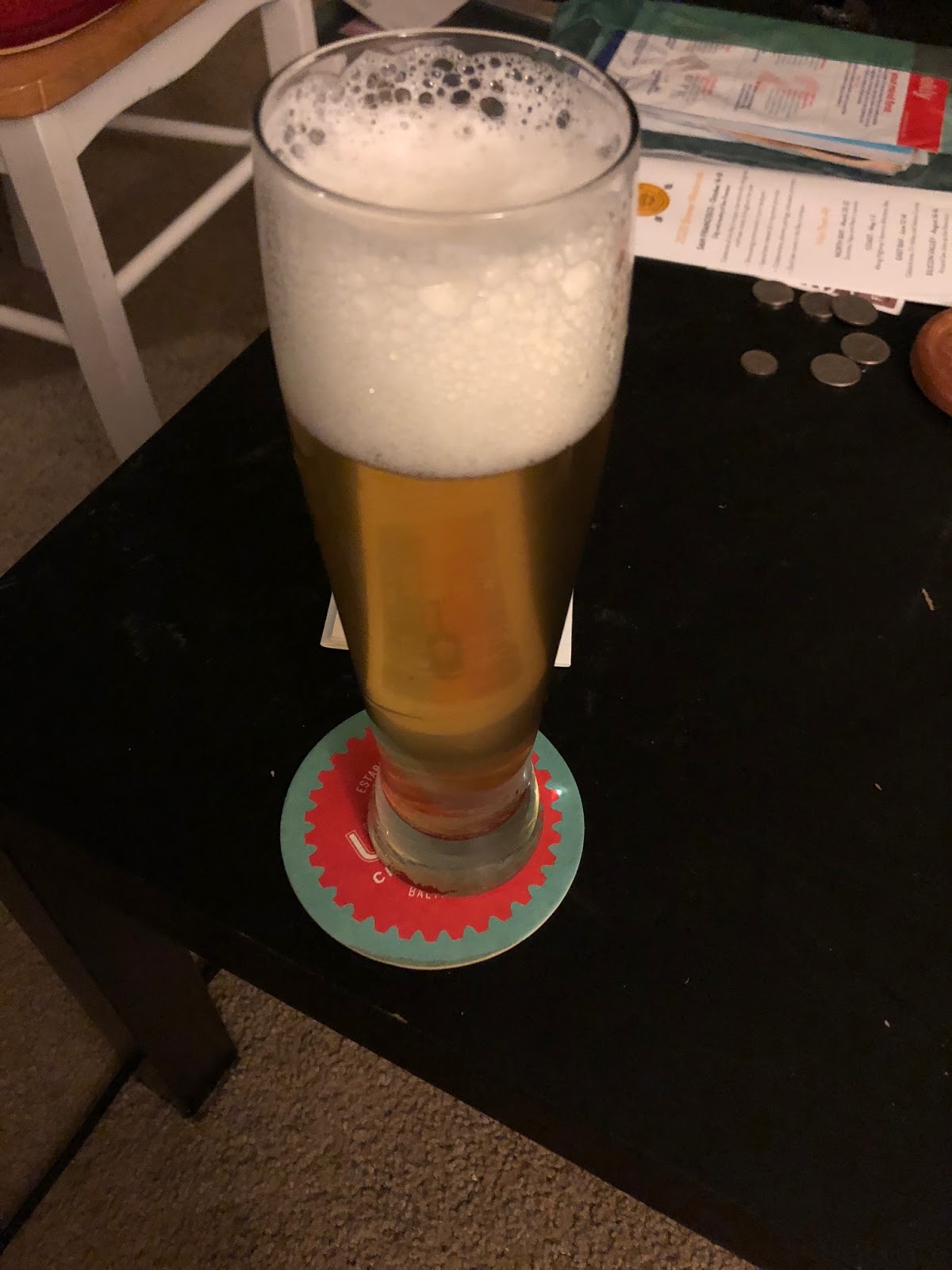
Appearance: Pours a nice light golden color, with a white medium sized head that fades somewhat quickly but leaves a small solid layer (the photo is about 5 minutes after pouring). Slightly hazy, not entirely surprising with a bottle conditioned beer and I may have not poured quite as cleanly as I could.

Aroma: The sweet, fruity, and phenolic notes that I associate with cherrywood smoke stand out but this is a fairly subtly smoked beer compared to many rauchbiers. Light grainy and honey malt sweetness from the malt and a very low note of sulfur from the yeast also appear. Not surprisingly the hops aren’t noticeable on the nose.

Taste: Sweet neutral malt leads the way followed by moderate smoky phenols and some fruitiness from the smoke. Finish is just lightly bitter with a lingering fairly light smoke character. Some would definitely find this very smoky but compared to other smoked beers it isn't very strong.

Mouthfeel: Medium low in body with medium carbonation, could maybe be a little more carbonated but I like it for this beer. The smoke phenols seem to linger and tingle the tongue and pull at the back of the throat a bit in the finish and aftertaste but I find it more refreshing than off-putting.

Overall: I’m extremely happy with this beer. The smoke is noticeable but not overpowering and I find it extremely drinkable and thirst quenching. I lost track of taking notes during this tasting as I kept just going back for more. The cherrywood smoked malt from Sugar Creek might be the least smoky smoked malt I’ve used but the character it does have is very enjoyable. This is the 4th time I’ve made some version of a smoked helles using cherrywood malt and it’s pretty clear why I keep coming back to that idea - it’s tasty. That said, less of the smoke character, a slightly thinner body, and a touch more carbonation would put this more in line with what I want out of a lightly smoked pale lager.

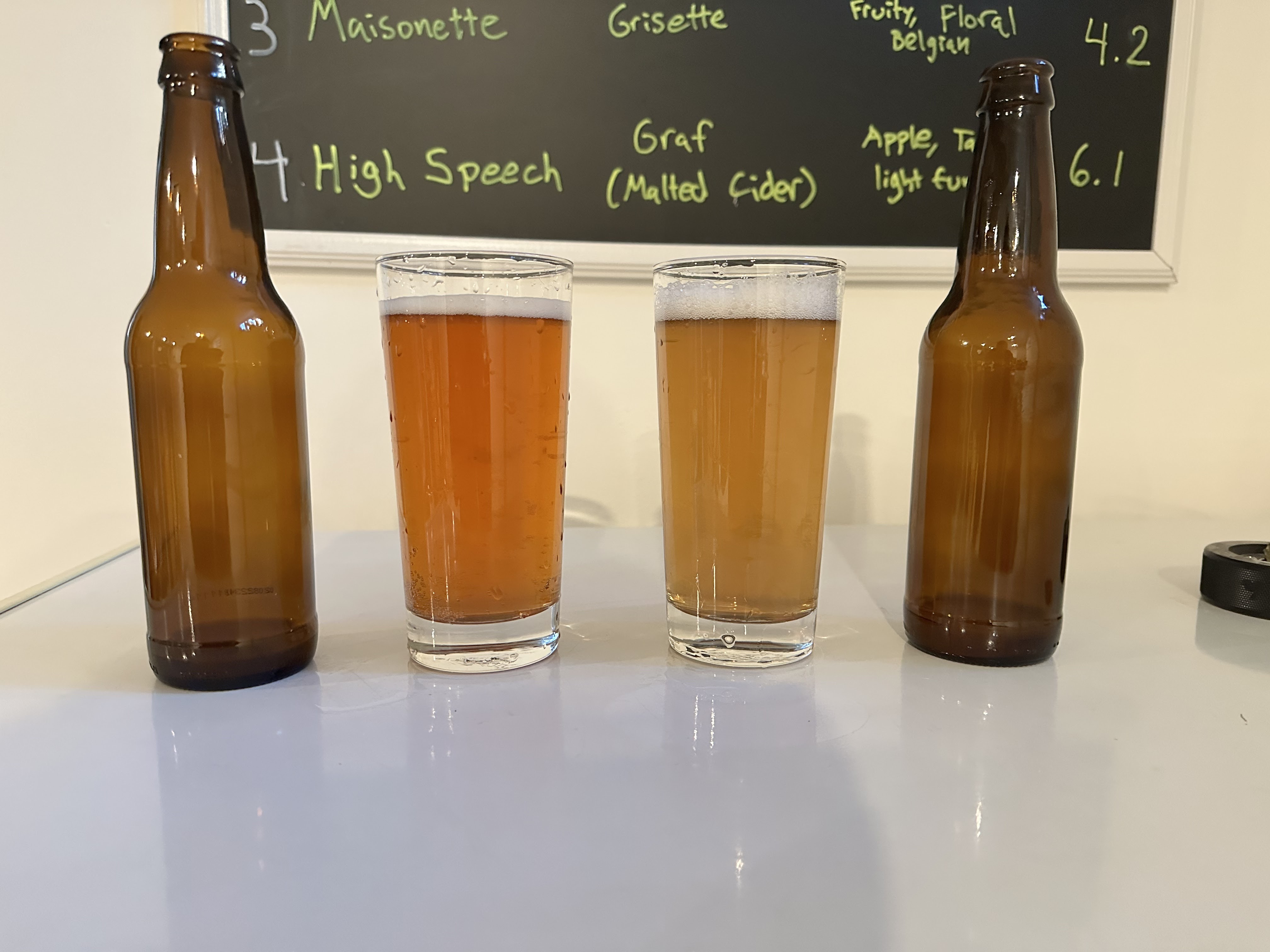
Fruited on the left, unfruited on the right

Cherry Fruited Version:

Appearance: Slightly orange/pink tint from the cherries. Head was very small and white and quickly faded to just a small ring. Haze is a touch higher than the unfruited version though that may have just been this pour.

Aroma: Light cherry is the dominant note. While the fruit isn’t strong the smoke is much subtler than in the unfruited version and I have to search hard for it. The light cherry aroma also seems to block the yeast and malt derived aromas as well, though I can just find some grainy sweetness when really trying. As it warms the fruity cherry aroma shows up more and more and phenolic smoke fades even further.

Taste: Moderate cherry flavor fills the mouth. Finish is lingering with just a touch of bitterness and phenolic character. While the cherry character isn’t strong it seems to dominate everything else and what does come through seems more like an off note to the cherry than smoke. The aftertaste has a strange tongue coating sensation that is likely the phenols but there still isn’t a smoky taste.

Mouthfeel: Similar medium level of body as the unfruited version but with a little less carbonation. This is probably due to using the same amount of priming sugar in this batch despite it being slightly larger. Higher carbonation would probably improve a few things, including the head and the ability for the smoke and fruit to pop more, but it’s not totally flat.

Overall: Not bad in any way and for a weird beer experiment that’s probably a win but this one doesn’t quite work. The fruit doesn’t so much compete with the smoke as the cherry flavor subdues any smoke into submission, making it seem more like a slightly strange cherry beer than a smoked beer with cherries. If I were to attempt this again I would likely use less cherries per gallon and/or a more prominent smoked malt. Using both more fruit (cherries or otherwise) and a much smokier malt (e.g. the stjordal style malt) might also be a fun experiment.

12/17/22 Brewday:

Ran into some issues milling as the battery on my drill overheated at one point, then the battery died after cooling down and had to be recharged. Dealing with this caused me to spill some grain and likely caused a slightly higher amount of the malt bill than usual to go uncrushed. Last pound or so of grains were milled and added once the battery had recharged, about 10 minutes after the initial mash in.

Treated 5 gallons water with a quarter campden tablet. Mashed in initially at 148F before adding boiling water about 5 minutes later to raise mash temp to 157F. Temp had fallen to 150F after an hour which is more of a drop than usual but I added some of the grain later, it’s cold out, and I stirred several times. First runnings gave 3.5 gallons wort with gravity measuring 1.051.

Batch sparged with 3 gallons campden treated water at ~120F giving 1.020 second runnings and a combined 6.5 gallons at 1.041

Wort had moderate smoke and barnyard aromas, not nearly as strong as when I made the 100% Stjordal smoked beer and with a very different character of barnyard, fruit, and breakfast cereal in addition to phenolic spicy smoke.

Ran into a few issues during the brewday, including the propane running out at some point during the boil when I wasn’t watching so I boiled for an additional 15 minutes after switching tanks.

After cooling to 60F the wort was transferred to a 6 gallon carboy and placed in a chest freezer set to 50F with the temperature gauge attached to the outside of the carboy. After 3 hours the temperature probe was reading 50F and I pitched a pack (12g) of Cellar Science "German" dry yeast which I have not used before but appears to be their version of W-34/70.

12/18/22: Increased temperature to 53 as there haven't been any real signs of fermentation after nearly 48 hours.

12/19/22: Still no real signs of fermentation more than 48 hours after pitching and I'm a little worried. The yeast packet recommended rehydrating, which I didn't do, and also recommends fermentation temperature of 54-62°F which is higher than it has been for most of the past few days. Gravity sample shows it is down to 1.040 which is down from the original gravity that was around 1.050. Increased chest freezer temperature to 55F to try and get it to really kick off fermentation. Taste of the gravity sample is good, fairly strong but not overly overpowering or phenolic in the smoke character but also with a lot of sweetness that needs to ferment out. Will be interesting to see how this one changes once fermentation really kicks in.

12/20/22: After a night at the slightly higher temperatures a nice layer of krausen and airlock activity show that this one is fermenting strongly now. Dropped the temperature by a degree to 54F, plan to slowly drop it further over the next week.

12/21/22: Dropped temperature to 52F. Still fermenting strongly.

12/22/22: Dropped temperature to 50F. Still showing strong signs of fermentation. Gravity reading at 1.028.

12/23/22: moved out of chest freezer to an area of the basement near a door where temperatures are measuring between the upper 50s and low 60s. Plan to leave for diacetyl rest/completion of primary fermentation before returning to the chest freezer for lagering.

12/29/22: 

Cherry version on the left, still transferring unfruited version on the right

Racked about half of the batch onto 3 lbs of Oregon Red Tart Cherry puree in a 3 gallon carboy and the remainder into a separate 3 gallon carboy. Plain version was placed in fridge at 32F to lager while the other version was left at room temperature to allow full fermentation of the fruit.

1/16/23

Racked unfruited version into bottling bucket with 1.8 oz table sugar boiled in 1/4 cup water. First time bottling in nearly a year and first time using a bottling bucket in as long as I could remember.

1/26/23

Followed the same bottling process as the unfruited for the fruited version. Tasting pretty nice with noticeable but not intense Cherry and drying phenolic smoke still coming through. Cracked open a bottle of the unfruited version - undercarbonated and still a touch sweet but very enjoyable with only moderate phenolics at this point. Will be interesting to taste both side by side once carbonated.

2/6/23: Brought a bottle of each to a bottle share where they were both pretty well received.

3/7/23: Tasting notes above.

4/2/23: The unfruited version of this beer received a 36 and placed first in the Wood and Smoke beer category at the DC Homebrewers Cherry Blossom Competition. I'm not entirely shocked to see this do well as a Smoked Helles in a BJCP competition, it was tasty, clean, and with a noticeable but not abrasive smoke character. One judge noted that more breadiness would help with the balance, and I think they have a good point and will likely use some Vienna malt in addition to less smoked malt the next time I make a smoked helles.

5/3/23: This beer didn't place in the Smoke, Historic & Wood Beer category of the BURP Spirit of Free Beer competition scoring a 20!? :The scoresheets don't really make sense, claiming a clorophenol(?) character that I don't get at all. While this beer is smokey for a smoked helles, and definitely has some smoke phenols, it is not an extremely smokey beer (like the Stjordalsol was) and I also don't get any of the faults the judges noted. It's tough when entering a beer in these types of styles because some people's taste thresholds are very different, as seen by the polar opposite scores this beer received in the two competitions. It's possible the beer is dropping off in quality after a few months but after having a bottle tonight I would still consider it very good.

10/27/23: had a bottle of the unfruited version for the first time in a while and it is still really drinkable. It has also gotten extremely clear at this point, by far the clearest bottle conditioned beer I’ve made. Really a nice beer that I may brew again at some point, even if I go closer to my regular smoked helles next time.

Friday, March 17, 2023

Radar Shadow - Amber Lager


After winning a silent auction for a year’s worth of Imperial yeast (only $60 for 12 packs) I was confronted with the dilemma of deciding which strains to use. Checking their list of available homebrew strains I saw they had a seasonal I wasn’t familiar with: Hygge. Hygge is a Danish word that reflects a lifestyle around coziness and comfort and unsurprisingly the strain is a Danish lager yeast (presumably from Carlsberg). The yeast’s description from Imperial is: “A northern European lager yeast famously used in Pilsner style beers that complement significant hop additions. Clean and crisp with a very light sulfur profile.” Having already made a number of pale lagers in the past year I didn’t really want to make another Pilsner but a significantly hopped lager with a little more malt character sounded nice.

This got me to thinking about my visit to the Carlsberg brewery and the red lager I had there: Tuborg Red. While I didn’t love the beer when I had it in May of 2016 the idea of a Danish red lager seemed intriguing and possible. Having a few pounds of characterful Vienna, Munich, and extra dark Munich on hand made me think that it might be nice to make a hoppy but also moderately malty red lager.

Trying to find information on Danish Red lagers as a starting reference point is almost impossible as every search seems to point to Figueroa Mountain’s Danish Red Lager, which is a Vienna Lager. Vienna Lager is probably in the realm of what I’m looking for but not exactly what I have in mind.

Looking for more examples of red/amber lagers to determine a good recipe led me to look at the BJCP defined “International Amber Lager” and “Czech Amber Lager” styles which are also in the ballpark of what I have in mind but flavored more with sweet/caramel tasting crystal malts instead of the toasty/malty Munich and Vienna character I’m desiring.

Searching further I discovered that in the 2021 version of the style guide kellerbier is listed as a historical style with new information I hadn’t previously seen or heard. This included that kellerbier originated from amber beers in Franconia, not the pale and hazy Helles and Pilsner versions I’m familiar with. Reading more about Franconian lagers I realized there are a wide range of styles and naming conventions in Franconia but that somewhere in this realm is probably close to the style I am looking for. I created a recipe for a red/amber that could sit somewhere between a Franconian Vollbier and Danish red lager (and maybe not that far off from a Vienna lager).

While picking up brewing supplies at Maryland Homebrew I discovered an expired pack of Jasper Yeast Franconian Lager and decided to pick it up to use for half the batch alongside the Hygge strain. While the planned brew day is more than a month after the yeast pack’s listed expiration date the high yeast count in Jasper Yeast packs, a large starter, and the fact that this is only being used for a small (~3 gallon) batch should mitigate any issues with underpitching.

Tasting Notes:

Aroma: Fairly strong aroma with malt dominating. Notes of bread crust and light chocolate cake, with subtle dark fruit and floral notes from the hops.

Appearance: Darker than intended, this one is probably a touch past deep amber and into lighter shades of brown. SRM is probably in the upper teens, quite a bit higher than the intended 14. It would probably look lighter if it was clearer but it has a noticeable, if fairly low, haze. Definitely could have used lagering after the re-fermentation. Head is small and off white but shows good retention and lacing.

Taste: Similar to the nose with moderate bready and sweet malt dominating. The floral and herbal hops are light but noticeable in the flavor and the finish is moderately bitter. Like the aroma there’s some subtle chocolate and dark fruit notes that show up more as it warms.

Mouthfeel: Medium bodied and with medium carbonation, this seems to be just right in both of these categories, allowing the malt to fill the mouth but also the hoppy bitterness to then wash away the sweetness.

Overall: I’ve thought a lot about this beer, both in designing and making it, cellaring and adjusting it, and tasting it over the past week. In the end the beer is much better than the diacetyl bomb it once was but I’m not sure it really works as an amber lager. I probably wanted this to be too many things, malty and sweet but also hoppy and refreshing, not too pale but not too dark in color, dry and quenchable but also full bodied. In some ways it does all of these but the end effect is somewhere between an overly sweet, dark, and malty Vienna lager and a slightly overhopped dunkel. While this fails to be the amber lager I hoped for, making a decently hoppy dunkel isn’t bad and I find myself happily drinking this beer, especially as an alternative to the other beers I have available. If I were to brew this again I would likely cut the amounts of dark Munich and midnight wheat by at least half, if not removing one or both entirely. I might also increase the hops, either with a late boil addition or a small dry hop. Doing these things should give more of an amber hue and give more of an even balance between the malt and hop flavors.

1/24/23: Created a 1.75 liter starter using 6 oz of dry malt extract. Added the Jasper Yeast Franconian lager pack and placed on stirplate.

1/26/23: Turned off the stirplate and put yeast starter in fridge to cold crash. It looks like I'm not the only one who thought of a red lager when hearing about Hygge as Basic Brewing released a podcast on developing amber lager recipes to use it in. This prompted me to do a little more searching for other recipes in this area and discovered that WLP850 Copenhagen Lager (seemingly White Labs version of this same strain) lists Amber Lager as a suggested style and Wyeast lists Amber Kellerbier as a recommendation for their Danish Lager strain. Maybe this is a good idea after all.

1/28/23: brewday

Mashed in with 3.5 gallons to hit 147F. After 25 minutes added 2 gallons nearly boiling water to reach 160F. After 35 minutes ran off first runnings and added .5 oz Perl’s hops. Added 3.5 more gallons of 180F sparge water to mash tun, then ran off second runnings and combined. Boiled for 75 minutes before adding immersion chiller, then another 5 before adding 1 oz Spalt Select and .5 oz Perle hops. 5 minutes later I added a tablet of Kick Carageenan then 5 minutes later cut the flame and started chilling. Chilled to just under 60F, transferred evenly to two separate 3 gallon carboys, pitched Imperial Hygge into one (“Dane”) and the decanted starter of Jasper Franconian into the other (“Frank”) and placed in chest freezer set to 50F. 

Both carboys looked very interesting with lots of what appeared to be protein, similar to a hot break or cold break. Hopefully this is just due to the carageenan tablet and the proteins settle out without any issues.

1/29/23: less than 24 hours after pitching both beers are showing signs of fermentation with decent sized krausens and airlock bubbling.

2/1/23: Fermentation seems to be slowing in both with the krausen starting to fall and very little airlock activity. I increased chest freezer temperature to 52F and plan to increase by a few more degrees over the next few days in order to cleanup any diacetyl.

2/2/23: Increased chest freezer temperature controller to 54F. Plan to leave at this temperature for at least a few days before doing a forced diacetyl test.

2/7/23: Increased temperature to 60F for a short diacetyl test, plan to decrease temperatures slowly after a few days. No diacetyl detected in sample but didn’t have time to do a forced diacetyl test and I need to get the chest freezer cold for serving beers on tap during the Super Bowl.

2/11/23: Lowered chest freezer temp 5F every 12 hours for the past few days to reach 45F for serving temp of kegerator.

2/12/23: Lowered to 30F for lagering. Planning on a quick lager before kegging if both are tasting ok.

2/17/23: Kegged each version separately. Dane version finished at 1.011 (77% attenuation) and is showing some diacetyl after kegging that I hadn’t noticed in a sample taken yesterday, will give it a little time to see if it’s enough of an issue for me to try to fix it or just enjoy it as is. Frank finished at 1.008 (83% attenuation) and doesn’t have any noticeable diacetyl at this point.

2/20/23: Both versions have strong diacetyl and were removed from the chest freezer to allow them to sit at room temperature for a second diacetyl rest. They will likely need extended time to clean up the diacetyl since there isn’t much yeast remaining in the kegs.

2/26/23: Still noticeable diacetyl in a sample, not terrible but not ideal. Added some of a mix of the two yeasts to both kegs along with a small sugar sample (~1 oz sugar to each keg). Hoping to kick the yeast back in to process the remaining diacetyl. Will probably rack remaining beer in both kegs into a single 5 gallon keg if the process works.

3/2/23: No noticeable diacetyl remaining in either, racked both into a single 5 gallon keg and set in chest freezer on pressure.

3/8/23: Tasting notes above. Discovered this useful information that might help explain why this beer looks darker than expected. https://www.brewingwithbriess.com/blog/predicting-beer-color-based-on-formulation/

4/16/23: this keg kicked. Pretty enjoyable beer and the flavors became more clean and cohesive and appearance had more clarity and slightly lighter color after the age. Would probably still reduce the hops or malts slightly if I rebrew but the most important thing seems to be patience.

Monday, January 30, 2023

Glass Mountain American Lager


American Lager

Recipe:

5 lbs Rahr 6-row
2 lbs flaked maize
2 lbs flacked rice
.5 oz hallertau mittelfruh (60 min)
.25 oz hallertau mittelfruh (15 min)
2 packs Diamond lager yeast (1 per 3 gallon carboy)
Came in just under expected OG at 1.044

Brew date: 12/10/22
Chilled to 60F, pitched yeast and moved to 50F chest freezer.

12/15: increased chest freezer temp to 55F to finish primary fermentation and move towards diacetyl rest

12/16: increased chest freezer temp setting to 65F for diacetyl rest

12/17: moved out of chest freezer into room in the mid to upper 60s to finish diacetyl rest

12/20: Gravity reading 1.006, lower than expected but not too low. Taste is pleasant and mild with some light corn and grain character but is also a little more fruity and flavorful than expected, possibly due to the diacetyl rest being too early/warm/long or the late hop addition coming through more than anticipated. Hopefully it cleans up and loses some of that character during the lagering period. No diacetyl detected so it was moved to the chest freezer currently set to 55F. I plan to lower temperatures further over the next few weeks once the other beer (a 100% cherrywood smoked lager) currently fermenting in there finishes primary fermentation.

12/23/22: began lowering temperatures by 5 degrees

12/25/22: lowered to 32F. Will stay at this temperature for a few days before kegging.

12/29/22: Racked both carboys into a single 5 gallon keg and harvested yeast. Keg was placed in chest freezer at 32F and 30 PSI to burst carbonate overnight. Flavor is still a bit fruitier than intended and has a touch of sulfur but not bad.

1/12/23: tasting notes

Appearance: pale and bubbly, maybe just a touch darker than I would expect for the style but that might have more to do with the clarity being less than crystal clear. If I brew this style in the future I’ll need to either add gelatin or use another means to clarify it. Head is big, fluffy, and white initially and quickly fades to a small layer that leaves nice lacing.

Smell: Smell isn’t very strong, especially when initially pouring in the low 30s. Some light sweet graininess that seems malty without much noticeable corn or rice character. There is a slight cider and pomme fruitiness with just a whisper of herbal character. Apple aroma increases significantly as it warms up giving more green apple (probably acetaldehyde).

Taste: Like the smell (and as expected) the flavors are subtle. Sweet and subtly grainy malt dominates with a slightly herbal and earthy character in the middle and a very light bitterness on the finish. Some light apple like fruitiness shows more as it warms, possibly acetaldehyde but possibly yeast derived ester fruitiness due to the diacetyl rest occurring earlier and warmer than it should have. The fruitiness increases as it warms but so do the grainy and herbal characters to keep it from overwhelming.

Mouthfeel: This may be the area this beer is most off from the style as it feels more full bodied and round than I would expect. The beer is fairly highly carbonated though I was having some foam issues initially and have lowered the CO2, but even with the high carbonation it feels surprisingly full and rounded on the palate. If I was to brew this again I would likely mash lower and use a different yeast.

Overall: I’m really enjoying this beer for what it is. In some ways it feels between an American Lager and a German Helles, perhaps due to the Hallertau hops and use of German yeast. The rice and corn (and 6-row) don’t stand out as obvious ingredients to my palette but I wonder if others would be able to tell it apart from a beer made entirely with Pilsner malt. If I were to try brewing this style again I would make a number of changes but this recipe delivered an enjoyable, if flawed, beer.

1/28/23: Keg kicked less than a month after packaging. It was pretty enjoyable and easy drinking and with a few parties at the house this one went very quickly. Not a style I'm dying to brew again but something I'll probably come back to in the future and aim to brew more to style.

Saturday, October 22, 2022

Doppelbock '22


Doppelbock has been my go to autumn beer for the past few years. The first iteration of the beer scored a medal at the California State Homebrew Competition. While I usually like to change things up I was very happy with how that beer turned out and have been trying to recreate it in the years since. Last year's version was enjoyable but seemed to be missing something in the maltiness category so I went out of my way to source the Briess Dark Munich (30L) that I had used in the original version and also increased the amount of Caramunich to a full pound. I otherwise kept the recipe largely the same with equal amounts of Pilsner, Vienna, and Munich malts and the pale chocolate malt that may not be traditional but seems to give a nice note of chocolate without being too roasty.

Tasting notes:

Smell: Big malt character pops out with milk chocolate and dark fruit (plum and raisin). The roast and fruit characters are probably a little higher than desired and mostly over power the more subtle bread and crust character from the Munich and Vienna malts. A touch of alcohol comes through as it warms. No hop or yeast derived aromas.

Appearance: Dark brown with nice garnet tints, especially in the light. Fairly clear but has a touch of haze that makes it seem darker. Head is small and off white and quickly fades to a ring of small bubbles.

Taste: Up front there’s a big sweet bread crust-like malt character but this quickly shifts toward a more roasty chocolate and burnt sugar character. Finish had notes of dried fruit and moderate bitterness that blends with the roast character to give a bittersweet chocolate impression. No hop character other than the bitterness.

Mouthfeel: Moderately carbonated and fairly full bodied. Alcohol is not hot but does give a warming sensation over time.

Overall: While not an overly bad beer this is probably the worst of the doppelbocks I’ve made. The roast character seems stronger than in past batches and overshadows the other characters of the beer. While this one seemed to have some rough, near metallic, off flavors when first kegged the additional time at cool temperatures and carbonation seem to have rounded them out. While I was excited to get the 30L dark Munich malt I think it was overwhelmed by using so much Caramunich, especially with the pale chocolate malt also in the mix and I will probably only use a quarter pound of each of those in my next attempt at this style. The failure to set my mill correctly and try to correct it by adding malt extract was also a mistake as it meant there was less of the Munich malt character in the end product to balance the roast and caramelized flavors.

8/19/22
Made a starter from a mason jar of yeast previously used on a Helles and a Pilsner. First time using this 2L Erlenmeyer flask and first time using a stir plate in a long time but both seem to work well. The starter should have been created a few days earlier for maximum viability but this should provide some increase to the amount of yeast available and provide vitality to the yeast already in the mix.

8/20/22
Brewday

Forgot to adjust my mill setting until half way through milling which led to undercrushing and low efficiency. I also added too much sparge water and ended up with ~7.5 gallons pre-boil. Between both of these I ended up with a pre-boil gravity ~1.040 which is no where near what was expected. In order to resolve these issues I did a 2 hour boil and added a pound of dry malt extract. Despite both of these adjustments the post-boil gravity was still only 1.066, a ways short of the planned 1.072 and more in the middle of the Dunkles Bock range than the low end of the the Doppelbock range as intended.

Hops were split between a first wort addition that was boiled the full 2 hours and a later addition that was boiled for only 45 minutes.

After cooling to 80F the wort was transferred to a plastic carboy and placed in the chest freezer at 50F. 

8/21/22
Approximately 18 hours after putting the wort in the chest freezer I shook the carboy to oxygenate and pitched the yeast starter from the stir plate.

8/22/22
Almost 24 hours since pitching it isn't show any real signs of fermentation so I increased the temperature slightly to 52F.

8/23/22
Fermenting strongly.

8/24/22
Fermentation seems to be slowing slightly so I increased the chest freezer temperature to 62 for a diacetyl rest.

8/26/22
Still fermenting, increasing the temperature seems to have kicked it back up a bit. Hopefully this will be able to get rid of any diacetyl without producing esters.

8/29/22
No signs of fermentation at this point. Began cooling off by lowering to 55F. Will continue decreasing temps for a few days until it gets down to lagering range.

9/28/22
I got a terrible sinus infection that hit me hard for nearly a month and took very poor notes during this time. The beer was eventually lagered, then kegged only to have my CO2 tank kick. 2 CO2 tanks later (I setup another one while still sick only to find out later a different keg was leaking) it is finally carbonated and starting to taste close to expectations.

9/29/22
Tasting above.

12/29/22: This batch kicked after adding a 1/2 gallon to a growler and drinking/dumping the remaining ~1/2 gallon. This one got pretty mixed reviews, no real complaints (other than one person saying it was watery(?) and it received a few strong compliments but very few people went back for a second pour and I rarely found myself choosing to reach for it during the 3+ months it spent on tap. I’m interested in rebrewing this with less character malts and a greater eye toward yeast health and fermenting temperatures but that likely won’t be any time soon.

Monday, August 1, 2022

Summer Pils '22


Fairly clear after a few weeks on tap.
A Goldings hop plant can be seen
growing on the line behind the glass.

I've brewed a few takes on Pilsner over the years. With pale lagers dominating the worldwide beer market it's surprising how few of them are as good as the classic Pilsner Urquell. For this beer I am going very classic in using almost entirely pilsner malt split between two European maltsters with Sekado Czech Pilsner malt and Weyermann Bohemian Pilsner Malt and just a small amount of Carafoam to hopefully keep up the body and provide plenty of head, given the moderately low expected OG and FG (although it may not do this as well as advertised). As I've done with some other beers recently I planned to split this between two 3 gallon carboys, each with a different yeast (Whitelabs Czech Budejovice and re-pitched Wyeast Munich Lager). This approach was intended to give me the option to either blend the two at packaging, or package each separately to be able to determine my preferences of each strain separately. Unfortunately, neither yeast seemed to want to take off and I had to combine both onto a yeast cake used for a smoked Helles.

Tasting Notes:

Smell: Sweet grainy and honey-like malt with some herbal, vegetal, and slightly funky hop notes. Fairly mild. No diacetyl or DMS that I can detect.

Appearance: Light gold with a small fluffy white head that doesn’t have much retention but does leave nice lacing. Fairly clear but not crystal. When first on tap it was fairly hazy but time and low temperatures seem to have almost entirely cleared up the appearance.

Taste: leads with a honey and sweet malt flavor that transitions to a slightly herbal and spicy hop character that eventually finishes in a slightly vegetal and medium-low bitterness.

Mouthfeel: moderately low body and fairly low carbonation. This one was more carbonated but some issues with the kegerator led to temperature and pressure swings that it still hasn’t fully recovered from. Not flat but could use more bubbles, especially for this style.

Overall: a pretty nice easy drinking beer with a small amount more flavor than your average American lager. A few friends consistently chose this over the 3 other beers I had on tap a few days ago and I enjoy it quite a bit too. Not quite what I want in a “Czech Premium Pale Lager” in that it could probably be a touch bigger, a touch cleaner in the finish, a touch more carbonated, and a touch more bitter, but it’s an easy enough drinker that should help cool me down after mowing the lawn over the next few months.

6/12/22
Brewday. Getting a later start than originally planned after cancelling plans to brew then un-cancelling and moving forward with the process. Forecast had called for rain most of the day when I checked this morning but after a short shower it looks like it may have cleared up so I decided to brew. Measured and milled out 4 pounds of the Sekado malt, 5 pounds of Weyermann Bohemian, and 1 pound of Carafoam. First time hearing of the maltster Sekado so it will be interesting if it gives a different character to the Weyermann Bohemian that I am familiar with, though there's a good chance I wouldn't be able to tell without beers made with each being side by side. Out of the bag the Sekado is a touch toastier and drier/harder but otherwise has a similar slightly crackery but otherwise clean and plain-grain flavor that I expect from pils.

Mashed at 152F for 1 hour (had fallen to 150F by end). Ran off first runnings then batch sparged at 160F. Runoff smells lightly sweet, with grainy, honey, and slightly hay like notes which seems pretty good for a pils. Only ended up with 6.25 gallons after runoff but decided to not add a quarter gallon of water since it was also only reading 1.041 pre-boil OG giving ~1.046 estimated post-boil to 5.5 gallons which is less than intended.

I weighed out the hops based on my calculations before realizing that I had underestimated the alpha acid percent of this particular pack of Saaz (4.0% actual vs 3.3% predicted). Rather than use less hops I decided to move the first and second additions further back in the boil, possibly giving more flavor/aroma in addition to bringing bitterness down to the target amount.

After the 60 minute boil I cooled to 80F (outdoor ambient temp) and racked to two 3 gallon carboys. Ended up with only 5 gallons of wort at 1.053 OG. While this would have left the beer gravity/ABV/IBUs in the range of the style guidelines I had hoped for this to be on the lower end of alcohol and bitterness so I boiled, chilled, and added another quart of water to each carboy to bring the gravity down to 1.048 and hopefully keep the beer from being too bitter. Carboys were added to chest freezer set to 40F to chill down. After 2 hours the outside of the carboys was still reading over 65F so I decided to wait overnight for them to chill further.

6/13/22
Increased chest freezer temperature setting to 50F and pitched yeast.

6/15/22
After nearly 48 hours at 50F there's no signs of fermentation. Lager yeast are generally slower to kick off and show less activity, especially at this low of a temp with the wort having been around 40F when pitching, but I would have expected some bubbles in the airlock by now. I may have underpitched given the age of the yeasts and lack of a starter, but thought I would be able to get away with it since the beer wasn't particularly high in gravity and each pitch was only going to half a batch. Increased chest freezer temp to 55F to hopefully allow it to kick off. If there aren't signs of life tomorrow I might need to take more steps.

6/16/22
Very minimal signs of fermentation today with a few bubbles sitting on top and the very occasional bubble out of the airlock. Temp on outside of carboy is still reading 51F so it has retained the lower temperatures despite increasing the temperature controllers set point. My basement is in the low 60s and could have been even cooler over night so maybe it shouldn't be too surprising that the chest freezer and gallons of wort didn't warm up too much. I pulled the carboys out of the fridge to allow them to warm some. If no signs of life in the next few hours I will purchase additional yeast today to add to them. I usually try to have a pack of dry lager yeast on hand for these types of situations but used my last one on the smoked helles.

6/17/22
I didn't make it to the homebrew store to grab more yeast and the beer is still showing nearly no signs of fermentation so both carboys were combined in a 6 gallon carboy that previously held the Smoked Helles. In hindsight I should have washed the yeast cake and cleaned the carboy first to minimize the amount of smoke that carries over but with it having been a lightly smoked beer I am hoping it doesn't fully ruin the pils. Even if the smoke doesn't come through this beer could have some issues due to the time spent sitting and oxygen intake from racking it to a carboy at this point. The carboy was placed back in the chest freezer and temperature lowered back to 50F. A few hours later and it is now showing an active fermentation with a decent krausen.

6/22/22
Removed from chest freezer to allow to rise to room temp (currently 66F) for a diacetyl rest.

6/24/22
Pulled a sample to check diacetyl progress. Flavor and aroma are a bit strange: cracker and bitterness as expected but also earthy, fruity, and slightly funky notes. No diacetyl flavor (butter) but there is a bit of an unexpected thickness to it that could be from diacetyl and at 1.010 it shouldn't feel as thick as it does. It hasn't been lagered yet and is currently looking hazy so maybe there is just some yeast or other particulate in the sample that will settle out and clean up. Despite the lack of diacetyl flavor I'm going to give it another day at the warmer temps before lagering in hopes that the thick/slick sensation fades. This beer doesn't seem entirely ruined but doesn't seem like it's going to be a good pilsner.

6/27/22
Forgot to put this one back in the chest freezer for lagering until today. Plan to leave it in there set to 32F for the next few weeks. Likely kegging around the weekend of 7/16.

7/16/22
Kegged and placed in keezer at 12PSI and 42F. Saved yeast in two unmarked mason jars and set in refrigerator. Taste at kegging is less strange than when last tasted but still seems to have a slight weird graininess and doesn’t feel as cohesive as expected for a pils. It's possible this is due to the Sekado malt that I'm unfamiliar with, the extended time before fermentation kicked off causing oxidation or other effects, the use of yeast from a beer with smoke causing some of that flavor to transfer over, or something else entirely. The flavor is a bit hard to describe or pin down (especially given the moderate hop flavor and bitterness that are also present) and it isn't entirely off-putting but seems out of place in this style. Hopefully a little carbonation and some more time can improve the beer further but at least it seems to be drinkable at this point.

7/29/22
Tasting notes given above. This one has turned the corner and gotten a good response from most people who have tried it but suffered from undercarbonation at the one homebrew club meeting I brought it to a few days before the tasting. I'm pretty happy with it but would say it isn't quite as good as most of the other pilsners I've made.

Monday, July 18, 2022

Smoked Helles '22


Smoked Helles has become my go to spring beer since first brewing a split batch that included it several years ago. This year I got a later start on it than usual but still wanted to get one going to have it on tap for the summer. Something about the low levels of bitterness, moderate crackery and bready malt, and a noticeable sweet smoke character from cherrywood smoked malt makes this one a refreshing drinker in the warm weather. It will be interesting to see how the Sugar Creek smoked malt compares to the Briess that I've used in previous versions.


Simple smoked helles:

75% (7.5 lbs) Pilsner malt (Weyermann)

10% (1 lb) Cherrywood Smoked Malt (Sugar Creek)

10% (1 lb) CaraHell (Weyermann)

5% (.5 lbs) Vienna Malt (Weyermann)

Tasting Notes:

Smell: light sweet caramel and honey like malts up front. The smoke comes through more as I drink but is fairly restrained and enjoyable giving notes of fruity sweetness and a touch of pork barbecue. No noticeable yeast or hop derived aromas.

Appearance: bright gold with a large fluffy white head. Probably a little too much carbonation making the head larger than intended but it works. The head fades fairly quickly to a thin layer but that thin layer then lasts throughout. Clarity isn't crystal clear but very good given that there were no filtrations or finings used.

Taste: leads with a lightly sweet and grainy malt character giving cracker, bread, and breakfast cereal notes that then wash slowly into a mild sweet and very lightly smokey flavor that lasts through a light but refreshing bitterness.

Mouthfeel: dry and crisp. Carbonation is maybe just a touch high but this drinks very well. Body is just the right level to let the flavors hit the entire mouth before fading away.

Overall: a very enjoyable and refreshing beer that I could happily drink multiple half liters of. The smoke is fairly low but I go back and forth on whether I would like it to be higher. Any less and it should be left out entirely but any higher and it might dominate some of the subtler character that makes the beer so enjoyable and refreshing. Even with how much I like to tweak my brews I could definitely see making this exact same recipe again with no changes. This one is probably in the top 10 beers I’ve brewed but probably wouldn’t make my top 5.

5/11/22
Planned out a vacation day to recover from the previous night's awesome The Menzingers show and brew a beer.

Mill had a couple rusty spots. Attempted to clean but couldn’t fully get them off, hopefully it doesn’t come off/carry through in the beer.

Mash started at 154 but fell to 148 by end. Mashed out with 1 gallon at 180F, ran off then batch sparged with water at 180F to reach 6.5 gallons.

Surprisingly little smoke smell during runoff. Maybe I should have upped the amount of smoked malt but at least I have 9 more pounds left to work with.

Brought to boil and added 1 oz Hallertau Mittelfruh hops and boiled for 60 minutes with an addition of Irish moss at 10 minutes. Chilled with immersion chiller to below 80F, transferred to 6 gallon plastic carboy and placed in kegerator at 45F.

After 7 hours pitched one jar of Munich lager yeast previously used for Maibock.

12 hours after pitching (19 after brewing) increased chest freezer temp to 50F. Added 1 pack of Lallemand Diamond Lager Yeast 8 hours later.

5/13/22
After 48 hours still not seeing any signs of active fermentation so increasing chest freezer temp to 55F

5/22/22
Still slowly fermenting with a decent krausen, increased chest freezer temp to 60F

5/27/22
Fermentation looks complete with just a few yeast rafts on top. Began slowly cooling.

6/12/22
After about 2 weeks at 30F the beer is still looking similar with some small yeast rafts but seems to be clearing up and looks ready for packaging soon. Gravity measurement shows it down to 1.011. Taste is fairly clean but a touch lighter on the smoke than I would like and maybe a little thinner/more watery, but both might improve with carbonation and warmer serving temperature. Will likely keg sometime in the next week.

6/17/22
Transferred to keg and set in chest freezer at 50F.

6/19/22
Poured a small sample tasting. Surprisingly clean, the smoke just barely shows up in the nose when I search for it, otherwise taste and smell is mostly clean with light herbal and honey character. I would probably use at least twice this much smoked malt, possibly more, if making this recipe with the same ingredients again. Not bad but closer to a plain helles than a smoked anything.

7/15/22
Tasting day with notes above. After about a month in the keg this one is quite nice. Interested to see what 9 pounds of the smoked malt does on its own given how subtle it is at 10% of a batch. It seems to be a bit more subtle than other cherrywood smoked malts I've used but has a very nice character to it.

Tuesday, April 12, 2022

Das Hund Maibock


I brewed this beer in January 2022 on my Dad's brewing setup. The recipe is posted here, tasting notes and cellaring notes from late in the process are below. A pretty simple recipe overall with ~60% pils and 40% vienna malt, a decent bittering charge of Magnum plus some small Hallertau Mittelfrüh additions late in the boil, fermented with a classic Munich lager yeast.

I can't seem to find any of the notes or photos from the brewday and have just one photo showing a temp reading a couple weeks later so I've included what process and tasting notes I do have below

Tasting Notes:
Appearance: Bright gold in color, certainly darker than the average Helles but not to the amber of a Vienna lager. Not as clear as I would like for the style but not a "hazy" beer by any means. Large white fluffy head fades slowly and looks very appealing. Overall it is maybe more of a "keller" Maibock than a traditional one but looks appetizing none the less.

Smell: Lightly earthy/grassy/leafy hop and malt character quickly gives way to sweet/cookie/caramel aromas. There's a touch of cider-like/apple fruitiness that may just be a combination of the hops and malt or may be yeast derived.

Taste: Starts off with a smooth enjoyable grainy/pilsner malt sweet malt character before transitioning to a much heavier caramel, cider, and vegetal finish which lingers with caramel/cookie/vanilla and some earthy hop character.

Mouthfeel: The booziness is only slightly apparent with a thinness that underlies the otherwise relatively sweet and thick body. Carbonation is moderate but seems about right for the style. The lingering sweet finish seems to be more due to the flavors than any astringency or specific mouthfeel character.

Overall: For a first attempt at the style I'm not unhappy but I don't think this would be considered a very good Maibock. The caramel and cider characters are much too high though I'm not entirely sure where they're coming from as the fermentation was kept cool for at least a decent amount of time during the early fermentation of the beer (though an unexpected hot streak in early February may have played a part?) and the malt bill doesn't contain any caramel malt. It's possible there was some caramelization due to the high burner heat and extended boil time and the fermentation was done in a cold basement, not controlled temperature conditions, which could have fluctuated more than expected and allowed some of the fruity/apple characters to come out of the yeast. Overall the beer is perfectly drinkable, maybe even too much so given the ABV, but it's not exactly what I was going for. I'm not sure I will re-brew this style any time soon as I find a lower ABV pale lager is often what people want and a more robust and characterful doppelbock is often what I want. If I do make another Maibock I'll increase the late hop additions to balance the malt sweetness and look to control the fermentation temperature better.

Kegged on 3/2/22 and Munich Lager yeast saved in mason jars for future use. Tastes a lot like my helles recipe which I guess makes sense given it's a helles bock, but it’s thinner and less malty than I had expected. Will see how it changes with carbonation.

3/12/22
Set in chest freezer at 32F.

3/26/22
Connected CO2 at 10PSI

3/27/22
Increased pressure to 15PSI and temperature to 45F. Poured a sample. Tasting stronger/boozier and thinner than expected. Hopefully some more time and more pressure will help round it out but doubt it will change too much.

4/2/22
Probably the most popular of the 4 styles I have on tap for my housewarming. Multiple people just described it as an enjoyable German lager though some pointed out some of the sweetness and "vanilla wafer" type qualities. To my taste it is more on the sweet and caramel-y side than I would like but no major off flavors, will need to do a deeper tasting soon.

4/10/22
Tasting date (tasting notes above).

Sunday, March 29, 2020

Munich Melon Hülles Lager

Nelson Version
I took a bit of a break from brewing (and even more of a break from blogging) but got back to it in January with a hoppy lager that is partially inspired by a line from Scott Janish's great book The New IPA. Specifically there's a note that Hüll Melon (sometimes written Huell Melon) is high in the 2MIB (2-methylbutyl isobutyrate) thiol which gives an apricot-like character, and can be enhanced even more with a lager fermentation. Some of these ideas are explored in this blog post by Scott. A fruity, (especialy apricot-y and melon-y) Munich Helles might not be classic but the subtle malt sweetness and graininess should lend balance and space for the hops to shine, without this coming out as a hazy IPA (or IPL). Searching around the internet it seems that a Helles with Hüll Melon has been done before by several breweries, including one of my favorite East Bay brewers, Original Pattern, with their Hella Hüll Helles Lager. I'll have to track down a can to compare with my version.


1/20/2020 Brew Day
Made a vitality starter of 8 oz DME, 1g Fermaid-k, 1800 mL water, 2 moderately old packs of Wyeast 2308 Munich Lager and a blend of lager yeast saved from my SMaSH Pils.

After several recent batches came out with a strange, harsh character I decided to not treat the water for this batch at all. While I'm not sure water chemicals are the cause of my recent issues I've narrowed it down to a few possible factors and this seemed like the easiest one to test. If this batch experiences the same issues I'll try adjusting my mill settings and do a full inspection of my equipment and review of my processes to see if there's another possible culprit. I'm including extra notes on this batch here to be able to pinpoint the cause of the issue if it happens as well too

Measured and milled 7.25 pounds Weyermann Pilsner malt and 9 oz Briess Goldpils Vienna. I planned to use Carahell but forgot I was out, should come out a little crisper and maltier with the Vienna but with a similar color.

Hit 152 on the direct infusion (a few degrees cooler than expected but close enough). Added half an ounce of hops to the first wort and began heating while batch sparging. Hit a combined pre-boil gravity of 1.039, about what was expected for the target 1.047 OG. Boiled for 1 hour then rapidly cooled with immersion chiller (added 45 minutes into boil) to 160. Added the 1.5 ounces of whirlpool hops then continued chilling for about 15 minutes to 68F (room temp). Ran off to plastic carboy through silicon tubing and moved carboy to chest freezer set to 50F. Pitched yeast a few hours later.

1/24/2020
Fermentation still going moderately with a medium sized krausen. Plan to move out of chest freezer to ~65F room temp for a few days once fermentation begins to drop. Smell from fermentation is strong with sulfur stink, hopefully that's being pushed out and won't carry to the final beer.

1/25/2020
Left in chest freezer but adjusted temperature up to 65F. Will likely take a few days to warm that high.

1/31/2020
No noticeable diacetyl on tasting and gravity down to 1.014. Set chest freezer to 32F for quick lagering.

2/6/2020
Split between 2 separate 2.5 gallon kegs, one plain one with an ounce of Nelson Sauvin hops.


2/19/2020
Plain Version
This one has been on tap for a couple of weeks and is a pretty enjoyable helles at this point. While there was a decent amount of fruitiness from the hops in the non-dry hopped version originally that has largely faded into a bready malt forward easy drinking lager. The dry hopped version was terrific early on, then seemed to experience some hop creep and had diacetyl, it was removed from the chest freezer for a few days and seemed to clear up but the hop character mostly faded as well.

3/28/20
Nelson half kicked, it was a really nice easy drinker with just enough fruity hop character to keep it interesting. The un-dryhopped version is much more straight forward, it's extremely easy to drink but is arguably too clean and many craft beer lovers would probably find it boring.

Tuesday, July 16, 2019

SMaSH Pils

As I previously alluded to in my Grande Maison saison post, the SFHG's second competition of the year will be a single-malt and single-hop (aka SMaSH) competition for club members. While I'm liking the way the Grande Maison mosaic saison turned out I always intended to brew a different beer for the competition and this is it. Crystal Light is my latest take on the Pilsner style using just 10 pounds of Viking Pilsner malt, 5 ounces of Crystal hops, and the same German lager yeast that I previously used in my Doppelbock (and have since used in a Helles).


Crystal hops are not the most popular choice these days but have a rich history since being first bred in 1983 and are somewhat common both as a supporting aspect in hoppy American styles, including Sierra Nevada's Torpedo, and as a main component in subtler styles due to it's German heritage. After receiving a half pound from Hops Direct at HomebrewCon 2018 I had been unsure how to best utilize them since I've never used it or had a beer solely hopped with it. In the end I decided to continue my effort to help clean out hops from the freezer and give them a try with a generous amount in a pilsner-ish beer.

The beer was intended to be mostly like a German Pilsner, but came out a bit more full bodied and closer to a Czech Pils, but with a different hop character. This was a really enjoyable beer to have on hand with some mild lemon character rounding out the mild herbal hop flavors and crackery malt character I expect from a pilsner. A touch of diacetyl but definitely within acceptable levels. A nice beer that I would probably tweak by using more hops or additional malts in the future.

3/26/19
Measured out 8.25 gallons of water, added 1/2 campden tablet and 5 mL 88% lactic acid. Measured and milled 10 pounds Viking Pilsner malt.

3/27/19
I accidentally broke the glass holding the first hop addition right after adding them to the boil. While I think there's less than a 1% chance that any glass got into the beer (and even lower chance that it would cause any issues if it did) I decided it wasn't worth the risk and dumped the batch. Thoroughly cleaned all the equipment and repeated the steps from previous day. On the plus side the only lost ingredients were 10 pounds of cheap malt and 2 ounces of free hops.

3/28/19
Used plastic cups for the hops this time and didn't run into any issues.

3/31/19
Fermentation appears to be going slowly but consistently.

4/4/19
Pulled out of chest freezer and kept at room temp in the low 60s.

4/7/19
Krausen has fully fallen and no signs of ongoing fermentation. Moved back to chest freezer at 50F.

4/8/19
Lowered chest freezer temperature to 45F and added gelatin following the Brulosophy method.

4/9/19
Lowered chest freezer temperature to 40F

4/10/19
Lowered chest freezer temperature to 35F

4/13/19
Kegged and place in chest freezer back to 40F. Taste is just ok, not as clean and crisp as I would like but no noticeable off flavors.

6/10/19
Entered in the SFHG SMASH competition last week, didn't place but was pretty well received. I ended up kicking the rest of the keg the next day.

Thursday, February 28, 2019

Tranquility Base Bock

When I think of the great lagers I've enjoyed my mind goes to a few locations: Festbier in a tent at Oktoberfest in Munich, unfiltered Pilsner on the anniversary of Pilsner Urquell in a bar in Prague, and Doppelbock in a big field in the Virginia Mountains. The last one might not be as iconic but let me explain...

My version in a glass stein
Nestled in the Blue Ridge Mountains in Virginia is a surprising wealth of breweries: Hardywood, Champion, South Street, Random Row, Pro Re Nata, Starr Hill, and Three Notch'd can all be found in Charlottesville or nearby Crozet. During the two years my wife was attending grad school at the University of Virginia I visited almost all of these breweries and had plenty of beers from all of them, more often than not appreciating the diversity and quality of offerings. It was a little surprising to see how strong the beer scene could be in this area when the place I lived at the time, the larger and more densely populated Arlington, Virginia, only had a couple of brewpubs that turned out mediocre fare and often shut down shortly after opening.

Not far away from the Charlottesville area, just south of Shenandoah National Park, and near plenty of hiking and outdoor activity areas, is Route 151. Taking this road south takes you straight to countless drinking destinations: Blue Mountain Brewery, Wild Wolf Brewing Company, Silverback Distillery, Bold Rock Hard Cider, Blue Toad Hard Cider, Veritas Vineyard, Flying Fox Vineyard, and Cardinal Winery just to name a few. While I had made the trip this direction a few times for different reasons, in February of 2017 I made it further south on the road, nearly an hour from Charlottesville, where, for the first time, I visited one of the best known breweries in the area: Devils Backbone's Basecamp Brewpub.

Devils Backbone is a brewery that is both loved and hated in Virginia and further abroad due to their great lagers (Vienna Lager is their flagship beer and a great example of the style) and their 2016 sellout to AB-InBev. One of the many Craft breweries to be bought out by what used to be Anheuser-Busch, Devils Backbone may be known as much for their vast marketing and availability as the quality of their products.

This is the pint that I fell in love with
While their sale to AB-InBev, and subsequent tactics by their owners to market and distribute their beers at the expense of Craft offerings, rubbed me the wrong way, I still believe they are the best producers of lagers on the East Coast and would happily drink a Schwarzbier or Baltic Porter from them any day of the week. So, with minimal reluctance, I found myself at the brewpub deciding what to order and the decision ended up being easy. While they had all sorts of terribly gimmicky beers (ginger Bock and fruited Hefeweisse to name just a few) the Basecamp Bound Bock seemed like an easy choice. And oh was it the right one.

Rushing into my mouth were waves of chocolate, deep rich melanoidin laden malt, full creamy mouthfeel, but also nuanced light fruit, fresh grain, and subtle spice, all ending in a crisp, dry, refreshing, and obviously lagered finish. I'm not ashamed to admit I drank a couple more while playing Kubb on their spacious lawn (fortunately I wasn't the one driving).
This is the long way of saying: I discovered how great Bock could be not from my travels to Europe but from an AB-InBev product in the middle of Virginia, go figure. I subsequently found out that this beer was actually the bigger brother style of Doppelbock and was even more impressed with the drinkability. The beer weighed in at a fairly hefty 7.6% ABV (it's a good thing I wasn't driving!). While Devils Backbone's site didn't provide much information (this link used to go to details on this beer but no longer does...) about the beer I knew that one day I would have to try to recreate it.

This brings me to June 2018, on the other side of the country, where I set out to brew a beer that rides the line between Bock (or by the 2015 BJCP definitions a Dunkles Bock) and Doppelbock, with a particular emphasis on noticeable, but not overwhelming, chocolatey character without coming off roasty or finishing sweet. Essentially I wanted this to be a bock/doppelbock that had the harmonious blend of complexity and simplicity only a malty lager can show.

Less dark in this smaller pour than other images
While I wouldn't call my Tranquility Base Bock a clone of the Devils Backbone beer (I doubt their version used Pale Chocolate Malt or some of the other less orthodox ingredients), and while it also didn't turn out perfect, I think I nailed my goal of a super drinkable, surprisingly strong, plenty malty, ever so noticeably chocolatey, refreshing lager.

I was not as rigorous with brewing notes on this beer as most batches but here is what I remember/jotted down:
Brewed on the stove top. Cooled down to 50F overnight then pitched almost expired packs of Mangrove Jack's Bavarian Lager and Fermentis Saflager W-34/70. Raised temp control and fermented at 55F for 5 days before being allowed to rise up to 68F for another 5. Tasting at that point showed no signs of diacetyl so it was cold crashed slowly over 3 days to 33F. After another 5 days it was transferred to keg, carbonated, and kept at 33F for another 4 days before raising the temp to 45F. The temperature in the kegerator has fluctuated between as high as 55F and as low as 19F (I didn't notice the thermostat fell out and the temp controller got the freezer cranking) but the beer has only seemed to round out more over time.

Tasting:

Appearance: Deep brown but not black. Early pours were very clear due to gelatin but late pours (as this one is) have some floaters.

Smell: Very malt forward: chocolate milkshake and fresh baked bread linger together. Some hints of toast and earth but hard to tell where that comes from, otherwise no obvious yeast or hop derived components.

Taste: Lighter on the chocolate than the nose would imply but still a nice light milk chocolate character mingles with the more pronounced notes of toast, bread, and a subtle but growing in the finish clean bitterness. Again, no real hop or yeast character present.

Mouthfeel: Medium-high body with medium carbonation, hit this one exactly where I'd like for the style so that it fills the mouth but doesn't linger too long.

Overall: Again, a beer that I'm very happy with even if it isn't exactly to style. I would decrease both the dark munich and pale chocolate malt slightly if I were to brew this closer to a traditional bock and increase the regular munich a touch if I were to re-brew with a doppelbock in mind. That said, I don't know that I'd want to change this beer much unless I was trying to win a competition.

10/9/18
Bottled 3 bottles from the keg and entered into California State Homebrew Competition under category 9A: Doppelbock.

12/8/18
Still on tap and still tasting great. The beer scored a 36 and received 3rd place in the Strong Euro Lagers category at the California State Homebrew Competition, a good result for a beer not brewed exactly to be a classic Doppelbock and at the low end of the category.

2/28/19
Thought this one had kicked but found out there were still a couple pints left and created the above tasting notes, still a super enjoyable beer more than 6 months after brewing.