Thursday, September 19, 2013

Northern California Round 2

After visiting Northern California several years ago I went again this summer. I wanted to finally give a quick summary of the experience.

Breweries:
I visited 4 breweries, 2 large nationally known ones and 2 small brewpubs.

In retuning to Russian River it was obvious that craft beer is alive and well in this country, maybe even too alive and well. People were streaming out of the place carrying full cases of Pliny the Elder and the wait to be seated was over an hour, even middle of the day on a Friday! When we were finally seated we were told it would be another hour wait if we wanted to do a tasting so we passed on the flight and each grabbed a Belgian beer.


With two sour beers and two non-sour strong Belgians it was a nice mix of what RR offers, minus the hoppy Americans. As always great stuff, maybe too great.

Rather than sit around for the hour while we waited to be seated at RR we decided to walk a few blocks to Third Street Aleworks for lunch and a tasting. While the food was excellent (I had a wild boar sausage) the beers were lackluster with all seeming to be an American variant (amber, blond, IPA, pale ale, steam beer, etc) while none were awful some seemed to miss the mark with the others being mainly boring examples of the style. At least we were able to get a seat, food and tasting flight in no time.

Continuing our Sonoma brewery journey we visited the very large (and again very crowded) Lagunitas. Here we ordered 4 more beers, none of which I have seen available and with styles ranging from Brandy barrel stout to a farmhouse ale. All were interesting and enjoyable but, similar to RR, the overcrowded space and uncaring service staff didn't make for as enjoyable experience as it could have been.

One unexpected stop was Magnolia in San Francisco. This brewpub was, like most of these places, super packed and provided pretty good beer. Beers here were fairly expensive however, especially compared to most brewpubs in my area which have cheaper pints than bars. Overall, alright but not good enough to merit a return.

Bars:
The only bars worth mentioning which we visited are The Monks Kettle and La Trappe. The Monks Kettle continued the theme of small, cramped and pricy. We shuffled into tiny spaces at the bar enjoyed our beers and split. La Trappe on the other hand had plenty of space and we enjoyed several beers from their great menu and some nice Belgian food as well. Only downsides were that the service was quite slow and not very knowledgable. Would happily go again.

Wine:
I drank too many wines to remember (to the point that I slept through the 4th of July fireworks). I enjoyed the "castle" tour and tastings. Despite how touristy, cheesy and pretentious the location is, the wines are reasonably priced and fairly good. We also did an excellent food and wine tasting/pairing session at Raymond after Castello. I highly recommend both as fun introductions to wine and the wine/tourist industry that is Napa. The trip certainly added a new spark to my desire to make a wine.

While there were many other drinks consumed and hundreds of other activities enjoyed I'll keep it to these for now...and throw in a picture from one of my hikes in Yosemite.

Tuesday, August 27, 2013

#29 - Simple Lambic (Funky Kast #4)

Not sure what took me so long to post this but I'll finally publish...

After bottling half of my sour brown I was ready to crank out another sour. Taking half of the yeast/bacteria cake from the sour brown and adding it to an extract lambic seemed a simple, effective method.  I used just under an ounce of saaz hops for 35 minutes to keep the ibus down and also boiled half a pound each of flaked wheat and Maltodextrin combined with 6 lbs of Wheat LME. In addition to the sour blend I also added American ale yeast to ensure full fermentation and 1 oz of Hungarian medium toast oak for the full barrel flavor of a classic lambic. I plan to add dregs of various sours as this one progresses.

Updates:
7/14/2013
A little over a month in the carboy and this beer is already down to 1.002.  Light sourness but also pretty young and sweet.  Added dregs of Cantillon Geuze.

8/25/2013
A very bad outhouse smell began to develop.  Pulled a sample and it doesn't seem to be the beer, maybe mold around the top of the carboy?  Beer smells and tastes about the same as a month ago, light lemony sourness and some grainy sweetness despite the extremely low gravity.

10/04/13
Wasn't able to taste/test gravity but the outhouse smell is gone. This beer might be ready for at least some to be bottled. I will have to taste in about a month and make some determinations but it is beginning to smell fairly sour and funky and I don't want this to go nearly as sour/acetic as the Flanders red.


11/02/13
Gravity down to 1.000. Taste is tart and refreshing. It might be about time to bottle at least some of this.

11/29/13
Racked 3 gallons onto .5 oz of previously used oak and bottled the rest. Still moderately sour but not overly complex.

5-28-14
Received some positive comments on this beer from a brother and his friends.  Might be time to do a full tasting write up.

11-18-15
Beer is over 2 years old with half the batch kegged.  Decent flavors, moderate acidity, no noticeable acetic acid or other off flavors.

12-13-15
14.5 oz. Oregon Fruit Red Tart Cherries pitted in water added to the keg with about 2 gallons beer remaining. Sweet Cherry puree and juice reserved for a later addition.

Tuesday, August 13, 2013

#30 - Amarillo IPA

Finding myself with 3 oz. of Amarillo hops, an open fermentor and no hoppy beers sitting around I decided it was time to brew another American IPA.  While my #28 American Saison features Amarillo and was designed to have a mild hoppiness this beer was intended to be much more bitter and hop forward without yeast character.  In order to up the bitter hop character I used a much different water chemistry profile than I had and added quite a bit of gypsum with just a touch of calcium carbonate.  The simple mash (2-row with just a touch of Vienna and Carastan) made for a fairly easy brewday, though I once again missed my target gravity.  I brought a few bottles of this beer to the beach with me and they were finished fairly quickly.  It's a very pleasant beer but not one that wouldl stand out in a crowd.

10/04/13
Wanted to do a tasting of this IPA...unfortunately (fortunately?) it appears my dad really enjoyed it and there aren't any bottles remaining. Probably for the best with a beer this hoppy which deserves to be enjoyed fresh. Only wish I'd taken a little more notes to have a better sense of how to tweak it next time around. Also wish I had taken a picture since that's really all this post has been waiting on since brew day in July. As the saying goes, only the good die young, and this was a good beer.

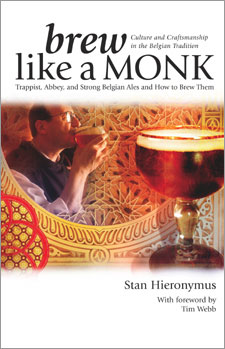
A Brief Brew Like a Monk Book Review


I've been holding off on writing this review both because I had other things to write about an because I wasn't entirely sure how I felt. Stan Hieronymus' Brew Like a Monk can be a really interesting and fun read at times with beer and monastery histories and descriptions flowing off the page. At other times it feels as though things are a jumble, processes and facts get repeated or thrown out at strange times. While I like the way the author goes about making each brewery and its beer into a story, it sometimes feels as though there's nothing to tell.

On the actual recipe formulation side of the book some of the recipes given seem a bit off and he often utilizes brewers to come up with recipes for styles they don't brew or at the least don't specialize in. Why not ask them about something they actually know?  While I'm sure Ron Jeffries (Jolly Pumpkin) or Vinnie Cilurzo (Russian River) respective recipes for a Blonde and a Golden strong are nice, I would much rather they gave ideas for sours which they specialize in, or at least Orval clone ideas.

All around I found the book a worthwhile straight through read which I may come back to next time I brew a Trappist inspired beer and which helped in formulating my recent quad recipe. Far from the worst but also not among the best as far as beer books go.  I look forward to reading the author's other work including For the Love of Hops: The Practical Guide to Aroma, Bitterness and the Culture of Hops but hope it is better edited and less scatterbrain.

Sunday, July 14, 2013

Quad Pack

An update on my brewery status: I just added 4 new fermentors.  To be fair each of these is a 1 gallon jug so my brewing output will probably not be increasing along with the number of openings.  I do have some exciting ideas for these small jugs including beer experiments, other types of fermentation and more sour and brett beer blends.  A few items that are high on the list:


  • Blending sour beers - A blend of my very sour brown with my young lambic or other future sours
  • Bretted Saisons - Creating a basic Saison and bottling 1 gallon straight with the other 4 split onto different secondary yeasts/blends including a sour blend, BKYeast C2 and the dregs of a Saison de Lente bottle, and another might receive a different Saison yeast or a culture of lactobacillus)
  • Wine - I am still yet to have made a wine and a recent return trip to Napa has me wishing to experiment, perhaps with a fruit wine or small batches of grape wine
  • Mead - Similar to wine it would seem much easier to begin my experimentation with Mead in small containers, especially with the numerous ideas I have for spices/fruit/yeast/blends/oak that I would like to try
  • Cider - I've only made one to date but would like to try many of the similar additions as with mead, and would like to have the ability to blend with mead/wine/beer without having too much.
  • Spiced Beer - While my Here Be Dragons! spiced Scottish ale was largely unsuccessful spicing a beer (possibly a porter or dubbel) in secondary with a number of different flavors that I have wanted to try out seems like a much better idea with one gallon rather than a full 5 gallons.  Some flavor profiles I've been considering trying out include Speculaas (ginger, cardamom, white pepper, cinnamon, nutmeg, clove), BBQ (brown sugar, cayenne, smoked paprika, black pepper), sage (maybe with sage honey as well) and caraway+honey
  • Dry hopped - Making a pretty standard recipe and dry hopping with different hops either 4 American types (e.g. Amarillo, Cascade, Citra, Warrior) or 4 non-traditional/world hops (e.g. EKG, Saaz, Sorachi Ace, Mr. Rainier) could make for a very interesting pale ale experiment
Lots of exciting ideas, some of which I'll surely attempt and others I may never get around to.  Experimentation with both classic ideas and entirely new ones is all about what this blog is about, searching for Good Beer in any way possible.

Sunday, June 2, 2013

#28 - American Saison


Saison is one of my favorite styles of beer especially on hot summer days.  It is also a very versatile style that I have experimented with a few variations over the last two years. For this variation I wanted to go with something a little more traditional than my past recipes but with a slight twist, in this case influenced by Boulevard Tank 7 by adding Amarillo hops and Ommegang Hennepin by adding ginger.
http://www.brewtoad.com/recipes/american-saison-15
  One important aspect of this recipe was keeping the fermentation warm to keep the DuPont strain going and to elicit the classic pepper and fruit character.  In order to try to maintain this warm temperature I wrapped the fermentor in towels and blankets and places a box over top to keep this insulation in place.

Sampled a few highly regarded beers of the style on brew day and saves the yeast (Brett and Sacc) from Saison de Lente.

Update 6/2/13
Down to 1.038, fermentation seems to have at least slowed if not stopped entirely and temperature has clearly dropped closer to the ambient low 60's than the 70s/80s it had been at for the first few. I will probably add the French Saison strain if I don't see a sizeable drop in gravity in a week.

6/9/2013
Down to 1.030, not as big a drop as I would like to see so I will purchase the French Saison yeast and add next week barring a bigger drop. Smell is black pepper, ginger and citrusy tropical hops.

7/14/2013
After 2 weeks with the Wyeast 3711 French Saison yeast the beer has plummeted down to a 1.002 gravity, time to bottle.  Taste is refreshing with some citrus characteristics and a surprising amount of candy sweetness despite the measured dryness.

7/28/2013
Bottled using conditioning tablets (4 tabs/12 oz or 6/22 oz). Tastes strongly of citrus with some solid pit fruits and a prickliness, and a balancing but not aggressive bitterness.

Sunday, May 19, 2013

#27 Scottish Export and Water Chemistry

Looking to balance my sour and hoppy beers of recent with something a bit dark and malty but not as dark as the banana stout I decided to try my hand at a Scottish Export ale.  While I have been taking water chemistry into account for a while now I did a full water profile for this beer adding minerals to my moderately soft water to reach a bit more complex character.


Update 6/9/13
Gravity down to 1.010, seems ready to bottle. Initial impression is sweet coffee character, more than I had expected from this small amoun of kiln coffee malt.

7/30/13
Had waited to post this hoping it would improve over time but it still seems a bit off. This is the second time I've had issues with Wyeast1728 Scottish Ale yeast. This may be coincidental, be a factor of the yeast strain which I'm particularly sensitive to or maybe due to fermentation temperatures. While it's hard to pin this beer's off flavor on a single characteristic (it reminds me a bit of both oxidation and autolysis without sticking out as either) the yeast or the malt (old pale chocolate malt and my first time using Franco-belges kiln coffee malt) seem the most likely suspects. I'm hoping some of this character will fade or  blend into the beer over time and this will become more drinkable.

10/3/13
Beer hasn't really improved with time but I decided to do a more complete tasting anyway.

In Grodz We Trust, #26 Tasting

About a month back I brewed my second smoked beer, a Gratzer (or Grodziskie in Polish) and American Wheat hybrid I call in Grodz we trust.  Classically using entirely or near entirely oak smoked wheat malt, Grodziskie has disappeared and made a bit of a resurgence with American craft versions popping up every now and then.  In my attempt I wanted only a slight bit of smokiness to blend in with a dry, dry hopped wheat beer base.

A- Pours a clear pretty yellow color which I chose to add the yeast to, giving a nice Hoegaarden like Wit color with constant carbonation bubble movement throughout.  Small head fades to a thin layer and leaves some lacing.

S- Similar to many of my other dry hopped beers as the Strisselspalt really shows up with light earth, spice, vegetal and fruity black currant aroma, just a touch of smoke mixed in.

T- The smoke takes center stage with a woody chargrilled character that is followed with earthy and spicy hops and a finish that is lightly bitter and still phenol smokey.

M- Very light, dry and thin with moderate carbonation.  This one is right where I was aiming for in terms of the mouthfeel.

O- This is a strange beer that is hard to pin down.  It's impossible for me to say how close it comes to a traditional Gratzer but I could see it being a popular beer among those who like smoked beers.  That said the moderate bitterness and hop aroma combined with the moderate smoke give a strange impression.  If I were to brew again I would likely cut the smoke in half to allow the hops to be more at the front or cut the smoke entirely and add more ginger to let the spice notes really play.  A drinkable, sessionable summer beer that will probably go great with grilling but certainly won't please most.

Monday, April 1, 2013

Raspberry Blonde

I brewed a raspberry blonde beer with my girlfriend on St. Patrick's day.  The beer was her idea (she said she wanted a red beer with raspberries in it) and I had her do most of the work outside of heavy lifting/moving hot water.  This was only my second all-grain batch in my cooler setup and her first attempt at making a beer.  I designed the beer with a medium-low abv, low ibu, and medium-low body in mind to allow the raspberries to really shine.  We ended up with just over 4 gallons rather than the desired 5 but OG was only slightly high so we decided not to adjust and just let it ferment for a few weeks before adding berries and going from there.

Update 3/31/13
Gravity down to 1.006. Racked off of trub and into 3 pounds of raspberries.  Girlfriend complained that she "wanted a red beer" whereas this was more of a gold.  Hopefully all of those raspberries impart some nice color in addition to flavor.  The plan is to bottle in 2-3 weeks if the flavor seems established.

4/14/13
Raspberries had lost most of their color so it seemed about time to bottle. Bottled with a low amount of sugar (2.1 oz) to account for residual fruit sugars. Beer had a very strong raspberry aroma and moderately fruity and sour raspberry flavor, but just a tinge of pink in the testing tube. It will be interesting to see how it tastes (and looks) once fully carbonated.

#18 Saison Double Tasting

Today I'm doing a tasting on some of the last bottles of my 18/18B Saison batch.  Originally intended to be a sophie inspired oak aged brett saison with large amounts of wheat, the brett really never came through in this one and I added half the batch to both oak and asian pears.  I brought a bottle of this to a brew club meeting where it seemed to be fairly well received.

A- Both versions are a pretty amber color but the pear version is both darker and cloudier.  The pear version also pours with a bigger head, hold the head longer and still has a ring around the outside after a few minutes while the other has just a few bubbles throughout.

S- Straight: White grape juice, hay, orange peel, juicy fruit gum.  Pear: Much lower levels of fruitiness with some slightly tart pear character and a nice oak level that gives a faint touch of smoke and vanilla.

T- Straight: fairly light flavors compared to the nose, the Juicy Fruit and hay/wheat character come through a bit while the beer finishes lightly sweet.  Pear: Light pear character definitely shines through, I can sense the oak but it helps to bolster the light flavors from the malt/yeast/fruit more than it sticks out on its own.

M- Both beers feel both a bit underattenuated and undercarbonated.  I feel this may be due to the brett never kicking in and bringing the gravity lower as I had expected.

D- Not bad.  The asian pear/oak version is certainly better and seems to have enough fruit to be perceivable without dominating while the oak seems to enhance that fruit character.  I don't think I will use this yeast again (WLP670 White Labs American Farmhouse blend) and the overall character was a bit like Urthel Saisonierre, though more complex.  I will probably never have a chance to do an asian pear beer again but I was happy with the results here and certainly would recommend for anyone else with easy access to them.