Tuesday, December 30, 2014

Czech Pilsner Tasting

It is commonly thought that clean, lightly hopped, pale beers are the hardest styles to brew.  The thinking is that, in a beer without too much character of its own, any flaws are easily noticeable. After my first attempt at a pale lager I can easily understand where this thinking comes from, and, while I tried to avoid many of the flaws that can occur by pitching a heavy amount of yeast and fermenting at a cool temperature, I still wasn't able to completely nail this one.

A- Pale gold (looks lighter than pictured) with a moderately tall head that fades to a thin layer.  Fairly, though not brilliantly, clear.  Looks like a pilsner, though the clarity and head retention could be better. Gelatin in the keg might fix the clarity and a touch of wheat in the mash might help with the retention, though I don't know that either is necessary.

S- A bohemian Pilsner should have some malt, balanced by some spicy Saaz, and maybe a touch of diacetyl on the nose.  While all three components are here, they are not in the proper balance with the buttery diacetyl showing first and heaviest, the sweet malt also coming through, and the Saaz hops being just perceptible.  Serving at nearly 50F might accentuate the diacetyl, but it's higher than it should be regardless.

T- Grainy, lightly buttery, sweetness is swept aside by a refreshing, spicy, moderate bitterness that lingers for just a moment on the tip of the tongue.  Again, a little bit high in the diacetyl though not as noticeable and better balanced by the hops than in the nose.

M- Moderate carbonation with a moderate to light body.  The diacetyl here seems to be adding to the body, keeping it from being overly thin.  No complaints with the mouthfeel of this one.

O- For my first attempt at this style, and for lagers in general, I'm fairly happy with this beer but can see a few obvious flaws.  Not doing a diacetyl rest until after fermentation had fully completed clearly detracted from the overall character of this beer.  Other than the one (moderate) flaw the beer is well rounded, and really pretty tasty.  This is a beer that I could see both BMC drinkers and beer nerds drink, but not rave about.  If I were to brew it again I would only make slight changes to the recipe (maybe a touch more finishing hops) and a slight tweak to the fermentation process (diacetyl rest before the end of fermentation) but all around I'd say this is a winning recipe, and the water chemistry, grain bill, and yeast definitely worked well.

Wednesday, December 24, 2014

#45 - Imperial India Pale Ale

After brewing a number of brett saisons and sours over the last year, I've dialed back the funk and overall weird factor in the last few months with an Oatmeal Stout, Bohemian Pilsner, and, today, an imperial IPA.  The beer is inspired in part by a beer that I've never had (Heady Topper) and a number of clones of that recipe (which I've also never tasted).  My recipe is, in no way, a Heady clone but instead attempts to use some of the best aspects of it (4 varieties of American hops, high levels of pale malt, sugar to dry out, around 100 ibu's) in an entirely unique way that should suit my tastes.

The malt bill is fairly simple: 14 lbs British Pale Malt (in place of the Pearl used for Heady), 1 lb Carahell (in place of any caramalt/etc), and 1 lb of Turbinado (in place of white sugar).  For the hop bill I decided to go with Nugget, Cascade, Chinook, and Amarillo.  While I originally had Palisades in the mix, I subbed them out for Chinook in order to get more of the classic pungency and pine of American hops that seems to be missing from my hoppy brett Saison which also featured large doses of Amarillo.  For the yeast I'm hoping that the lightly peach character of Wyeast West Yorkshire Ale will give a somewhat similar profile to what is often described for the Alchemist's Conan strain (which is also said to originally derive from a British ale strain).


When I first began brewing and writing this blog I didn't have much of a taste for hoppy beers with IPAs being more of a novelty that I could respect but not enjoy.  Overtime that has changed and I've become more interested in the world of hops and, with that, some of my best brews to date have been either straight to style American IPA's or interesting takes on the IPA style.

I have high hopes for this beer but it is my first time brewing an Imperial IPA (or Double IPA depending on your preference) and it is still not a style that I tend to gravitate towards, with most examples of the style having an overly bitter profile that voids any complexity from the hops and malt bill.  In the end, I'm hoping this one will be balanced enough and provide a nice alternative to on tap to the roasty Oatmeal Stout, the moderately bitter but otherwise clean (and halfway done lagering) Bohemian Pilsner, and (a just kegged) Cyser.

12-16-2015
After rapid and forceful fermentation for the first 48 hours the airlock is now mostly still. Loosening the bucket revealed a a thick, gelatinous krausen that looks a bit like a thin dough. Pulled a small sample: cloudy, with thick haze, not sure if it is just active yeast or some proteins. Smell is extremely hoppy with taste being biting bitterness and alcohol. A little worried about this one in a few ways at this point but I am hoping another week and some dry hopping will calm it down.

12-21-2014
Pulled a sample, flavor is much improved, piney, citrusy, and fairly bitter. Gravity all the way down to 1.012. Added dry hops (1 oz Cascade, 1 oz Chinook, 2 oz Amarillo, 2 oz Nugget). Planning to keg in the next 3-5 days.

Tuesday, November 18, 2014

#44 - Pilsner Brew Day - My First Lager

With my keezer finally in place and currently only occupied by 1 5 gallon keg and an assortment of bottles now is the first time in my life that I have a great chance to ferment a lager.  I'm also heading to New Zealand at the end of the week, giving a perfect time period to crank the chest freezer temp up a little for lager fermentation temps.

Knowing that now was the time to brew a lager the only question was, what lager would I start with? While I've long wanted to brew a BMC-ish "plain" beer (complete with adjuncts and light hopping), my recent trip to Europe introduced me to so much lagered goodness.  While I originally thought about brewing my favorite newly discovered style from Europe, the Czech Černý (which seems to sit somewhere between a Munich Dunkel and a Schwartzbier), I thought better of it due to already having a dark, roasty beer on tap and wanting something more pale and balanced.  The German Oktoberfest style beers I drank in the Wiesn tents, and the Helles and Dunkels I drank in the bars and beer gardens, were well crafted and easy drinking, but I've already had more of them than I would want for a few years.  So then, what lager to brew? Why not the most influential lager that set the bar for countless styles and the vast majority of beer consumed: Bohemian Pilsner.

While in Prague I was fortunate enough to enjoy a number of Pilsners including the original, Pilsner Urquell, in both its usual filtered and special unfiltered version (the unfiltered version is rarely seen outside of the city of Plzen but I happened to be in Prague the same weekend as Pilsner Urquell's brewing anniversary of October 5th).  Both of these, and a number of the other Pilsners offered in the Czech Republic, were excellent and I wanted to go for as classic of a Pilsner Pivo (beer, in Czech) as possible.  In my eyes there are 5 traits that make a Bohemian Pilsner what it is:
  • Soft water
  • Pilsner Malt
  • Lager Fermentation
  • Saaz Hops
  • Decoction mash
While I had these characteristics in mind, in order to fully design my recipe I looked at the most recent issue of Brew Your Own magazine which focused on German and Czech Pils. I also reviewed the four Bohemian Pilsners to have won gold at the NHC. Some notes that I found interesting:

  •  In addition to Saaz, Sterling was a common hop choice
  • Nearly every recipe used a small percentage of slightly darker malts in addition to Pilsner (often Vienna and/or CaraPils)
  • Not all recipes required a decoction with some using a single infusion mash
  • Diacetyl rest was often (though not always) mentioned as necessary
  • Long, extremely cold (~32F) lagering periods and extremely soft water were musts
With all of this in mind I decided to stick with the traditional Saaz, use a little CaraPils and CaraMalt (would have been CaraHell but HBS didn't have it), but avoided doing my first decoction and instead used a slightly more complicated grain bill and a step infusion mash.

11/13/14
2 days before brew day. I built a 1 gallon starter at room temperature (~68) with 2 packs of Wyeast 2000 Budvar Lager.  While 2 packs might not have been necessary, lagers typically require significantly more yeast than Ales and I wanted to make sure that mine took off without a hitch.

11/15/14
Brew day. I purchased 6 gallons of distilled water and added in 3.5 gallons of filtered Arlington, VA water, with no other water chemistry treatments.  Cooled wort to ~60 post fermentation before moving wort and starter to 42F chest freezer.  Will pitch yeast tomorrow once cooled and bring temps up a little.

11/17/14
Yeast was pitched yesterday morning and chest freezer temperature raised to 48F. Fermentation slowly showing signs of life.

12/3/14
Temperature increased to 60F for diacetyl rest.

12/5/14
Temperature decreased to 35F for lagering.

12/6/14
Gravity down to 1.013 (exactly what was predicted pre-brewing!).  Taste is moderately hoppy and grainy, maybe a slight off-flavor, not sure if it is due to using some older Saaz for bittering or an aspect of the Budvar yeast but it comes off a bit earthy.  Hopefully a month or so at lagering temps will bring this down but already tasting like an interesting and respectable pilsner.

Tuesday, November 11, 2014

Lambic #3

What can I say? I have a sour beer problem.  With my lambic #2 currently very funky but not sour at all I wanted to brew another beer with the yeast cake from my first few sours.  My Sour Mix #1 started with Wyeast's Roeselare blend and has since had dregs from Drie Fonteinen and Cantillon, BKYeast's C2 brett isolate, and American Ale yeast added.  Popping open the top of bottle storing the mix of yeast and bacteria gave such great aromas that I'm confident in the direction this one will head.

This beer is all about the yeast/bacteria so I kept it as simple as it comes for the recipe: 5 pounds dry malt extract, 2 ounces lambic blend hops (1.2% AA) for 60 minutes and my Sour Mix #1.

10/24/14
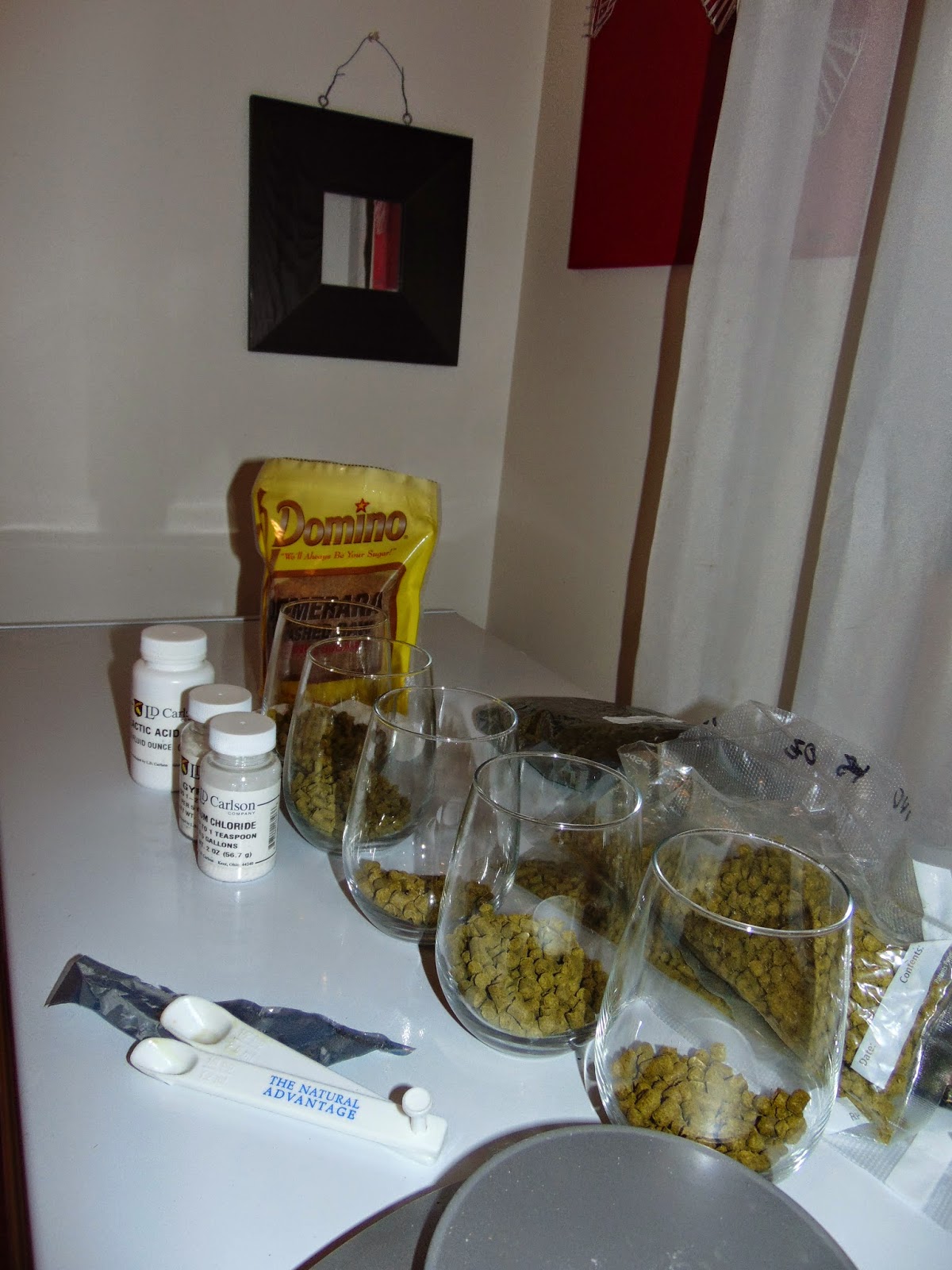
Brewed on stove top with 6.5 gallons of unfiltered Arlington water with K-Meta added.  1 tbsp phosphoric acid 10% and 1 tsp each of gypsum and calcium chloride added prior to boil.  Extract and hops added at full boil and boiled for 60 minutes prior to chilling. OG measured at 1.054.

10/25/14
With no signs of active fermentation taking off I added yeast from my Saison Blend #1 (Wyeast French and Belgian saison yeasts).  Some bubbles appearing in airlock after 12 hours.

10/26/14
Gravity down to 1.006.  A little fruity, slightly bretty, a touch bitter.

11/1/14
.5 ounces Pinot Blanc soaked medium-plus toast Hungarian oak cubes (and about 8 ounces of the pinot) added to primary.

Tuesday, November 4, 2014

#43 - Oatmeal Stout

After a long time off from brewing a dark, malt driven beer I found myself really craving a refreshing, chewy, hearty stout.  I also have been eating a lot of oatmeal recently and really wanted the creamy smoothness and slightly nutty flavor of oats to come through in the finished product.

I based this beer off of the two successful porter/stout beers I have made in the past with some influence from my English pale ale.  The beer is intended to take the middle road between sweet and bitter, but the malt character should definitely be the driving factor.  One other important aspect of this beer is the yeast, Wyeast West Yorkshire Ale. I have wanted to try the strain for a long time and see this beer as an opportune way to build up a culture of it that I can use in anything that could use a bright, peachy yeast presence, from balanced bitters to extremely hoppy double IPAs.

Tasting Notes:

A- Pours with a beautiful big cascading beige head.  Opaque, very dark brown body with some noticeable yeast and hop residue at the bottom.

S- The stonefruit notes of the yeast lead with pear and peach.  There are also some mild roast notes of toast, nuts, and just a touch of dark chocolate.  Pretty much exactly what I want a stout to smell like.

T- Starts with light sweetness, toast and nuttiness, followed by some dark chocolate roast and a moderately bitter finish.  The fruit of the nose is much more subdued, just barely coming through.

M- Slick and creamy, while a little low on the carbonation (the gas disconnect was not properly attached initially so this may have been slightly rushed).  I can still get behind a lightly carbonated stout.

O- Very happy with this one.  While I would have liked more coffee character it is still an oatmeal stout where the oatmeal and roast both come through without being overly strong to make this anything more than an easy, cold weather drinker.  I'm also very happy with the yeast character as it stands out, without dominating or calling too much attention to itself.

Updates:
10/18/2014
Brewed on stove top.  OG of 1.052, a little odd tasting at this point, though maybe I just don't remember what a stout wort should taste like.

10/21/2014
Fermentation has slowed dramatically.  Gravity down to 1.022; hopefully it will keep dropping over the next few days.  Taste is good: a bit biscuity, grainy, and nutty with a definite oat slickness and a touch higher bitterness than expected.

10/25/2014
Gravity still reading at 1.022.  8 ounces of maple syrup added, hopefully this will ferment and rouse the yeast.  The beer might not attenuate any further due to the high mash temp and large amount of oatmeal.

11/1/2014
My inaugural kegging. Set force carbonation to 30 psi to quickly carb for dispensing in a couple days.

11/3/2014
Poured a tiny sample, gas disconnect seems to have not been fully attached.  Will re-attach and begin force carbonation over.

Saturday, November 1, 2014

Picnic Tap Keezer

Today I took one step forward in my quest for great beers when I finally decided to take the dive into kegging.  My new setup is very simple with just a 7.0 cu. ft. chest freezer from Home Depot with a Ranco temperature controller and a 5 gallon ball lock keg and 5 pound CO2 tank and regulator inside.

While I've been relatively happy with bottling for nearly 4 years now, there's a number of reasons that made me finally decide to purchase a chest freezer and kegs for a keezer build:

  1. Carbonation Consistency - I've often been disappointed by overcarbonated beers, with a few being very undercarbonated as well.  Overcarbonating a beer can detract from the flavor (carbonic acid gives a bite and heavy carbonation makes it harder to taste subtle flavors), from the body (beers feel more "seltzery" and less full bodied) and detract from the overall drinking experience (difficult to pour, have to wait for heads to fall, can cause dregs to mix in).  Undercarbonated beers are generally not as big of an issue but sometimes leave beers feeling flat and watery, not how beers should float around in the mouth.
  2. Bottle bombs - This is sort of a 1.a since this is just an extreme case of carbonation issues.  I've had a few batches of bottles that have been overcarbonated to the point of exploding over the years which have scared the crap out of me.  The issues with using too much priming sugar or having an infection cause increased carbonation isn't much of a concern due to kegs generally not being naturally carbonated, the cold crashing process reducing yeast and bacteria viability, and the significantly higher levels of pressure that kegs can handle compared to bottles.
  3. Oxidation - This is also a two part issue.  One issue is with general oxidation of beers, with several of my batches that were aged for a long time or moved to secondary experiencing oxidation effects that greatly detracted from their flavors.  The second issue is with hoppy beers, where flavors fade quickly and fade even quicker when naturally carbonated in bottles.  The move to kegging (at least the having access to carbon dioxide part of it) allows me to purge secondaries and kegs with CO2 and package hoppy beers (in keg or potentially bottling from keg) with less oxidation.  A few of these topics were discussed in Mike Tonsmeire's recent post about IPA tips.
  4. Cold Storage - the purchase of a chest freezer for kegging provides a large space for kegs (and potentially bottles) to be stored cold. Previously I had to find space in my fridge, not always an easy task, and there was certainly never room for the 20+ gallons of beer that I have now. In the past my beers were often stored at room temperature which helps to deteriorate their quality.
  5. Secondary Fermentation Temperature Control - While I plan on using the chest freezer for kegs (~40°F) and not as a primary fermentation fridge (55-65°F) this very cold temperature could still occasionally be used for extended secondaries or lagering, a capacity I didn't previously have.
  6. Light - The 3 factors which degrade beer: oxygen, heat, and light.  While brown bottles do a decent job keeping out light and I haven't noticed any light-struck skunkiness in my beers, kegs are even better, making sure that even pale, light beers (where these skunked qualities often show up) would be protected.
  7. Versatility - As mentioned earlier, I can still bottle beers, now I just have the option not to, and that's a beautiful thing.

It's interesting to note that ease of use or time saved aren't being mentioned here.  While hopefully these are positive aspects there is a bit of a learning curve with kegging and, even though I've spent a long time researching how it is done and how I'd like to build my setup, there are still going to be mistakes and issues.  Additionally, while I hope the cleaning and sanitizing process isn't quite as tedious as it is for bottling, there are still multiple parts to clean and sanitize on a regular basis from the keg and its parts, to the tap lines, to the keezer itself.

It is worth mentioning that the biggest downside to kegging seems to be the sheer amount of equipment required, which both costs money and takes up space.  I currently have just one keg and the cost of my system has already ran over $600 (although I was able to buy the $200 chest freezer  with gift cards so it didn't feel like as big of a hit).  Part of the reason for the cost being so high is that I went with all new equipment, rather than used versions which are usually about half as expensive.  Moving forwards I could easily see spending another $500 to get all of the bells and whistles I'm currently looking at (and that's still with picnic taps).

I put my oatmeal stout on tap today and am trying to quickly pressurize it to have it ready within a few days.  I'm very excited but also a little anxious; I'd hate to only have one beer on tap and it not be very good.

Tuesday, October 21, 2014

#42 - StarTropics - Hoppy Brett Saison

With the end of summer quickly approaching here in DC (and me preparing for my trip to Munich for Oktoberfest!) I found myself with a free weekend, a few empty carboys, and a desire to make one last saison during the hot season.

For this beer I wanted heavy hop flavors and lots of bitterness, backed up with enough malt to keep things balanced, interesting, and ready for Autumn.  I also wanted to further explore the combination of Nelson Sauvin and Brettanomyces that I tried a few beers back so for the yeast I used the slurry from the Brett Saison as the primary (rather than in the secondary) and added Crooked Stave dregs to add even more varieties of fruity and funky Brettanomyces.  I also kept Nelson Sauvin as a major component of the hop profile but added my two favorite citrusy American hops: Cascade and Amarillo.

As I've done with many beers, and particularly often recently, I plan to experiment with this beer after the primary ferment, though this time I don't have preset plans.


Expected
1.061 OG
1.008 FG
62      IBU
7.0% ABV
10     SRM

Fermentable
Amount

Use
PPG
Color
Maris Otter Pale (UK)
8.5 lb
61 %
Mash
38
3 °L
Vienna (US)
4.5 lb
32 %
Mash
35
4 °L
Caramel/Crystal 60L (US)
0.5 lb
3 %
Mash
34
60 °L
Victory (US)
0.25 lb
1 %
Mash
34
28 °L

Hop
Amount
Time
Use
Form
AA
Nugget (US)
0.5 oz
60 min
Boil
Pellet
14.10%
Cascade (US)
2.0 oz
4 days
Dry Hop
Pellet
7.10%
Amarillo (US)
3.0 oz
4 days
Dry Hop
Pellet
8.50%
Nelson Sauvin (NZ)
1.0 oz
4 days
Dry Hop
Pellet
12.00%
Cascade (US)
2.0 oz
5 min
Whirlpool
Pellet
7.10%
Amarillo (US)
1.0 oz
5 min
Whirlpool
Pellet
8.50%
Nelson Sauvin (NZ)
3.0 oz
5 min
Whirlpool
Pellet
12.00%

Name                                         Average Attenuation
Brett Saison Blend                         87.50%

9/13/14
Brewed on stove top with no issues.  Whirlpool hops actually done as 20 minute hop steep.  OG measured at 1.058 (with a slightly low reading hydrometer).  Fermentation took off within 8 hours.

9/17/14
Fermentation still fairly active, gravity only down to 1.022 so this one should have a ways to go. Flavor is a melange of peach and white wine with just a touch of the bitterness showing through under the still high sweetness.

9/25/14
Gravity down to 1.007 with fermentation at a near standstill but the Brett will probably continue working away for a little while.

10/16/14
Running way behind on this one due to getting delayed on my return from Europe but finally added the first wave of dry hops (1.5 oz Amarillo, 1 oz Cascade and .5 oz Nelson Sauvin) to the primary.  Gravity down to 1.006 and tasting super funky without much hop presence prior to the dry hop additions.  Had been hoping to keg this, but getting the kegerator in place has also fallen behind schedule so I will probably just bottle in 8-10 days after another round of dry-hopping.

10/21/14
Racked 3 gallons onto the second wave of dry hops.  The remainder (about 1.5 gallons) was split between two 1 gallon jugs, one with 4 oz. demerara sugar and paradise seeds and the other with lime juice and a tangelo tincture I have been holding onto for a while.  My entire apartment is currently engulfed with amazingly fruity and citrusy hop aromas.

10/25/14
Bottled 3 straight gallons as #42, Demerara version as #42B, and Lime/Tangelo version as #42C.

7/16/16
Approaching two years in the bottle and this one is tasting pretty good. Hop character has certainly faded but the Brett character still gives a lime and pepper impression.

Friday, September 26, 2014

Nelson Brett Saison Tasting

I really enjoyed the fresh, kiwi/white wine/melon character of the straight version of my Prairie Artisan Ales' 'Merica inspired beer.  The Brett version took a little more time to grow on me however, which is why I am only now getting around to a formal sit down and review.

A-Burnished gold with some definite haze to the point of being fairly opaque.  Some of the clarity is likely due to the dry hopping, while some also seems to be condensation on the glass.  The small white ring of a head lasts for a long time around the edges of the glass.

S- Immediately upon popping the top there is a huge pineapple character that comes out.  In the glass the scent continues to be heavy on the Brettanomyces derived fruit and funk, with the hops playing a strong supporting role.  There is strong pineapple, barnyard, mango, decaying grass, and subtle orange rind in the beautiful bouquet.

T- This one is certainly dank, earthy, and citrusy.  The kiwi/melon I found to be more dominant in the straight version are subverted by the funky Brett here.  Bitterness is moderate, just enough to part the slight grainy sweetness in the middle and help transition to a long funky finish.

M- Dry with moderately low carbonation.  I had purposely primed without much sugar in case the Brett had continued doing its work but this definitely could have used more bubbles.

O- A solid beer.  The hop character is much lower than the straight version (likely due to the 2 weeks in secondary after dry hopping).  This seems like a decent introductory Brett beer with the funk being noticeable but not overwhelming and the hops giving off a nice tropical fruit character without being overly bitter.  A good beer that I would like to build off of in the future.

Saturday, September 20, 2014

#39- Spiced Dubbel Tasting


A- fairly cloudy, medium dark brown, small tan head that lasts. Cloudier and darker than desired, but some of this might come from the spices.

S- sweet belgian esters of bubblegum and banana give way to heavy phenols with cinnamon, clove, black pepper and light herbal notes.

T- much like the nose the fruit an sweetness lead with moderate spice following. The spice seems more subdued than the aroma would suggest. The beer finishes with a confusing blend of earth, clove and a touch of alcohol heat.

M- fairly dry with moderate carbonation.

O- not a very good beer. Not too surprising considering it is a blend of a Dubbel that suffers from oxidation and a quad that ended up causing bottle bombs.  These darker Belgians are some of my favorite commercial styles and yet I seem to struggle more to brew them than any other style... Back to the drawing board.

Sunday, August 24, 2014

Side by Side Black Saison Tasting - #41 and #41B

Finally getting around to tasting my second iteration of black Saisons. A few weeks in the bottle seem to have settled these down to the point where much of the flavors I noticed at bottling- earthy funk, orange, grassy hops - have become much more subdued. The white pepper however is still bracingly strong and I would cut the amount used by half were I to do this again.

Appearance(both)- The white pepper version appeared to have a little more dregs in the bottom but both beers appear identical in the glass, with a very dark mahogany color with garnet highlights and an off white one finger head that fades slowly leaving patchy lacing. So far so good.

Straight
Smell- orange, cocoa, apple, light nuttiness, black pepper, grass/hay earthiness

Taste- surprisingly light in flavor, lightly fruity (raspberry), some earthiness, a very small appearance from the dark malts with touch of coffee when I search for it. Finishes with a bit of piney bitterness that just beats out some slight caramel/sugar sweetness and flavors on the end.

Mouthfeel- feels higher in body than would be expected for the low FG and yeast strain. Carbonation is moderate. Pretty good mouthfeel all around.

Overall- a bit lacking. The orange character seems subdued and calling this "hoppy" is a misnomer...the hops really have to be searched for. Maybe the most surprising element of the beer is the subtlety of the roasted malts, with only the occasional glimpse of ash, cocoa, coffee, etc. I had feared this beer might be dominated by these characteristics but the even moderate amounts seem underwhelming. All of that said, the beer goes down smooth with nothing too off putting, I could see those who dislike "dark beers", "hoppy beers", "Belgian beers" or "craft beers in general" finding this one fairly drinkable.

#41B White Pepper Version (with a touch of clove and ginger)

Smell- huge white pepper (somewhat herbal and very peppery) with only a touch of clove able to compete at all. As it warms some of the fruity berry character makes its way into the mix.

Taste- like the nose the pepper dominates. While only lightly spicy on the palate the flavor dominates most of the subtle characters present in the base beer with only the burnt sugar presence in the finish seeming to off a complementary element.

Mouthfeel- again, surprisingly moderate in body and carbonation. Doesn't overemphasize the pepper, in a beer where pepper is already overdone.

Overall- with the base beer coming out a little underwhelming in the flavor profile this beer is easily dominated by the high level of pepper. While white pepper may not have been a bad addition to the overall character, it should have been much more restrained to keep this from being a purely pepper flavored beer. The ginger and clove also seem lost in the mix, though they were never intended to be major components. Fans of white pepper like myself can find some enjoyment and novelty in this, and it certainly isn't undrinkable, but it really does miss the mark.